
By Michael Peabody –
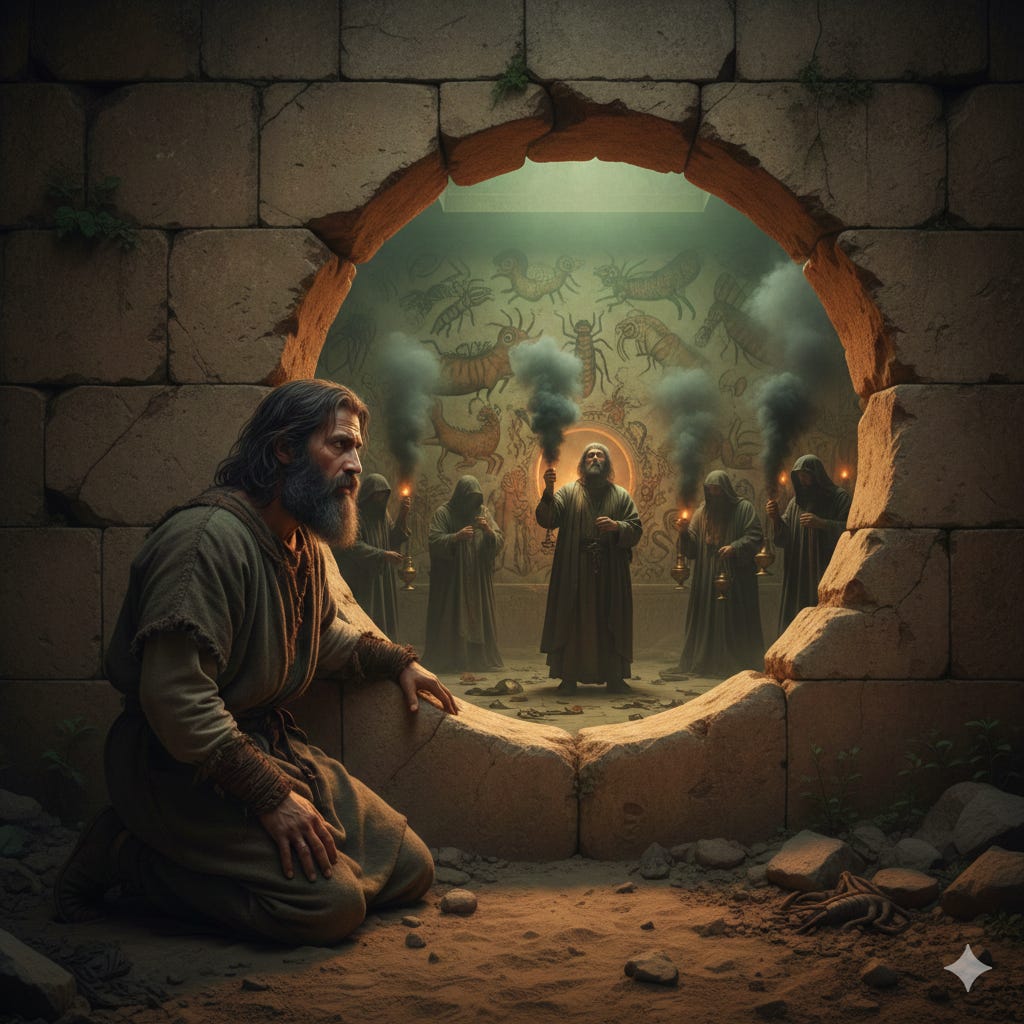
There is a passage in Ezekiel that reads less like ancient prophecy and more like a federal indictment. God takes the prophet by the hair, “and the Spirit lifted me up between earth and heaven and brought me in visions of God to Jerusalem” (Ezekiel 8:3), and deposits him at the north gate of the inner court of the temple. What God shows him there is not theological abstraction. It is a guided tour of institutional corruption, room by room, offense by offense, face by face. And the guide keeps saying the same thing:
“Turn again, and you will see greater abominations than these.” (Ezekiel 8:6, 8:13, 8:15)
Greater. And greater. And greater still.
Anyone who has followed the Epstein case past the headline and into the flight logs knows exactly what that escalating structure feels like.
The Vision and the Hole
God’s first instruction to Ezekiel upon arriving at the temple is precise and physical. “Son of man, dig in the wall.” Ezekiel digs, and finds a door. “Go in and see the vile abominations that they are committing here.” (Ezekiel 8:8-9). What he finds inside is not a handful of rogue priests. It is seventy men (seventy: the number of the full council of Israel’s elders, the leadership class entire) burning incense to images that crawled across every wall of the room. And God names one of them: Jaazaniah son of Shaphan (Ezekiel 8:11). A family name that meant something. A pedigree of covenant faithfulness weaponized as cover.
The explanation God provides for why this is happening in the dark, behind the wall, beneath the temple of the living God, is the sentence that should be carved above the entrance to every commission of inquiry ever convened into institutional abuse:
“For they say, ‘The Lord does not see us, the Lord has forsaken the land.’” (Ezekiel 8:12)
That is the complete theology of every man who ever sat in a position of sacred trust and preyed upon a child. The Lord does not see. The cameras are not running. The children will not be believed. The prosecutor can be managed. The agreement can be sealed. The witness can be silenced. And if the worst happens, if exposure comes, the institution will protect itself, because the institution always protects itself, because the institution and the abuser have the same interest in the same silence.
The Lord does not see us.
Ezekiel’s entire career is the refutation of that sentence.
The Manifest as Scripture
The Epstein flight logs function in our moment the way Ezekiel’s vision functioned in his: an inventory of the powerful caught behind the wall. And what the inventory reveals is not a fringe operation. It is a social infrastructure threaded through the commanding heights of Western civilization at the turn of the millennium.
The political class first. A two-term President of the United States flew on Epstein’s plane more than twenty times, on flights where Secret Service agents were not present, a logistical choice that required active effort to arrange. A senior prince of the British royal family (the monarch’s second son) was photographed with his arm around a girl who has described in sworn testimony what happened to her in his presence. He settled. He paid. He never explained, under oath, what explanation would have required.
The financial class. The billionaire retail magnate who built one of the world’s most recognizable lingerie empires, a brand whose entire commercial logic was the managed sexuality of young women’s bodies, handed Epstein power of attorney so sweeping it amounted to a transfer of identity. Epstein purchased one of the largest private residences in Manhattan from this man for one dollar. One dollar. The magnate says he was defrauded. He may be telling the truth. But the relationship that made such fraud possible still requires explaining.
The intellectual class. A celebrity physicist and prominent public atheist visited Epstein repeatedly and defended him publicly after his 2008 conviction. One of the founding fathers of artificial intelligence research at the nation’s most prestigious technical university was named in testimony. That university’s Media Lab actively concealed Epstein donations, taken after the 2008 conviction, labeling them “anonymous” in internal documents. Anonymous. At a university that trades on its reputation for rigorous truth-seeking. The hole in the wall has many addresses.
The mechanism that made the net so wide had three components:
First, access as currency: Epstein’s dinner tables were valuable because of who else sat at them, which meant attendance conferred status, and status created incentive to protect the source of status.
Second, compromise as insurance: the camera in the room, real or rumored, is sufficient; you need not threaten a man explicitly if he understands you possess what would destroy him.
Third, and most important, institutional silence as complicity. The federal prosecutor who negotiated the 2008 non-prosecution agreement (a man who later served as a cabinet secretary in a presidential administration) told transition officials he had been informed Epstein “belonged to intelligence” and to leave it alone. The victims were not informed of the agreement, in violation of federal law. The system did not fail to catch Epstein. The system was the protection.
He died in federal custody in 2019. The security footage malfunctioned. The guards were asleep and falsified their logs. He was the one who could have named names, fully, under oath, in open court. They said he is dead. And his clients, the demand side of a trafficking operation, have faced, with rare exception, no legal consequence whatsoever.
The Church and the Same Architecture
To apply this only to secular elites and ignore the church would itself be a form of the sin Ezekiel describes. God shows the prophet yet more:
“He brought me to the entrance of the north gate of the house of the Lord, and behold, there sat women weeping for Tammuz.” (Ezekiel 8:14)
The fertility cult, with its eroticized theology, practiced openly at the gate of the temple itself. And then the final abomination: men with their backs literally turned from the sanctuary, worshiping the sun:
“and behold, at the entrance of the temple of the Lord, between the porch and the altar, were about twenty-five men with their backs to the temple of the Lord, and their faces toward the east, worshiping the sun toward the east.” (Ezekiel 8:16)
The corruption does not exist alongside the sacred. It has colonized it, turned its back on it, used its architecture as cover.
The Catholic abuse scandal. The Southern Baptist cover-up. The parade of celebrity pastors who preached the sanctity of the vulnerable while preying upon them. These are not anomalies produced by bad individuals who happened to find religion. They are the predictable consequence of institutions that confused the maintenance of the sacred space with actual holiness, and then made the same calculation the elders made in the dark: the Lord does not see us.
The prosperity gospel had already done the theological work of sacralizing wealth and power so thoroughly that a man with Epstein’s money could walk into almost any room in America, including rooms with pulpits, and be treated as a person whose company was an honor. The women he trafficked could not walk into any of those rooms.
God’s response to Ezekiel’s horror at all he has been shown is not consolation. It is confirmation:
“Is it too light a thing for the house of Judah to commit the abominations that they commit here, that they should fill the land with violence and provoke me still further to anger?” (Ezekiel 8:17)
Is it a small thing? Is it minor? Is it, to use the preferred language of institutional self-protection, a complex situation requiring careful discernment? It is not a light thing. It has never been a light thing.
The Mark and the Grief
Before judgment falls in the vision, something remarkable happens. God calls a man clothed in linen with a writing case at his side, and gives him a singular instruction:
“Pass through the city, through Jerusalem, and put a mark on the foreheads of the men who sigh and groan over all the abominations that are committed in it.” (Ezekiel 9:4)
The destruction that follows does not touch the marked ones. The criterion for the mark is not doctrinal correctness, not institutional affiliation, not social standing. It is grief. Active, registered, undeniable grief at the state of the house.
The appropriate response to the Epstein case, its scope, its protection, its dead witnesses and living clients and ongoing legal suppression, demands grief of exactly this kind. Not partisan satisfaction. Not the ghoulish entertainment of celebrity exposure. Grief, because real children were used as objects by real men who knew exactly what they were doing and calculated, correctly, for many years, that they would never face a human tribunal.
God told Ezekiel why judgment was coming in terms that make the scope of accountability inescapable:
“The iniquity of the house of Israel and Judah is exceedingly great. The land is full of blood, and the city full of injustice.” (Ezekiel 9:9)
Full of blood. Full of injustice. Not partially. Not in isolated pockets. Full.
The Glory Departs: and Where It Goes
The most heartbreaking sequence in all of Ezekiel is not the judgment. It is the departure. The Shekinah, the manifest presence of God, does not abandon the temple suddenly. It moves reluctantly, step by step, as if hoping someone will notice and repent: from the inner sanctuary to the threshold (Ezekiel 9:3), then to the east gate (Ezekiel 10:19), then to the mountain east of the city (Ezekiel 11:23). God lingers at the door. And then He leaves.
The sign that God has departed an institution is not that it collapses immediately. It is that it continues. The rituals happen. The offerings are collected. The language of the sacred is spoken with full confidence and empty authority. And the abominations continue behind the wall because there is no longer anyone home to see them, and the men in the dark have convinced themselves there never was.
But Ezekiel does not end there. The same book that records the departure records the return. The same prophet who watched the glory leave watched it come back:
“And behold, the glory of the God of Israel was coming from the east. And the sound of his coming was like the sound of many waters, and the earth shone with his glory.” (Ezekiel 43:2)
The river flows out from the new temple, “wherever the river goes, every living creature that swarms will live” (Ezekiel 47:9), healing what was dead, restoring what was taken, bringing life to places the salt water had killed.
That river is not a metaphor. It is a promise. And it runs directly toward everyone the powerful men thought they had discarded.
A Call for Justice, and a Word to Those Who Survived
Justice in this case means naming what happened by its name. It means not accepting the settlement as the end of the accounting. It means demanding that the legal apparatus of democratic societies answer why the clients of a convicted sex trafficker have been, in almost every case, permitted to continue their careers, their foundations, their fellowships, their friendships with people who knew.
“Thus says the Lord God: Enough, O princes of Israel! Put away violence and oppression, and execute justice and righteousness.” (Ezekiel 45:9)
Enough. The word is not gentle. It is a boundary drawn in the ground by the finger of God, and what is on the far side of it is judgment that does not negotiate.
Human institutions have failed the survivors of Epstein’s operation. They failed them when they were recruited as teenagers. They failed them when the non-prosecution agreement was sealed without their knowledge. They failed them when settlements came with confidentiality clauses. They failed them when the man who could have been compelled to testify died in a federal cell with the cameras off. This is the record. It should be stated plainly and without softening.
But there is a word that human failure cannot revoke, and it was spoken to people in a situation not unlike this one, people who had been used, discarded, and told by every surrounding power that their suffering did not register. God said to Ezekiel, for the people in exile, in words that were not comfort so much as declaration:
“I will seek the lost, and I will bring back the strayed, and I will bind up the injured, and I will strengthen the weak.” (Ezekiel 34:16)
He did not say He would try. He did not say He would do His best given the circumstances. He said He would seek. He said He would bring back. He said He would bind up. These are not aspirations. They are the commitments of the one being whose word is indistinguishable from the deed the word describes.
To every survivor of what happened on those flights, in those houses, on that island: the accounting that the courts refused to complete is not cancelled. It is deferred, and the one to whom it is deferred does not accept sealed agreements, does not malfunction on camera, does not fall asleep at his post. He does not need testimony, because He was in every room. He needs no flight log, because He saw every flight.
He does not trade in non-prosecution agreements. He does not distinguish between the man whose name appeared once on a manifest and the man whose name appeared forty times. The river in Ezekiel, the one that flows from the throne, turns salt water fresh, and brings life to dead places, flows toward the injured and the strayed and the discarded. Not around them. Toward them. The promise is specific. The promise is eternal. And unlike every sealed agreement in every federal courthouse in every jurisdiction where these men exercised their protection, this promise was made by someone who cannot be bought, cannot be pressured, and does not die in custody.
“The Lord does not see us,” they said in the dark.
He saw.
He sees.
And the river flows.