
This is the second installment of a three-part series examining evangelical support for the rebuilding of the Third Temple in Jerusalem. In Part One, we explored the foundational theology: the dispensationalist belief that a rebuilt temple is necessary so that the Antichrist can sit in it (2 Thessalonians 2:3-4), the elaborate prophetic timetable invented by John Nelson Darby in the 1830s, the red heifers shipped from Texas to Israel, and the dissenting voices, from Messianic Jews to Catholics, who warn that this project is neither the act of friendship it appears to be nor sound theology by any historical standard. Today, we examine what happens when that theology migrates from the sanctuary to the situation room.
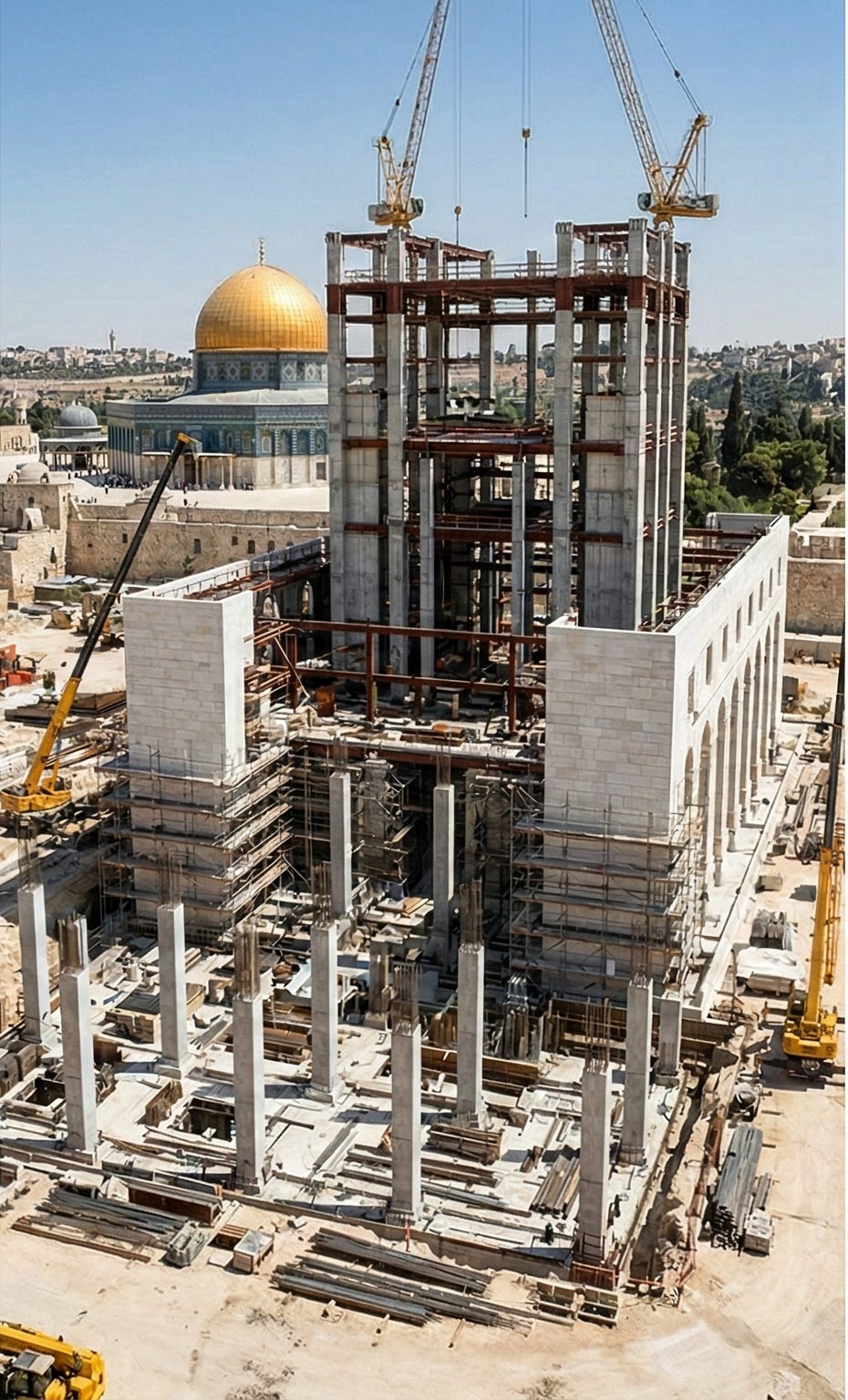
Pete Hegseth and the Mainstreaming of Temple Talk
The fact that Third Temple theology has migrated from the margins of American Protestantism to the corridors of political power became impossible to ignore when Pete Hegseth, then a Fox News personality and later confirmed as Secretary of Defense, was recorded at a 2018 Arutz Sheva conference in Jerusalem declaring: “There’s no reason why the miracle of the re-establishment of the temple on the Temple Mount is not possible. I don’t know how it would happen. You don’t know how it would happen, but I know that it could happen.”
Hegseth framed his remarks in the language of miracles and milestones: “1917 was a miracle, 1948 was a miracle, 1967 was a miracle, 2017, the declaration of Jerusalem as the capital of Israel was a miracle.” The subtext, for anyone literate in dispensationalist theology, was clear. Each “miracle” is a prophetic checkpoint. The Temple is the next one on the list.
NPR reported that both Hegseth and Mike Huckabee, nominated as U.S. Ambassador to Israel, espouse Christian Zionist beliefs that tie Israel’s existence to biblical prophecy and the Second Coming. Huckabee has publicly stated that he refuses to use the term “West Bank,” insisting instead on the biblical names “Judea and Samaria,” and has denied that Israeli settlements constitute an “occupation.” These are not merely political positions. They are theological ones, rooted in a reading of Scripture that requires a specific sequence of geopolitical events to unfold before Christ can return.
The Riddleblog, a Reformed Christian commentary, posed the uncomfortable question that dispensationalist supporters of Israel rarely wish to confront: “There must be a rebuilt temple in Jerusalem for the Antichrist to make a deal with and then betray Israel. But if it is the United States which facilitates the rebuild of the temple (or at least the clearing of Muslim holy places from the Temple Mount) then does this come from benign intentions?” The ReligiousLiberty.TV investigation raised the same concern, noting the “fusion of religious and nationalist agendas” visible in Hegseth’s rhetoric and the broader alignment of dispensationalist eschatology with expansionist Israeli territorial claims.
It is a question that deserves an honest answer. And the honest answer, for anyone who takes dispensationalist theology at its word, is: no. The intention is not benign. The intention, however wrapped in the language of blessing and solidarity, is to facilitate the fulfillment of a prophecy that ends with the betrayal of Israel, the reign of the Antichrist, and a tribulation of unimaginable suffering.
The Jewish Side of the Equation
It would be unfair to suggest that the Third Temple movement is entirely an evangelical invention imposed upon unwilling Jewish participants. It is not. The desire for a rebuilt Temple is woven into the fabric of Jewish liturgical life. Three times daily, observant Jews pray for the Temple to be rebuilt speedily in their days. The Amidah, the central prayer of Jewish worship, contains a formal petition for its restoration.
But the Jewish theological understanding of what the Temple represents could not be more different from the dispensationalist one. For Orthodox Jews who support the Temple’s reconstruction, it is the locus of divine presence, the Shekinah, and its rebuilding signals the complete redemption of Israel and the world. There is no Antichrist in this story. There is no Great Tribulation. There is no seven-year betrayal. There is only the fulfillment of ancient covenant and the dawn of an age of peace.
Moreover, many Orthodox Jews, including most ultra-Orthodox rabbis, oppose human efforts to rebuild the Temple. They argue that only the Messiah has the authority to undertake such a project and that any premature attempt to force God’s hand risks profanation of the holy site or worse. Maimonides himself wrote that the tenth red heifer would be offered by the Messiah, implying that human efforts to produce one ahead of his arrival are, at best, presumptuous.
Secular Israeli officials, for their part, have historically treated Third Temple activism as dangerous messianism. They are acutely aware that any alteration to the status quo on the Temple Mount, where the Al-Aqsa Mosque and the Dome of the Rock have stood since the seventh century, could ignite a regional conflagration. When Israel captured the Temple Mount in 1967, Defense Minister Moshe Dayan famously returned administrative control to the Islamic Waqf, calculating that the risks of asserting Jewish sovereignty over the site were simply too great.
Hamas spokesperson Abu Obaida, in a January 2024 speech, explicitly cited the arrival of red heifers in Israel as one of the provocations that contributed to the October 7, 2023 attack. Whether one regards that claim as sincere or cynical, it demonstrates the incendiary potential of Temple Mount activism, a potential that evangelical donors in Texas and Tennessee may never have to face personally but that Israelis and Palestinians confront every day.
The Theology of Stage-Setting
There is a term in dispensationalist circles for the geopolitical events that they believe are moving the world toward the fulfillment of prophecy: “stage-setting.” It is a theatrical metaphor, and a revealing one. The actors do not yet know their lines. The curtain has not yet risen. But the scenery is being constructed, the props are being placed, and the audience (the raptured Church, watching safely from heavenly balconies) will soon take their seats.
This concept of stage-setting carries with it an implicit moral permission structure. If God has ordained that the Temple will be rebuilt, and if the Antichrist will desecrate it, and if the Great Tribulation will follow, then these events are not disasters to be averted but prophecies to be fulfilled. The believer who helps move the pieces into place is not accelerating catastrophe. He is cooperating with divine sovereignty.
But one must ask the Christian who holds this position: What does it say about your friendship with Israel that you are, by your own theological admission, helping to construct the building in which the worst thing in human history will occur? What does it say about your love for the Jewish people that your eschatology requires their betrayal by a false messiah, a great tribulation that targets them specifically, and, in many dispensationalist formulations, the death of two-thirds of the Jewish population before the remnant turns to Christ?
The Apostle Paul wrote to the Romans that “all Israel will be saved” (Romans 11:26), but in dispensationalist theology, this salvation comes only through a crucible of suffering that makes the Holocaust look like a prelude. This is the part of the story that does not appear on the fundraising brochures for Christian tours of the Temple Institute.
An Alternative Reading
It is worth noting that the dispensationalist interpretation of 2 Thessalonians 2:3-4 is not the only one available to Christians, nor even the oldest. John Calvin, commenting on the passage, identified the “temple of God” not as a physical building in Jerusalem but as the Church itself, and the “man of sin” as the papacy, which had usurped the seat of Christ’s authority in the visible Church. The Protestant Reformers, from Luther to Knox to the framers of the Westminster Confession, universally held a historicist reading of prophecy that located the Antichrist in Rome, not in some future Middle Eastern dictator.
The historicist position holds that Paul was describing a spiritual reality, the corruption of the Church from within, and that the “temple” in which the man of sin sits is not a stone edifice on Mount Moriah but the community of believers itself. On this reading, no physical temple needs to be rebuilt for the prophecy to be fulfilled. It has been fulfilling itself across the centuries wherever religious authority has been perverted into tyranny.
There is also the preterist reading, which argues that Paul’s words were fulfilled in the first century, perhaps in the events surrounding the destruction of the Second Temple in 70 A.D., when Roman armies desecrated the sacred precincts before razing them to the ground. On this view, the prophecy is not pending. It is past.
Both of these interpretations have older pedigrees and broader ecumenical support than dispensationalism. The Catholic Church, the Eastern Orthodox churches, the Anglican Communion, the Lutheran tradition, and the Reformed tradition all reject the dispensationalist scheme. What is often presented as “the biblical view” of the end times is, in historical terms, a nineteenth-century theological innovation, a system invented by Darby, systematized by Scofield, and popularized by Lindsey and LaHaye.
Coming in Part Three: If the dispensationalist reading of prophecy is not the only one, what alternatives exist, and what do they reveal about the assumptions baked into the Third Temple project? In our concluding installment, we examine the Seventh-day Adventist doctrine of the heavenly sanctuary, which argues that Christ already ministers in a real temple not made with human hands, and that any earthly reconstruction is not a stage for His return but a trap for those who do not understand where the real sanctuary is. We also confront the constitutional question that Madison foresaw two centuries ago: what happens to the republic when policy and prophecy merge? Tomorrow: the heavenly sanctuary, the liberty of conscience, and the gift with the curse inside.