
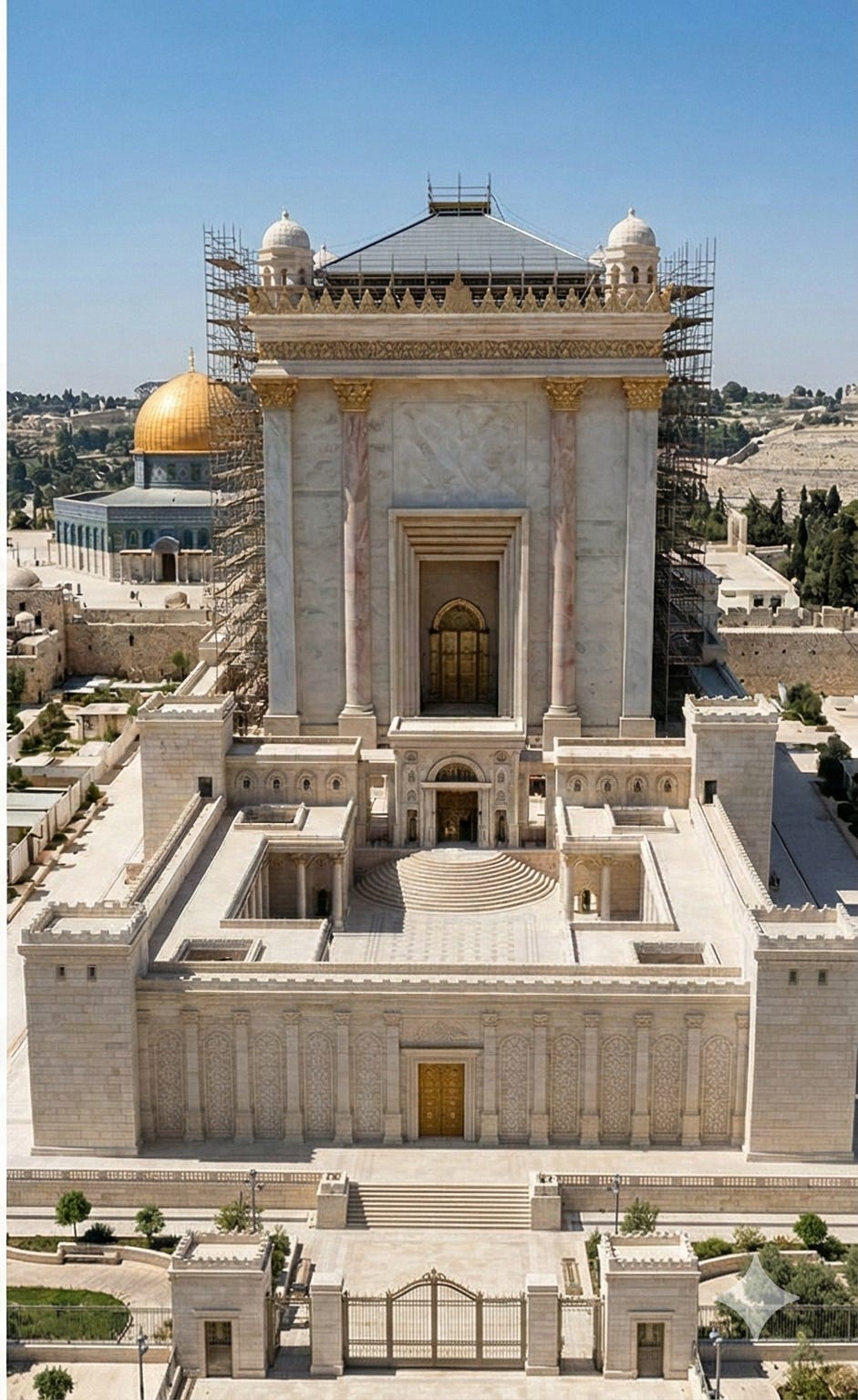
This is the final installment of a three-part series examining evangelical support for the rebuilding of the Third Temple in Jerusalem. In Part One, we laid out the dispensationalist theology that treats the Third Temple as a necessary precondition for the Antichrist’s rise, and heard from Messianic Jewish and Catholic voices who reject the entire enterprise. In Part Two, we traced the migration of that theology into American political power, examined the Jewish community’s own divided response to their evangelical benefactors, and confronted the moral logic of “stage-setting” for the apocalypse. Today, we turn to the Christians who read the same Bible and reach a radically different conclusion about what “sanctuary” means, and we ask what happens to a republic when its foreign policy is yoked to a prophetic timetable.
The Seventh-day Adventist Perspective: A Heavenly Sanctuary, Not an Earthly One
Perhaps no major Christian denomination has offered a more thorough and sustained critique of the Third Temple theology than the Seventh-day Adventist Church. And it is worth examining this perspective in some detail, because it represents not merely a difference of emphasis but a fundamentally different understanding of what the word “sanctuary” means in Scripture.
Adventists teach that the earthly sanctuary system, from the tabernacle of Moses through Solomon’s Temple, was always intended as a “miniature representation” of a real sanctuary in heaven (Exodus 25:8-9, 40; Hebrews 8:1-5). When Christ died on the cross and the temple veil was torn from top to bottom (Matthew 27:51), the entire earthly sacrificial system reached its appointed end. The lamb on the altar was superseded by the Lamb of God. The earthly priesthood was superseded by Christ’s high-priestly ministry in the heavenly sanctuary. The Amazing Facts ministry, an Adventist-affiliated organization, has summarized this position plainly: “When Jesus died, the veil in the earthly temple ripped in two from top to bottom, signifying that the temple no longer held meaning,” and rebuilding a temple for animal sacrifices would be “as useless as it was then.”
This is not merely an abstract theological claim. It carries a direct and pointed implication for the Third Temple movement: if the entire purpose of the earthly sanctuary system was to point forward to Christ, then reconstructing it after Christ has come is not an act of faithfulness but a step backward, a theological regression that implicitly denies the sufficiency of the Cross. Ellen G. White, the influential Adventist author, wrote that the earthly sanctuary and its rituals constituted “a compacted prophecy of the gospel.” The Adventist Review, the denomination’s flagship publication, describes the heavenly sanctuary as “the very center of Christ’s work in behalf of men and women” and “the foundation of our faith.” The sanctuary is not a building project in Jerusalem. It is a present reality in heaven, where Christ intercedes as High Priest (Hebrews 7:25).
For Adventists, Daniel 8:14, the prophecy that speaks of 2,300 days after which “the sanctuary shall be cleansed,” does not refer to a future physical temple in Jerusalem but to Christ’s work of pre-Advent judgment in the heavenly Most Holy Place, a ministry they believe began in 1844. This doctrine, known as the Investigative Judgment, is unique to Adventism, but it has the effect of completely redirecting the prophetic gaze away from the Temple Mount and toward heaven itself. The “cleansing of the sanctuary” is not accomplished with red heifers and Levitical priests. It is accomplished by Christ, in a real sanctuary not made with human hands.
This theological framework produces a distinctive and urgent warning about the Third Temple project. As the ReligiousLiberty.TV analysis noted, Adventists “often warn that expecting Jesus to set up an earthly kingdom in old Jerusalem is a dangerous misunderstanding.” They believe that Christ’s return will be a visible, global, supernatural event (Revelation 1:7, “every eye will see Him”) that no one can engineer through geopolitical maneuvering. Any figure who appears in Jerusalem, takes a seat in a rebuilt temple, and claims to be the Messiah is, by Adventist reckoning, almost certainly the great deceiver. Ellen G. White wrote in The Great Controversy that Satan’s “crowning act” of deception will be to impersonate Christ himself, appearing as a dazzling, radiant figure who heals the sick and proclaims a message that sounds almost indistinguishable from Scripture. She warned: “In different parts of the earth, Satan will manifest himself among men as a majestic being of dazzling brightness, resembling the description of the Son of God given by John in the Revelation.”
This is the nightmare scenario that Adventist eschatology holds up as a mirror to the dispensationalist dream. Where dispensationalists see the Third Temple as the stage for the Antichrist’s temporary blasphemy before Christ’s triumphant return, Adventists see it as the potential stage for the most convincing impersonation of Christ ever attempted, one that would deceive not only Jews but Christians, Muslims, and the watching world. A rebuilt temple would give theological plausibility to the appearance of a false messiah precisely because so many people, across so many traditions, have been conditioned to expect someone to show up there.
The Adventist position thus flips the entire Third Temple narrative on its head. The dispensationalist says: “We must build the temple so that the Antichrist can sit in it, so that prophecy can be fulfilled, so that Christ can return.” The Adventist replies: “Christ does not need an earthly temple. He already ministers in the heavenly one. Any earthly temple built for prophetic purposes is not a stage for Christ’s return. It is a trap for those who do not understand where the real sanctuary is.”
It is a position that deserves more attention than it receives, particularly in an era when the political machinery of the most powerful nation on earth is being steered, in part, by people who believe a temple must rise on a contested hilltop before God’s plan can proceed.
The Liberty of Conscience Dimension
From a religious liberty perspective, the entanglement of dispensationalist eschatology with American foreign policy raises profound concerns. When a Secretary of Defense speaks publicly about the “miracle” of rebuilding the Temple, he is not merely expressing a private religious opinion. He is signaling, to allies, adversaries, and the volatile actors on the ground in Jerusalem, that the most powerful military apparatus in human history is guided, at least in part, by a theological conviction that the apocalypse requires specific real-world events to unfold in a specific sequence on a specific hilltop in East Jerusalem.
The First Amendment protects the right of every American to hold whatever eschatological convictions he pleases. It does not protect the right to use the machinery of the state to fulfill those convictions. When policy and prophecy merge, the constitutional architecture designed to keep religion and government in their proper spheres begins to buckle under pressures it was never designed to bear.
James Madison, in his Memorial and Remonstrance Against Religious Assessments, warned against “the first experiment on our liberties,” the principle that any entanglement of government with religious objectives, however seemingly benign, sets a precedent for greater entanglement to follow. The evangelical project of temple-building diplomacy is precisely such an experiment. It dresses eschatological ambition in the clothes of geopolitical alliance and asks the republic to fund, defend, and advance a theological timetable that most Christians in the world do not share.
Conclusion: The Gift with the Curse Inside
The most troubling aspect of evangelical support for the Third Temple is not its audacity but its dishonesty, or, if one wishes to be charitable, its compartmentalization. Millions of evangelical Christians sincerely love the Jewish people, pray for the peace of Jerusalem, and give generously to Israeli causes. Many of them have never paused to follow the logical thread of their own theology to its conclusion.
But the conclusion is inescapable. In the dispensationalist narrative, the Third Temple is not a house of prayer for all nations. It is a trap. It is a building constructed so that the worst enemy of God and humanity can sit in it and declare himself divine. It is the trigger mechanism for a tribulation that will engulf the very people whom evangelicals claim to bless. The friendship on offer is the friendship of those who hand you the materials to build your own gallows and call it a gift.
This does not mean that every evangelical who supports Israel harbors sinister intentions. Most do not. But theology has consequences, and when a theological system requires the suffering of an entire people as a necessary plot point in someone else’s salvation drama, it is not enough to say that the intentions are good. The road to the abomination of desolation, it turns out, is paved with them.
Any Christian who wishes to stand genuinely with Israel must first decide whether he or she stands with Israel as a partner, a nation of real people with real interests, real vulnerabilities, and a real right to determine its own religious future, or as a prop in an eschatological pageant whose final act was scripted two centuries ago in a Plymouth Brethren meeting hall.
The Apostle Paul, who knew something about the dangers of using people as instruments of someone else’s theological program, wrote a simple instruction to the church in Rome: “Love must be sincere” (Romans 12:9). It is difficult to see how a love that requires your friend’s destruction before your Savior can return meets that standard.
The temple they wish to build is not for God. By their own confession, it is for the Beast. And until that confession is spoken plainly, not in theological code, not in the small print of prophecy conferences, but in the same clear voice with which they declare their love for Israel, the friendship they offer will remain the most dangerous kind: the kind that tells you exactly what it intends to do, in words it never hopes you read.