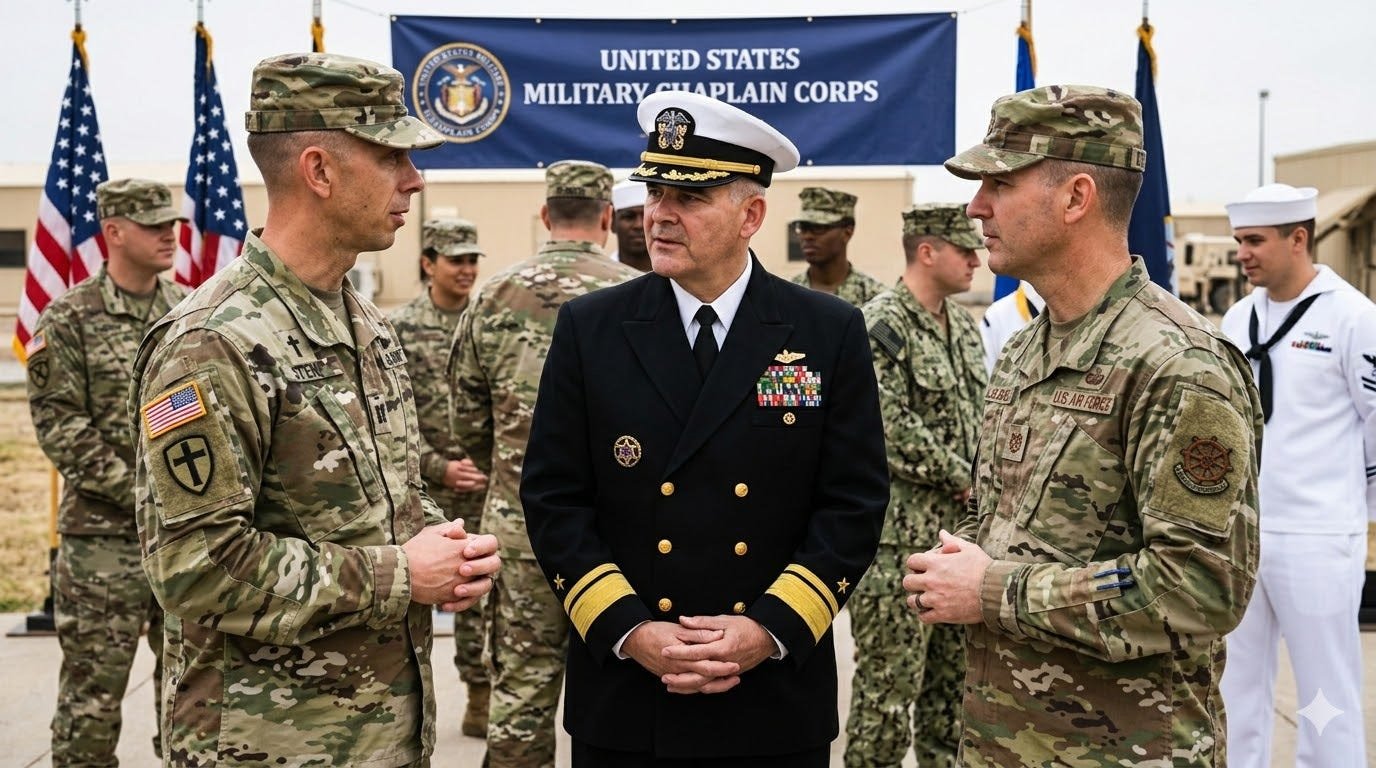

WASHINGTON — For more than two centuries, the military chaplain has occupied a singular position in American war-making: equal parts pastor, counselor, and constitutional guarantor, tasked with ensuring that the men and women who carry rifles can also keep their faith. That role is now under sustained pressure from two directions at once, caught between a Pentagon pushing a culture war on one front and the unresolved wreckage of the COVID-19 vaccine mandate on the other.
Defense Secretary Pete Hegseth has moved aggressively to reshape the military’s approach to religion since taking office in January 2025. His directives have eliminated a major Army spiritual wellness document, proposed new restrictions on which faith traditions qualify for chaplain affiliation codes, and effectively ended religious beard waivers for most deployable service members. Critics across the religious liberty spectrum, including advocates who share his stated interest in protecting Christian expression in uniform, say the effect has been to narrow, rather than expand, the constitutional guarantees he claims to champion.
At the same time, Congress is weighing the RESTORE Act, a bipartisan audit mechanism targeting what its sponsors call a systematic betrayal of service members who sought religious exemptions from the military’s COVID vaccine mandate. Approximately 28,000 religious accommodation requests were filed across the armed forces during the mandate period. Fewer than 400 were approved.
‘No More Beardos’
The most visible flashpoint arrived on Sept. 30, 2025, when Hegseth summoned hundreds of generals, admirals, and senior enlisted leaders to Marine Corps Base Quantico, Virginia, for what amounted to a cultural manifesto delivered in uniform. “No more beardos,” he told the assembled brass. “The era of rampant and ridiculous shaving profiles is done.”
A memorandum issued the same day directed the Pentagon to revert to pre-2010 grooming standards, making religious beard waivers “generally not authorized” and limiting any remaining approvals to non-deployable service members in roles with low risk of chemical attack or firefighting duty. Existing waivers, including those held by Sikh, Muslim, Jewish, Norse Pagan, and Christian service members, were ordered reevaluated within 90 days.
The legal exposure was immediate. Federal courts have consistently held that the government must accommodate sincerely held religious beliefs unless it can demonstrate a compelling operational interest and the absence of any less restrictive alternative. In 2016, the Army itself tested whether Sikh soldiers with beards could achieve a proper gas mask seal and concluded they could. Hegseth’s stated rationale of respirator safety has been the subject of pointed skepticism from former military officials and civil liberties attorneys.
“For Sikh soldiers, shaving or cutting their beard is like cutting off a limb,” said Marissa Rossetti, senior staff attorney at the Sikh Coalition. “We have Sikh service members who are deployed with beards right now. It is not a hindrance to how they are serving this country.”
The Council on American-Islamic Relations wrote to Hegseth stressing that religious freedom remains “a constitutional right, even in uniform.” Four senators — Gary Peters, Elizabeth Warren, Tim Kaine, and Kirsten Gillibrand — warned in November 2025 that the new standards risked forcing observant service members from the ranks at precisely the moment the military faces persistent retention and readiness concerns.
Hegseth’s response, updated guidance issued this month, requires that any accommodation applicant submit a sworn statement of belief, a written explanation of the religious conflict, supporting documentation, and a written sincerity assessment from the unit commander. A chaplain’s opinion on the nature of the belief is now mandatory. A legal advisor must confirm compliance with the Religious Freedom Restoration Act before any decision is made. The architecture of the process, in other words, demands that service members prove their faith worthy of the Constitution’s protection.
Burning the Fitness Guide
In December 2025, Hegseth announced a broader reshaping of the Chaplain Corps itself. He ordered the immediate suspension of the Army’s Spiritual Fitness Guide, a 112-page document developed by the Army Chaplain Corps and released in August 2025. The guide was designed to address spiritual resilience among soldiers regardless of specific religious affiliation, drawing on frameworks of meaning, purpose, and inner strength.
Hegseth objected that the guide mentioned God only once and relied on what he called “New Age notions” of consciousness and connection rather than virtue. He announced plans to create a new list of recognized religious affiliation codes for chaplains, without specifying which traditions might be removed, and declared the coming changes would constitute a “top-down cultural shift” returning chaplains to their role as “pastors and shepherds” rather than what he characterized as “emotional support officers.”
The practical consequence of eliminating religious affiliation codes for minority traditions is significant. A service member cannot request a chaplain from a tradition not recognized by the Department of Defense. An endorsing religious body stripped of its code loses the ability to place chaplains in uniform. Critics note that Hegseth’s stated goal of protecting faith in the military exists in tension with policies that narrow which faiths receive official recognition.
Advocates for pagan, Wiccan, and other minority-tradition service members have raised particular alarm. The Wild Hunt, a publication covering minority religious communities, reported in December 2025 that no further details had been released on what the replacement spiritual program would look like, leaving minority-faith chaplain endorsers in legal and institutional limbo.
The Vaccine Mandate’s Long Legal Shadow
Whatever else the current Pentagon may accomplish in the name of religious revival, the previous administration’s record on faith in uniform remains a persistent liability. The Biden-era COVID-19 vaccine mandate generated more religious accommodation litigation than any military policy in recent memory, and its legal consequences are still working through the courts and the Capitol.
More than 8,400 service members were discharged after refusing the vaccine. Of the approximately 28,000 religious accommodation requests filed across the armed forces, fewer than 400 were approved, a rate below 2 percent. A federal judge in Texas found that the Navy’s process amounted to theater, with outcomes predetermined before applications were reviewed. “There is no COVID-19 exception to the First Amendment,” wrote Judge Reed O’Connor. “There is no military exclusion from our Constitution.”
President Trump signed an executive order on Jan. 27, 2025, directing reinstatement with full back pay for any service member discharged solely for vaccine refusal. As of mid-2025, fewer than 130 of the roughly 8,400 discharged troops had returned to service, reflecting the gap between executive promise and bureaucratic execution.
The RESTORE Act, introduced by Sens. Ted Cruz, Katie Britt, Rick Scott, and Mike Lee, would establish a Special Review Board to audit the full record of vaccine-mandate religious accommodation denials, review career impacts including stalled promotions and adverse evaluations, and authorize corrective action including backdated promotions and expungement of adverse records. The bill’s sponsors estimate that between 18,000 and 20,000 service members who filed exemption requests remained in service but suffered career consequences for asking.
In February 2026, the Supreme Court declined to hear two Air Force cases, Poffenbarger v. Meink and Doster v. Meink, that had challenged the vaccine mandate on religious grounds. Lower courts had dismissed the cases as moot on the grounds that the mandate had been rescinded and service members could return. The justices’ silence leaves unresolved the broader question of whether the military’s handling of those tens of thousands of requests violated RFRA and the First Amendment at scale.
The Chaplain in the Middle
Chaplains occupy a constitutionally peculiar position. They are government employees authorized to perform religious ministry, a function the Establishment Clause would ordinarily prohibit. Courts have long sustained the Chaplain Corps on the grounds that without it, the military would effectively deny service members access to their faith, violating the Free Exercise Clause. The chaplain exists, in other words, to honor a constitutional bargain: the government may compel service, but it cannot compel apostasy.
DoD Instruction 1304.28, as revised in May 2024, sets out the current framework for chaplain appointment and conduct. Chaplains are required to advise on religious accommodation requests, maintain confidentiality, and provide care with regard for the dignity of all service members. Where a chaplain’s religious endorsing organization prohibits a specific form of ministry, the chaplain must offer a referral to another qualified chaplain. The instruction also bars any service member from forcing a chaplain to perform rites contrary to the chaplain’s own religious convictions.
The Military Chaplain Act of 2025, introduced by Rep. Keith Self of Texas, would codify those protections and add explicit legal guarantees that chaplains can minister in accordance with their own sincerely held beliefs and their endorsing body’s tenets. First Liberty Institute, which litigated the Navy SEAL vaccine cases, argues that without such protections, chaplains face institutional pressure to perform in ways that conflict with their faith.
That is, to put it plainly, a real tension. A chaplain’s legal duty is to serve a religiously diverse population. A chaplain’s theological commitment runs to a specific tradition. When policy narrows which traditions receive institutional recognition, the first casualty is the minority-faith service member who can no longer find a chaplain equipped to serve them. The second casualty may be the constitutional premise that makes the Chaplain Corps possible in the first place.
What the Law Requires
The Religious Freedom Restoration Act, enacted in 1993, requires the federal government, including the military, to demonstrate a compelling interest before substantially burdening a person’s exercise of religion, and to use the least restrictive means of furthering that interest. The Supreme Court has never carved out a blanket military exception to RFRA. Courts have consistently required individualized review of religious accommodation requests and rejected categorical denials.
Hegseth’s grooming policies do, technically, preserve a review process. What they accomplish is a structural presumption of denial. Religious beard waivers are “generally not authorized.” Approvals are confined to non-deployable roles. Sincerity must be documented, sworn to, and assessed by the unit commander. The architecture is designed to screen out all but the most persistent and well-documented requests, which is not the same thing as a compelling-interest analysis applied in good faith.
Federal courts have spotted the distinction before. They will likely have the opportunity to spot it again.
In 1783, George Washington wrote to the Hebrew Congregation of Newport that the United States gave “to bigotry no sanction, to persecution no assistance.” Hegseth invoked Washington’s name at Quantico to justify his chaplain reforms. The tradition he cited is broader, and more demanding, than the policy he announced.
Michael Peabody is the founder, publisher, and editor of ReligiousLiberty.TV, covering First Amendment and religious liberty law.
