
Why Catholicism is Emerging while Mainstream Protestantism and Evangelicalism are Struggling
On a Catholic Answers podcast this fall, and again from the dais at the Heritage Foundation earlier this month, Michael Knowles returned to a line from Alexis de Tocqueville that once read like the eccentric aside of a nineteenth-century Frenchman and now reads like reporting. “I believe that our descendants will tend more and more to be divided into only two parts,” Tocqueville wrote in Democracy in America, “those leaving Christianity entirely and those entering into the bosom of the Roman Church.”
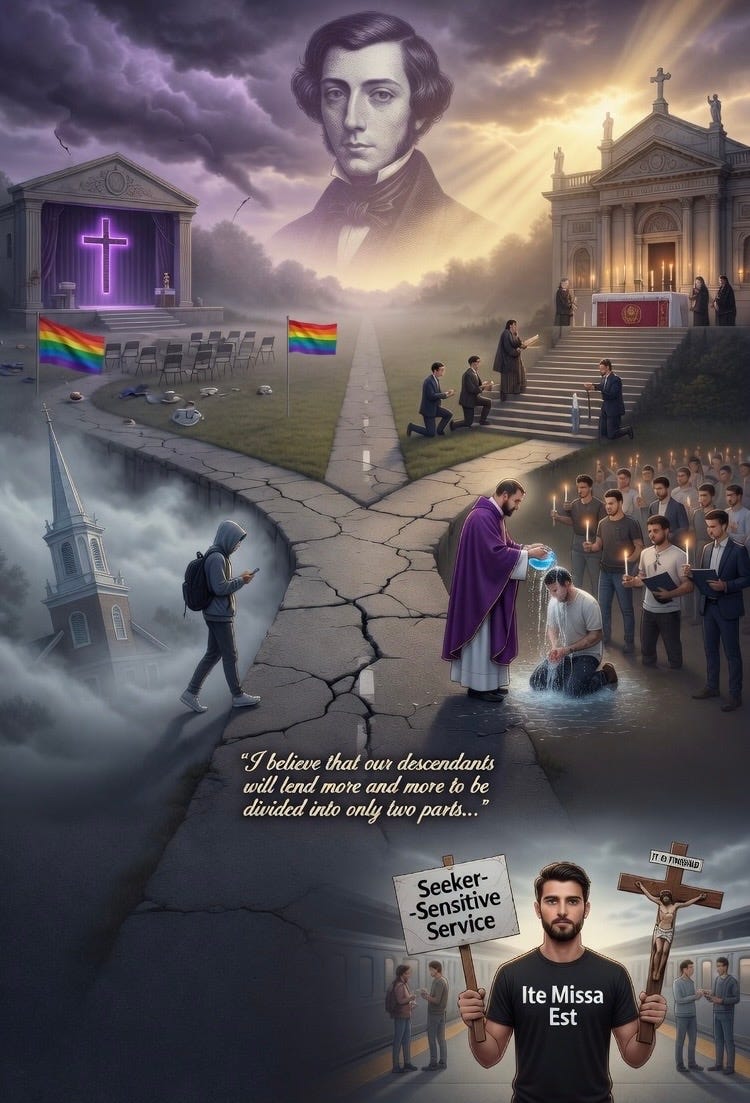
Knowles credits Tocqueville with foreseeing the shape of twenty-first century American religion. The numbers from Easter 2026 suggest he may be right.
The Easter 2026 Numbers
Data gathered by the National Catholic Register from 71 American dioceses, and separately by the Catholic prayer app Hallow from 140 of the country’s 175 dioceses, show an average 38 percent increase in adult converts over last Easter. A related survey found a 57 percent jump specifically among unbaptized adults seeking full initiation. The Archdiocese of Los Angeles reported a 139 percent year-over-year increase. Chicago was up 52 percent, New York 36 percent, Newark 30 percent on top of a 72 percent rise since 2023. Detroit welcomed 1,428 new Catholics, its highest total in 21 years. The Archdiocese of Oklahoma City alone expected nearly a thousand unbaptized adults to enter the Church, a 57 percent increase over 2025.
Within 16 dioceses that keep detailed longitudinal records, the average gain over 2024 was 83 percent. The growth is disproportionately young and disproportionately male. A Gallup release this week found that 42 percent of American men ages 18 to 29 now say religion is very important to them, up from 28 percent in 2022 and 2023. For the first time in the 25 years Gallup has tracked this question, young men have overtaken young women on the measure. Brad Wilcox, the University of Virginia sociologist, told The Washington Times that young men who “felt rejected during COVID and the ‘great awokening’ of our culture in the last decade” have turned to the Catholic Church because it is “one of the few institutions welcoming them with open arms.”
France is reporting a parallel surge, with record adult baptisms and particular growth among teenagers and young adults. Skeptics, including Notre Dame sociologist Christian Smith, counsel patience. Only two of the 16 detailed dioceses have yet surpassed their conversion totals from the year 2000. The current numbers look, for now, like a recovery from historic lows rather than a breach of historic highs. But the direction is unmistakable, and it is precisely the direction Tocqueville predicted.
Tocqueville’s Logic
Writing in 1835, Tocqueville observed a peculiar logic working through the American religious landscape. He saw Protestantism in America as a thousand variations on a theme, each one an act of private judgment, each one authorized by the individual believer’s reading of conscience or scripture. Over time, he reasoned, the momentum of private judgment would do its work. Some would judge their way out of Christianity entirely. Others, exhausted by the proliferation of private judgments, would seek a fixed point and find it in Rome. The middle ground between rationalism and the papacy would thin out.
He made the prediction with the confidence of a logician, not a partisan. Tocqueville himself was no enthusiast for doctrinal Catholicism. He described himself in a letter to Arthur de Gobineau as “as much of an unbeliever as I may be,” even while confessing that he could not read the Gospels without “a profound emotion.” His interest in religion was social and political. He thought democracies could not survive without it.
Tocqueville’s meditation on the unbeliever is worth quoting in full context. “In ceasing to believe religion is true,” he wrote, “the unbeliever continues to believe it is useful.” The secularist, in his telling, remains haunted by the treasure he has let slip. “He therefore regrets his faith after he has lost it, and deprived of a good of which he knows the entire value, he fears to take it away from those who still possess it.” Modern atheism, on this account, is a condition of melancholy rather than triumph. The regret is the tell.
How the Mainline Compromised Itself Away
What Tocqueville did not fully anticipate was how Protestantism in America would hasten its own hollowing. He assumed private judgment would do the work. In practice, American Protestantism accelerated the process by choosing, at almost every fork in the road, whichever path required the least of its adherents.
The mainline denominations took the first route. Beginning roughly a century ago, Methodist, Presbyterian, Episcopal, Lutheran, and Congregationalist leadership elected to reconcile Christianity with whatever the educated classes happened to believe at any given moment. Biblical authority gave way to historical criticism, then to existentialism, then to liberation theology, then to therapeutic spirituality, then to the intersectional catechism of the present decade. Each accommodation was framed as sophistication. The cumulative effect was that a young person walking into a mainline sanctuary in 2026 is likely to hear a sermon indistinguishable from a municipal proclamation, delivered by clergy whose own confidence in the resurrection is difficult to locate. The pews emptied accordingly. Between 1987 and 2024, mainline Protestantism lost more than half its membership. The institutions that survive now function largely as real estate portfolios with worship services attached.
How Evangelicalism Dumbed Itself Into Irrelevance
Evangelicalism took the opposite route and arrived in roughly the same place. Rather than compromise itself into the secular academy, it dumbed itself into the entertainment industry. The megachurch model traded the historic rhythms of Christian worship, liturgy, creed, sacrament, catechesis, for a concert, a TED talk, and a small group. The stage lighting improved. The theology thinned. What survived was a message calibrated to produce an emotional response without making doctrinal demands: God has a wonderful plan for your life, Jesus wants you to flourish, here are seven principles for a better marriage. The prosperity gospel was the floridly corrupt version of this impulse. The seeker-sensitive service was the respectable version. Both assumed that the way to reach modern Americans was to ask less of them.
The result is a generation of young people raised inside evangelical subculture who cannot tell you what their church believes about the Eucharist, the atonement, the nature of the Trinity, or the authority of Scripture, because nothing in their formation required them to know. They received a Christianity of feeling, unanchored to history, untethered from doctrine, enforced by nothing more durable than the emotional momentum of the worship set. When that momentum runs out, typically around age nineteen, they exit. Some become atheists. A growing number, as the Easter numbers show, go looking for the thing their evangelicalism was pantomiming and find it in Rome.
The Harder Road
Knowles makes the point with characteristic directness. The young men flooding the catechumenate are not leaving serious Protestantism for Catholicism. Serious Protestantism has become difficult to find. They are leaving a Christianity that asked nothing of them for one that asks nearly everything, and discovering that the harder thing is the more honest thing. The Latin Mass parish demands posture, fasting, confession, and the slow work of doctrinal formation. The non-denominational campus ministry demands that you show up on Thursday and feel something. Given a real choice between the two, a remarkable number of twenty-three-year-old men are choosing the harder road.
What Adventists Should Take From This
There are reasons for Adventists and other confessional Protestants to watch this development with sober interest rather than reflexive alarm. The collapse of the mushy middle is not, in itself, bad news for any tradition that has kept its doctrinal nerve. It is only bad news for traditions that assumed the mushy middle was a sustainable place to live. Adventism has its own version of the mainline temptation, the quiet drift toward respectability purchased at the cost of distinctiveness, and its own version of the evangelical temptation, the youth conference pyrotechnics that substitute for catechesis. Both temptations end in the same demographic cliff.
A generation is asking serious questions about truth, authority, and the body. The Catholic Church has offered answers its catechumens find compelling. Those of us operating from different confessional premises must ask whether we are offering anything comparable, or whether we have confused relevance with dilution and ended up with neither. The three angels’ message is not a demographic strategy. It is a summons. But the summons presumes listeners who believe, with Tocqueville’s unbeliever, that religion is at least useful, and ideally true.
The Older Question
The other lesson is older than Tocqueville. Men and women do not finally choose between competing styles of worship. They choose between the living God and the void. The statistics from Los Angeles and Newark and Oklahoma City are the visible surface of a spiritual exchange going on in ten thousand unreported conversations, on subway platforms and in dorm rooms and at gravesides. The choice in front of every reader of this sentence is the same one Tocqueville described, sharpened now by circumstance. What do you believe, and whom do you follow, and what are you willing to stake on it.
Jesus put the question more simply. “Who do you say that I am.”