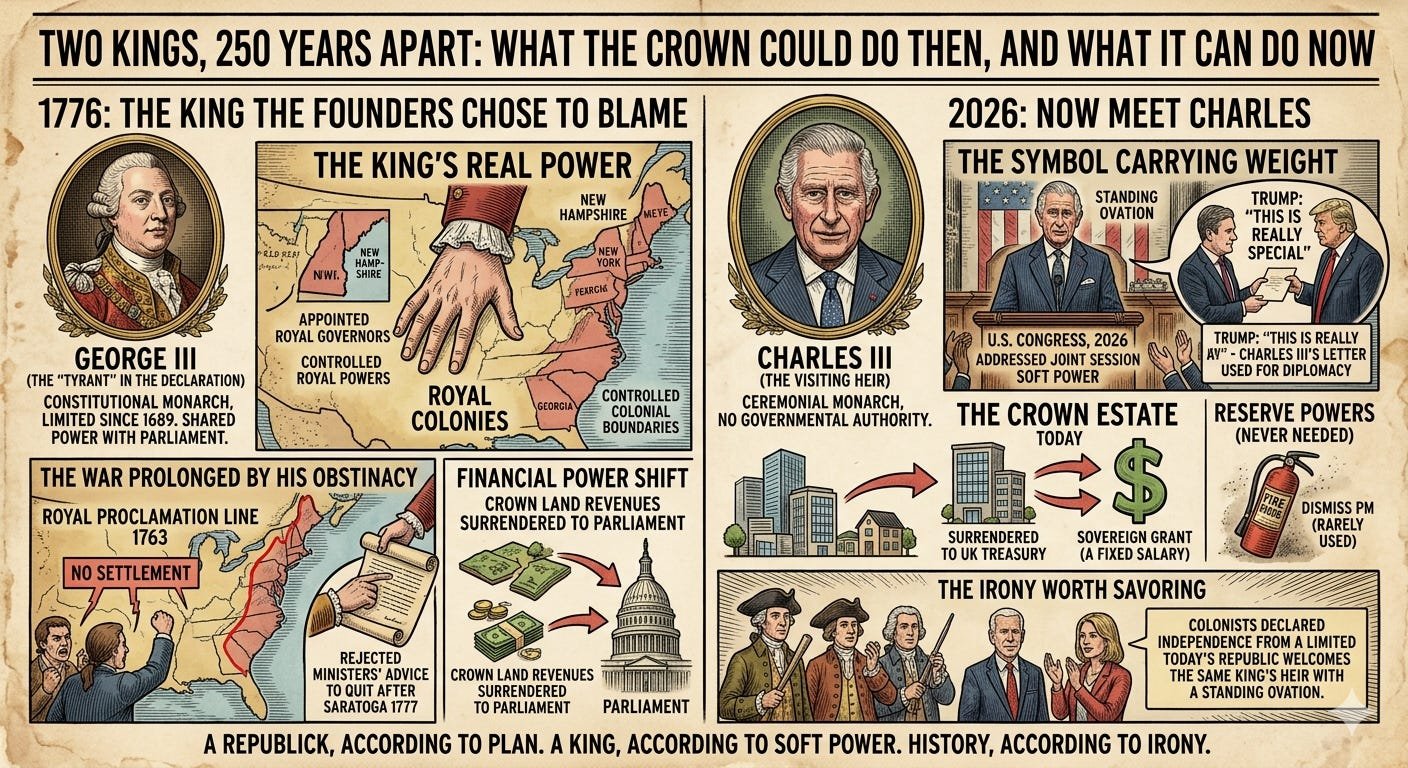
This July, the United States turns 250 years old, and the party will include a notable guest: the King of England. Not just any king, either, but the direct heir to the throne of George III, the man Thomas Jefferson immortalized as history’s foremost tyrant and whose name the founders attached to everything they despised about the old world. King Charles III addressed a joint session of Congress last month, becoming only the second British monarch to do so in American history. The symbolism writes itself, and it raises a question worth asking on the occasion of the 250th birthday: how much power did George actually have, how much does Charles have now, and what does the answer tell us about how much the world has changed?
The King the Founders Chose to Blame
During George III’s reign, Britain was a constitutional monarchy, ruled by a cabinet or ministerial government. Throughout the eighteenth century the direct political power of the monarch had been in decline, a development at work since the Glorious Revolution of 1688 and the passage of the English Bill of Rights, which limited monarchical power, in 1689. 
In other words, the colonists were fighting a constitutional monarch who shared power with Parliament, not an absolute king who ruled by personal fiat. Jefferson’s Declaration knew this, and listed George’s offenses anyway, because blaming a king makes for better revolution than blaming a legislature.
Although many Americans, such as Thomas Jefferson, placed the blame for the Revolution squarely on George III’s shoulders, no British monarch in more than a century was in a constitutional position to exercise any real responsibility. 
That said, George was not a passive bystander. He was deeply, stubbornly engaged. Until the revolution, the king backed his governments rather than dictating to them, defending parliamentary authority over the British empire by pushing his leading ministers to win the war.  His real contribution to the American cause, unintentional as it was, came through sheer obstinacy. George III’s primary role in the war was prolonging it well after Lord North lost all confidence that it could be won, following news of Burgoyne’s surrender at Saratoga in 1777. The King came to see victory over the United States as critical to the survival of the British Empire, and for that he firmly believed the war must go on. 
So the actual history is this: Parliament caused the Revolution. George prolonged the war out of personal conviction. Jefferson blamed George personally because it was more dramatic, and frankly more useful. The founders needed a villain with a face, a crown, and a name. George III was available.
What George Actually Had
Despite the constitutional limits, George III operated in a world where the monarch still possessed genuine political weight. He chose his ministers, and those choices mattered. He could press, lobby, encourage, and obstruct in ways that shaped policy even if he could not dictate it. Newly released troves of his public and private papers show a monarch who was a passionate champion of the rule of law, who embraced the fact that he shared power with Parliament and that his authority was not unlimited.  He was not a tyrant. He was something perhaps more interesting: a king who genuinely believed in the constitutional order and fought hard within it for what he thought was right, including a war that most of his own ministers eventually wanted to quit.
Land, Colonies, and the Crown’s Real Grip
Whatever the formal constitutional limits on George III’s personal authority, one area where the Crown’s reach was concrete and tangible was land. The thirteen colonies were not organized uniformly, and the degree of royal control varied considerably depending on how each had been established.
Royal colonies were governed directly by the British government through a royal governor appointed by the Crown, and included New Hampshire, New York, New Jersey, North Carolina, South Carolina, and Georgia. Charter colonies were granted to businesses, whose owners created the laws but were required to base them on English law, including Connecticut, Massachusetts Bay Colony, and Rhode Island. Proprietary colonies had charters granting ownership to a single person or family, with full governing rights: Delaware, Maryland, and Pennsylvania. 
In the royal colonies, the Crown’s hand was direct. Governors answered to London, not to local assemblies, and land grants flowed through the Crown’s authority. The entire legal framework for who owned what, and on what terms, traced back to a feudal theory of title that placed the king at the top of every chain of ownership in the empire.
George pressed that authority westward as well. In 1763, he issued a Royal Proclamation forbidding any European settlement in British territories west of the Appalachians, partly as a concession to allied Native American groups who had fought with Britain against France.  To colonists who had fought in that same war and expected to settle the lands won by it, this was an outrage. The Crown was drawing a line across a continent and telling British subjects they could not cross it. That was not symbolic power. That was a king controlling the terms of an entire civilization’s westward expansion.
Crown land was land owned by the monarch, the income from which had, since the reign of George III, been surrendered to Parliament in return for a fixed annual sum for the sovereign’s expenses.  The arrangement confirmed both how much land the Crown historically held and how the balance of financial power was already shifting toward Parliament even during George’s own reign.
Now Meet Charles
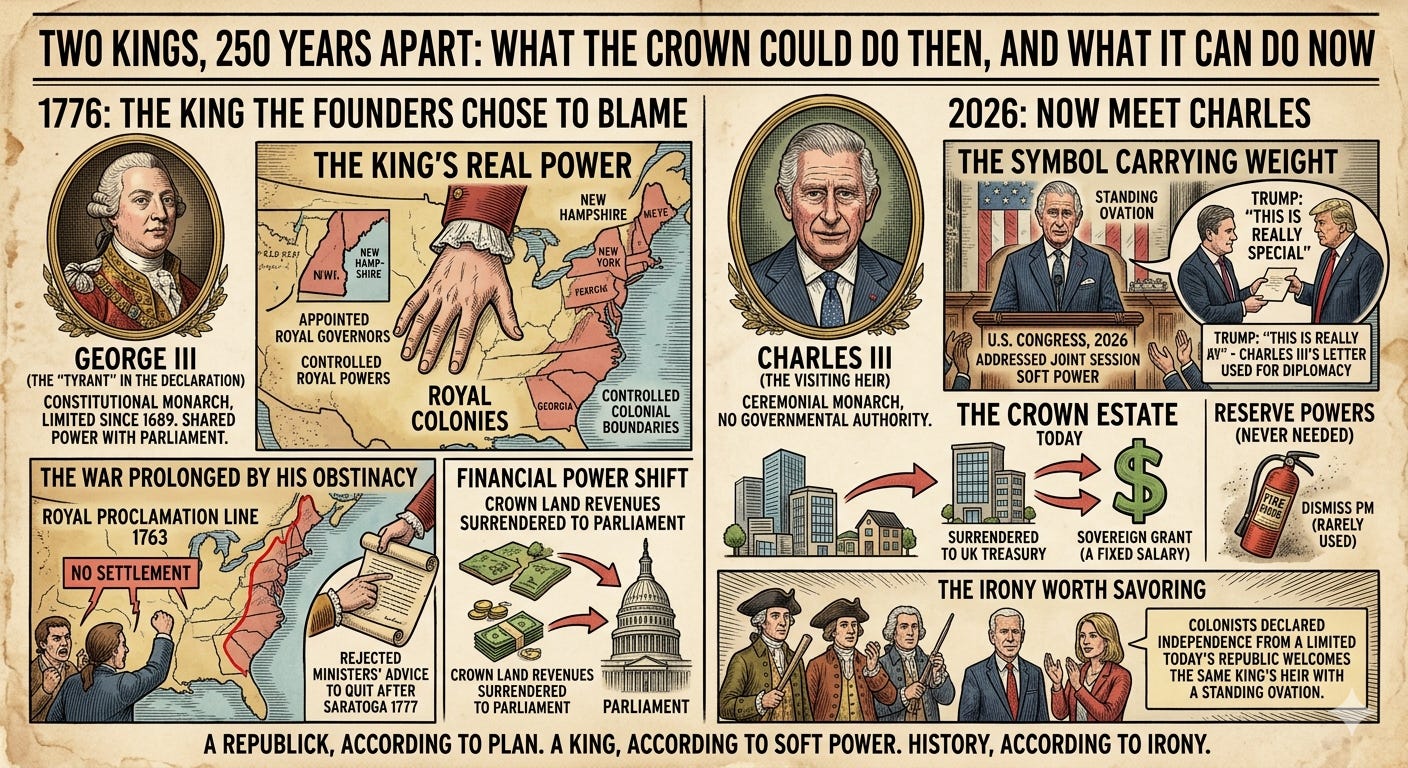
Two and a half centuries later, the monarchy has shed most of what George had left. The king cannot engage in government business, and cannot take action independently of Parliament and the Prime Minister.  The speech he delivers at the State Opening of Parliament is written entirely by the government. The Royal Assent he stamps on legislation is a formality so complete that no monarch has refused to give it since 1708. 
There are reserve powers, technically. Charles retains the lesser-known power to dismiss a Prime Minister who refuses to resign after losing the confidence of ministers and the House of Commons.  Constitutional lawyers keep this on their lists the way people keep the fire extinguisher under the sink: theoretically useful, almost certainly never needed.
King Charles owns none of America, controls no governors, draws no lines across any continent, and issues no proclamations about where anyone may or may not settle. The Crown Estate in the United Kingdom holds considerable property, but Charles surrenders its revenues to the Treasury in exchange for the Sovereign Grant, essentially a salary arrangement dressed up in medieval vocabulary. The feudal theory of land title that once gave a British king authority over every acre from the Atlantic seaboard to the Appalachians has been reduced to an accounting transaction.
The Part That Actually Matters Now
Here is where the comparison gets genuinely interesting. George III had constitutional power he exercised through political maneuvering. Charles has almost none of that, and yet he just addressed a joint session of the United States Congress.
The visit came at a moment of unusual turbulence between two nations long accustomed to calling each other indispensable allies, with observers watching closely whether the British monarchy could deploy its singular brand of soft power to smooth what diplomats and allies have privately struggled to manage. 
George III tried to hold the empire together with soldiers and tax collectors. Charles is doing something different, something George could never have imagined: showing up in Washington not as a sovereign making demands, but as a symbol carrying weight that elected officials cannot replicate. When Prime Minister Keir Starmer visited President Trump in the Oval Office, he produced a personal letter from King Charles as his opening card. “This is a letter from the king,” Starmer said. “This is really special.”  Trump, who reportedly finds the ancient lineage of the monarchy genuinely fascinating, responded accordingly.
The Irony Worth Savoring
Two hundred and fifty years ago, American colonists declared independence from a king who was, in the constitutional sense, already fairly limited. They built a republic on the explicit rejection of monarchy, wrote a constitution with no crown in it, and got to work.
Yesterday, a British king with no army, no veto, and no legislative power flew to Washington and addressed Congress to a standing ovation. The republic the founders built now looks to the institution they rejected as a source of diplomatic ballast in turbulent times.
The founders who fought over the Proclamation Line of 1763 would find that either deeply satisfying or slightly anticlimactic. They built a republic, wrote a constitution, and pushed the frontier all the way to the Pacific without asking any king’s permission. Two and a half centuries later, the king flew to Washington and got a standing ovation for it.
George III would find the whole thing either deeply satisfying or completely baffling. Possibly both.
