
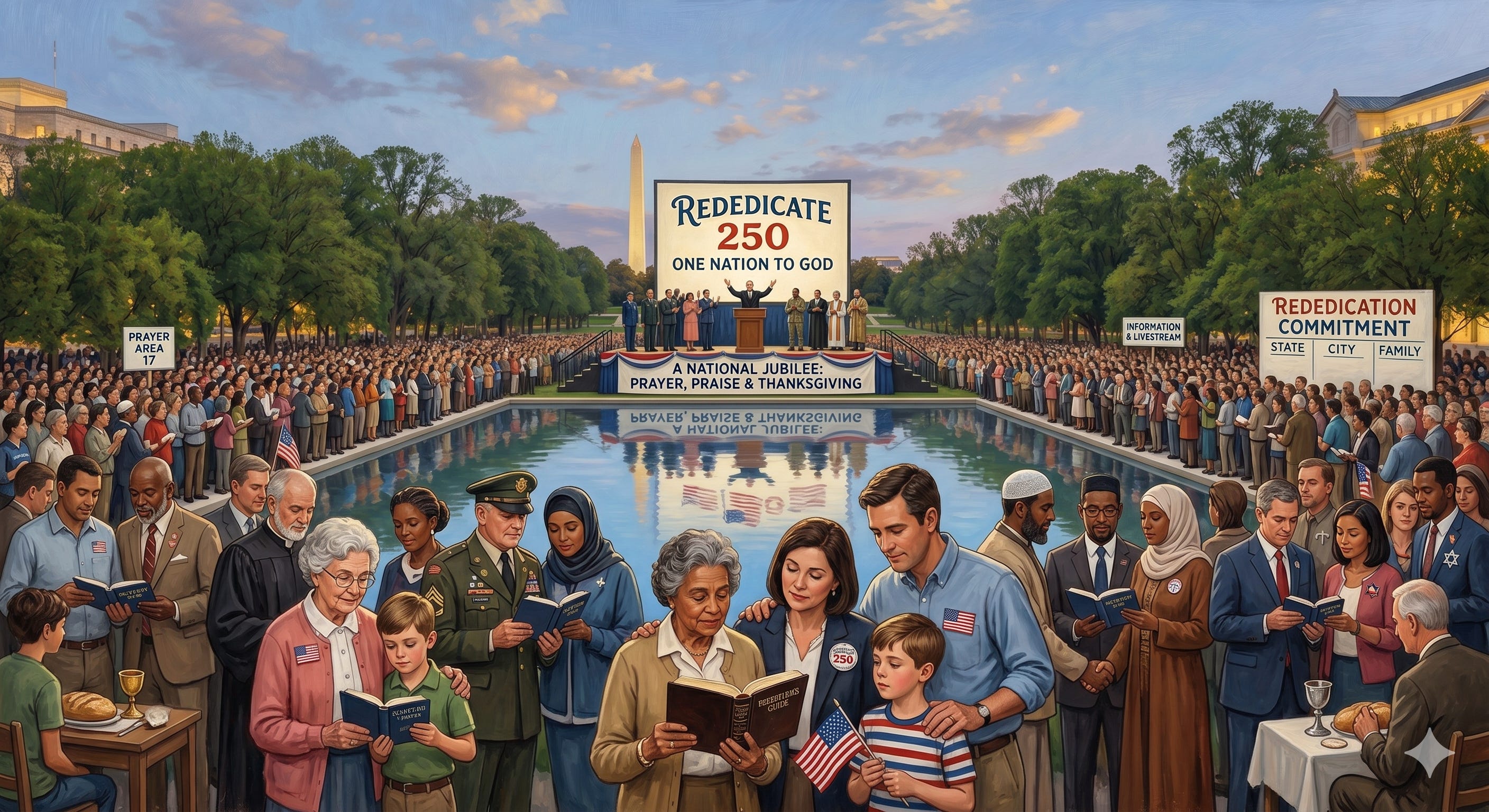
On Sunday, the National Mall will host what its organizers call a national jubilee of prayer, praise, and thanksgiving. The event is Rededicate 250, organized by Freedom 250, a White House-backed public-private partnership billing itself as a once-in-a-lifetime opportunity to “rededicate our country as One Nation to God.” Cabinet secretaries Pete Hegseth and Marco Rubio are scheduled alongside Cardinal Timothy Dolan, Franklin Graham, and Grammy-winning Christian musicians. The president extended the personal invitation at the National Prayer Breakfast. Two days before the semiquincentennial summer begins, the executive branch of the United States government is running a revival.
Website: Rededicate 250 – https://freedom250.org/celebration/rededicate-250-a-national-jubilee-of-prayer-praise-and-thanksgiving
The word at the center of this event deserves more attention than it has received.
“Rededicate” is not a neutral term. In Protestant theology, a dedication is a specific act with specific meaning. When parents bring an infant to the front of a congregation for a baby dedication, they are not merely expressing affection. They are presenting that child to God, making a public covenant, asking the church community to participate in raising the child in the faith. The child cannot consent. The community accepts a spiritual obligation. The act is serious, binding in intent, and assumes a relationship between the one being dedicated and a particular God. In Catholic and liturgical traditions, the act goes further still. In that context, dedication does not merely present; it initiates. It washes, marks, and incorporates. It changes the status of the one upon whom it is performed.
Now ask the question the organizers have not answered: which of these models applies to a nation?
If Rededicate 250 is a baby dedication in civic form, then the American people are being presented to God by their political leaders without their individual consent, with the assumption that the community, defined here as the nation, will participate in raising the country in the faith. If it more closely resembles a baptismal rite, the implications are graver still. Dedication does not ask. It acts. It confers a status. A government that baptizes, even metaphorically, a pluralistic republic of 335 million people into a specific religious covenant has not held a prayer service. It has made a theological claim about the nature of the state.
To be clear, this is not a call for reflexive suspicion. Americans of genuine faith have gathered on the Mall before, prayed over their country before, and asked God’s blessing on the republic before, and those gatherings have enriched rather than threatened the constitutional order. The First Amendment was never designed to scrub religion from public life. It was designed to ensure that no single tradition could conscript the machinery of government in its service. The distinction is real, it matters, and collapsing it in either direction does damage. Treating every expression of public faith as a constitutional emergency is its own kind of error, one that mistakes secularity for neutrality and ends up privileging irreligion over belief. That is not the argument here.
The argument here is more specific. It concerns the word “rededicate” and what it is doing in this sentence: “rededicate our country as One Nation to God.” The subject of that dedication is not the individual believer standing on the Mall with a flag and a hymnal. It is the United States of America. That shift, from personal piety to national covenant, from the gathered faithful to the entire republic, is not rhetorical flourish. It is a theological claim about what kind of entity America is, who speaks for it, and to whom it is accountable.
The organizers may intend something far more modest. A personal rededication, the kind preached in revival tents for two centuries, is an individual act of renewed commitment. If Sunday’s event functions in practice as an invitation for individuals to renew their own faith on a shared occasion, the First Amendment has room for that, and more. But the language of the event consistently collapses the distinction. Organizers describe a “unified moment of rededication” in which the country itself is being rededicated. Whether the ceremony honors that distinction or dissolves it is precisely what remains to be seen.
This is worth watching carefully rather than condemning in advance. Events of this kind reveal their theology in the details. The specific prayers offered, the language used by political officials from the stage, whether participants are asked to speak on behalf of the nation or only themselves, whether the diversity of American belief is acknowledged or simply absent, all of it matters. The First Amendment question will not be fully answered by reading the website. It will be answered by watching what actually happens when the Cabinet takes the stage and the music stops.
That is the kind of scrutiny a free press and an informed public owe to any event of this scale, offered not in the spirit of hostility to faith, but in the spirit of fidelity to a constitutional order that has served believers and nonbelievers alike for 250 years.
A Watcher’s Checklist: Constitutional and Religious Liberty Issues to Monitor at Rededicate 250
The following questions are offered in good faith, not as a brief for the prosecution. They are markers of a constitutionally significant event that citizens, journalists, and legal observers should track in real time, with the same rigor they would bring to any significant exercise of government authority, and with the same generosity they would extend to any expression of sincere religious conviction.
-
Government endorsement of religion. Do political officials speak in their personal capacity as believers, or do they speak on behalf of the United States government? Is the nation presented as having a religious identity, and if so, by whom and in what terms?
-
The scope of the dedication. Is the rededication framed as an individual act for those present, or as a corporate act performed on behalf of all Americans, including those who did not attend and did not consent? Who is the subject of the dedication, the gathered faithful or the republic itself?
-
Denominational representation. Are non-Christian traditions represented substantively, or only ceremonially? Does the program reflect the actual religious composition of the American public, which includes approximately 4 million Muslims, 7 million Jews, and a growing plurality of the nonreligious? Breadth here would be a genuine mark of civic seriousness.
-
Use of taxpayer resources. To what extent are federal agencies, federal personnel, federal platforms, or federal funding supporting this event? Is Freedom 250 operating with financial transparency, and can the public distinguish between private generosity and public expenditure?
-
The America250 question. Does this event coordinate with or further sideline the congressionally authorized America250 commission? The existence of a parallel structure outside congressional oversight is a legitimate governance question, separate from the religious one.
-
Presidential framing. Does the language surrounding the event imply that patriotic Americans are expected to participate in the religious act? There is a meaningful difference between a president saying “I invite you to pray” and a president saying “we are rededicating the nation.” The first is an expression of personal faith. The second is a claim of representative authority.
-
The historical account. How are the founders characterized from the stage? The founding generation was theologically diverse, and Jefferson, Madison, Franklin, and Paine held views that would disqualify them from membership in most of the congregations represented at Sunday’s event. Accuracy here is not an attack on faith. It is a service to it.
-
The morning after. What claims, if any, do organizers or officials make in the days following the event about what has been spiritually or politically accomplished on the nation’s behalf? The meaning of a dedication is often most visible in how it is subsequently invoked.
America’s 250th birthday deserves a celebration as large and as serious as the republic itself. Whether Sunday’s event serves that purpose, or narrows it, will not be determined by its critics or its promoters. It will be determined by what is actually said, sung, and consecrated on the Mall. Watch with open eyes and, where possible, open hearts.