The Weaponization of Faith: Cultural Anxiety and the Russian Trap
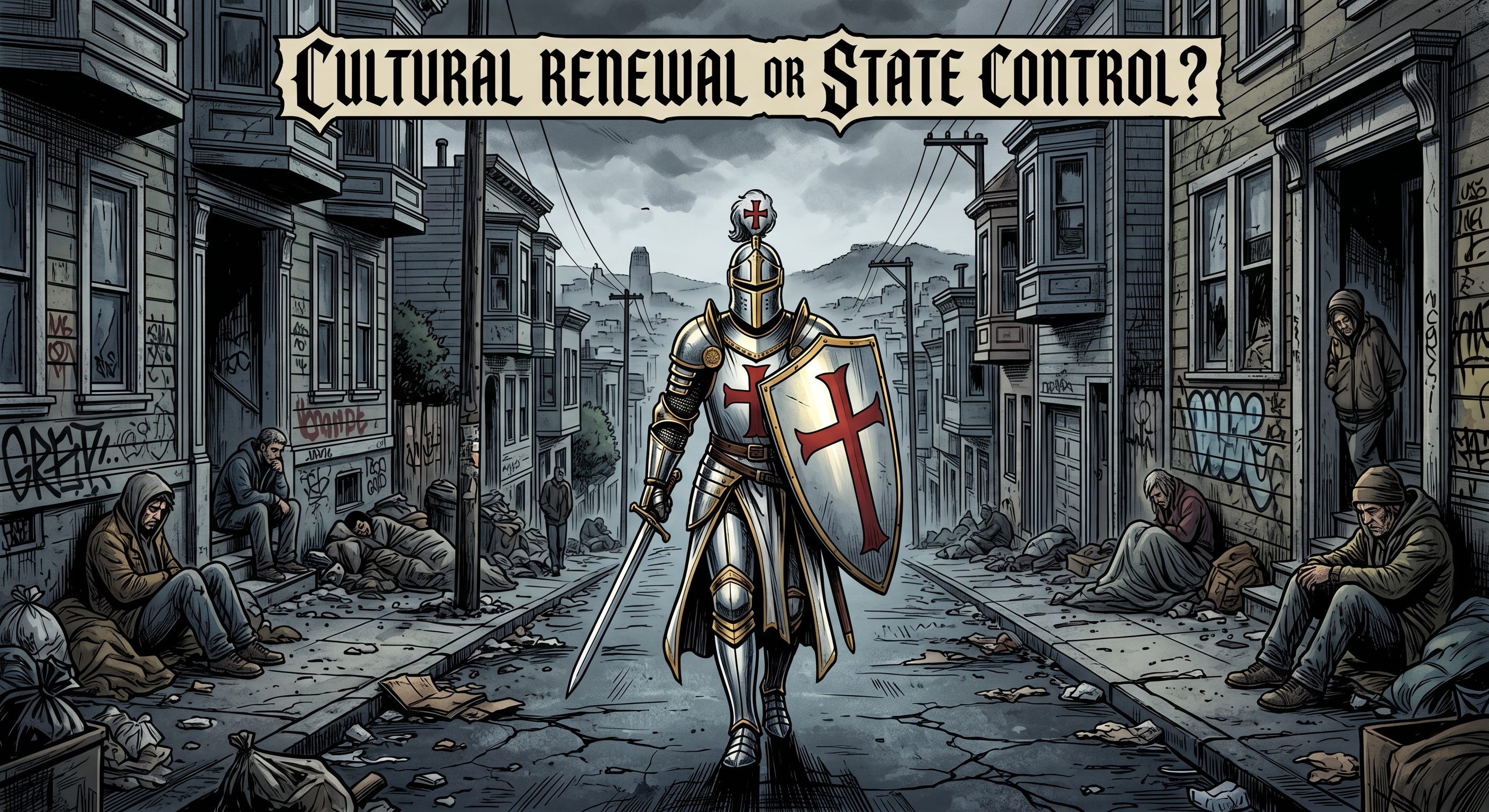
For millions of Americans, the feeling that their faith is under siege is not a mere political talking point. It is a visceral, lived experience. We look out at our streets and see a reality that is increasingly detached from the moral framework that once anchored this nation. We see a society where common sense has been discarded in favor of radical social engineering, exemplified by laws such as the New York statute that replaces the terms “mother” and “father” with “gestational” and “non-gestational parents.” We see our cities plagued by lawlessness and drug abuse, with zombie-like figures roaming our streets, a direct manifestation of a society that has abandoned the concepts of personal responsibility and runs roughshod over the fact that human beings are made in the image of God.
The diagnosis of decay is correct. There is a legitimate, burning desire to renew this country. It is perfectly reasonable to demand that the state fulfill its basic function of maintaining order and not dissolving it. A functioning state has an interest in ensuring that the rule of law prevails, that the streets are safe, and that the fundamental institutions of society, such as the family, are protected rather than systematically scrambled. In this sense, cultural renewal is a necessary state function. The government has an obligation to stop the slide into chaos and to uphold the basic moral baseline required for a republic to survive.
The Trap of the Political Convert
However, the danger arises when the desire for cultural renewal is conflated with the desire for religious renewal. We are seeing a new breed of political actors, people like Candace Owens and Tucker Carlson, who have spent their lives in the pursuit of political power and are now newly interested in the language of Christianity. For these individuals, Christianity is not a call to personal repentance or a surrender to the sovereignty of Christ. Instead, it is a tool for cultural warfare. They see in the state a weapon to be seized and used to enforce a “traditionalist” vision.
This is the Constantinian impulse. When Emperor Constantine converted, he did not fundamentally change his nature; he simply changed his toolset. He took a faith that had survived and flourished on the periphery and brought it into the center of the imperial throne. He taught the world that the church could gain the whole world if it was willing to trade its prophetic voice for the authority of the state. These modern converts are repeating this error. They are not looking for the Sermon on the Mount, which calls for turning the other cheek and living in radical love. They are looking for a political philosophy that validates their enemies list and offers them the machinery of government to crush their opposition.
The Old European Error
Glenn Beck issued a video warning today that this fascination with state-aligned faith is a dangerous regression to what he calls the Old European Error. Throughout history, European nations operated under the assumption that the throne must support the altar to keep civilization intact. This arrangement creates a hot house for faith. It produces a controlled environment where the church is kept warm by the state, but the plant itself inevitably dies. When the state forces people to profess a faith, it ceases to be a living, breathing conviction and becomes a mere department of the government.
The modern push toward a Russian-style authoritarian Christianity is the ultimate manifestation of this error. It is a siren song to the anxious American who is tired of losing the culture war. It tells them that they do not need to do the hard work of raising their own children, witnessing to their neighbors, or living out their faith in the quiet corners of life. Instead, it offers a shortcut: Align with a strongman, embrace the power of the state, and force the culture back into order.
But the state cannot produce religious renewal. The state can force a citizen to follow a law, but it cannot force a heart to worship. If we rely on the government to act as our savior, we will find that we have built a kingdom of men that is fragile, corruptible, and deeply opposed to the freedom of the spirit.
The Priesthood of All Believers
The true, revolutionary power of the Gospel is the exact opposite of this state-fused authority. The heart of the Christian faith is the doctrine of the priesthood of all believers. This is the radical, world-changing idea that every individual has direct, unmediated access to God through Jesus Christ.
The state wants a monolith. It wants a subject who bows to the flag and the altar simultaneously, with the government acting as the primary mediator of both. But the Gospel is between Christ and the individual. It is personal, internal, and inherently resistant to state control.
When the Apostle Peter wrote that Christians are a royal priesthood, he was asserting that no Emperor, no King, and no political strongman stands between the believer and their Savior. This is the very thing that the authoritarians of every age have feared most. They fear a citizenry that answers to a higher authority than the regime. They fear a people who believe that their conscience is captive to the Word of God, not the edicts of a political party or the mandates of any earthly ruler.
Revival, Not Revolution
If we choose the shortcut, the path of political power and the promise of a Christian Empire, we may find that we have sold our soul for a kingdom that was never God’s. We must reject the cheap tricks of the culture war and instead return to the rugged, individual, and deeply transformative power of the Gospel itself.
For freedom, Christ has set us free (Galatians 5:1). We must be careful not to surrender that freedom back into the hands of those who would use it to build their own worldly altars. The American way, forged by founders who understood the dangers of both state-mandated religion and godless secularism, is a harder road. It requires the slow, unglamorous work of governing our own appetites, strengthening our own families, and witnessing to our neighbors through persuasion rather than coercion.
The culture is broken, and the state must play its part in restoring order. But we must never mistake the restoration of law and order for the salvation of the soul. That work belongs to the individual. It belongs to the family. It belongs to the church. We do not need a Christian Prince or a state-approved church to save us. We need a revival that starts in the individual heart. We must remember that the Kingdom of God is not established by a legislative vote or a government decree. It is established in the hearts of those who have decided that they serve the King of Kings, and that they will never, under any circumstances, render to Caesar what belongs to Go
d.