Britain’s Smoke-Free Generation
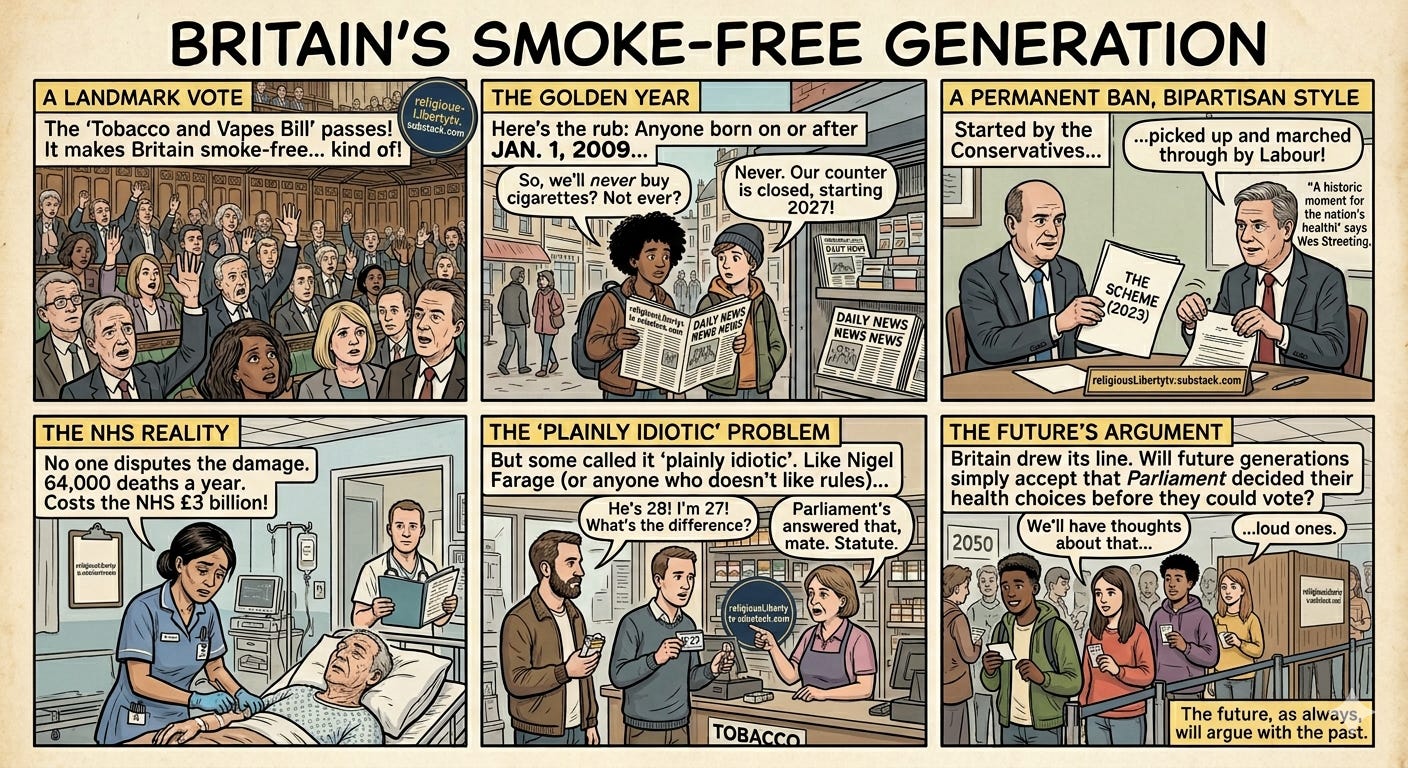
The Tobacco and Vapes Bill has cleared both the House of Commons and the House of Lords, and what it says, stripped of the parliamentary language and the press releases, is this: anyone born on or after Jan. 1, 2009 will never legally buy a cigarette in the United Kingdom. Not at 18, not at 45, not on their deathbed in some National Health Service ward while the rain hammers the windows and the morphine drip runs low.  The age restrictions kick in Jan. 1, 2027, and after that, the tobacco counter is closed to an entire generation. Permanently. By act of Parliament.
Let that settle for a moment.
The bill covers all four constituent countries — England, Scotland, Wales, Northern Ireland — and it awaits only the signature of King Charles III, who has already indicated he approves.  The King approves. Of course he does. Everyone approves of things that will never affect them.
The bill’s parentage is bipartisan, which is how you know the bureaucratic fever has truly taken hold. Rishi Sunak’s Conservatives cooked up the original scheme in 2023, then abandoned it before the election like a half-smoked cigarette dropped on the pavement outside a polling station. Labour picked it up, dusted it off, and marched it through Parliament under Health Secretary Wes Streeting, who called it “a historic moment for the nation’s health.”  Historic. Yes. So was Prohibition.
The numbers, to be fair, are not invented. Smoking produces 64,000 deaths per year in England alone, 400,000 hospital admissions, and costs the NHS roughly 3 billion pounds annually.  These are real bodies, real beds, real money hemorrhaging out of a system already held together with goodwill and underpaid nurses. No serious person disputes the damage. The argument was never about whether cigarettes kill people. Cigarettes obviously kill people. The argument is about who gets to decide, and Parliament has now answered that question with the full weight of statute.
Nigel Farage, who smokes and leads Reform UK with the energy of a man who has never been told no about anything, called the bill “plainly idiotic” and promised to repeal it if he ever reaches Downing Street. His specific objection deserves at least a moment’s acknowledgment: a decade from now, a 27-year-old will be legally prohibited from buying cigarettes in a shop where a 28-year-old standing beside him can buy as many as he likes.  That is genuinely absurd on its face, the kind of bureaucratic seam that makes libertarians foam and lawyers rich.
The counter-argument is that every age threshold produces exactly this neighbor-at-the-boundary absurdity. The 20-year-old who cannot drink legally in America stands next to the 21-year-old who can. We accepted that. We made our peace with the arbitrary line because the alternative was no line at all. Parliament is betting that the same logic applies here, permanently and for an entire generation.
New Zealand tried this first, passed the law in 2022, watched a more conservative government walk in and repeal it in 2023.  Britain has noted the lesson and pressed forward anyway, with 68% of the public behind them as of early 2025.  Democratic cover. The great narcotic of governance.
The bill reaches further than tobacco. Vaping is prohibited in cars carrying passengers under 18, in playgrounds, outside schools, and at hospitals. Vape advertising is broadly banned. Ministers gain new powers over flavors, packaging, and display.  The regulatory apparatus, once assembled, has a documented tendency to grow.
None of this touches the adults who smoke today. Their habits are grandfathered in, their tobacco perfectly legal, their slow voluntary transaction with the industry undisturbed. What Parliament has done is wall off the industry’s future customers — one specific generation, defined by birthdate — and called that public health.
Maybe it is. Maybe in 2050 some researcher will publish the data showing the lung cancer rates dropped, the NHS beds freed up, the years added to lives that would otherwise have burned away one filter at a time. Maybe Wes Streeting will be vindicated and Nigel Farage will be a footnote.
Or maybe a generation will grow up knowing that Parliament decided, before they were old enough to vote, what they would be allowed to put in their own bodies for the rest of their lives — and they will have thoughts about that. Loud ones. In whatever direction the political wind happens to be blowing when they finally get to the polls.
Either way, the law is on the books. Britain has drawn its line in the year 2009 and dared the future to argue with it. The future, as always, will.