Can a Teacher Secretly Facilitate a Student’s Religious Conversion?
A federal judge just cleared an Illinois history teacher who provided a Bible to a Muslim student and connected her with Christian converts without her parents’ knowledge. While the court ruled this was not “unconstitutional coercion,” the legal battle is far from over.
The parents now face a defamation trial for calling the teacher a “groomer” in the media, a case that could redefine the boundaries of parental rights and teacher influence in public schools.
Read the full analysis of Chaudhry v. Thorsen, including a hypothetical dissent, and see how it compares to high-profile gender identity disclosure cases.
Case Info: Chaudhry et al v. Community Unit School District 300 Board of Education et al Case No. 3:20-CV-50381 Date: March 18, 2026
What were the facts of the Chaudhry v. Thorsen case?
The dispute centered on Aliya Chaudhry, who attended Jacobs High School between 2017 and 2019. Aliya, raised in a Muslim household, testified that she had been questioning her faith her “entire life”. She approached Thorsen, a social studies teacher and faculty sponsor for a student led Bible group, because she viewed him as a “nice guy” who understood religion in a historical context.
During their interactions:
-
Thorsen answered Aliya’s questions about the Bible and Christianity.
-
He encouraged her to speak with her parents or an imam about her doubts.
-
At Aliya’s request, he provided her with a Bible given by a third party.
-
He connected her with community members who had converted from Islam to Christianity after she expressed fear of her parents’ reaction.
Aliya converted on November 14, 2018, asserting it was the result of her own research. When her parents discovered a Bible in her room in February 2019, they lodged a complaint, leading to Thorsen’s suspension and eventual resignation.
Why did the court dismiss the Establishment Clause claims?
Judge Johnston applied the “coercion test” to determine if Thorsen had unconstitutionally established religion. The court found no violation because Aliya was not a “captive audience”. To the contrary, she sought Thorsen out voluntarily and attended only a few meetings of the student led “Uprising” club.
The court noted that:
-
No religious activity was mandatory.
-
Thorsen’s actions did not involve school sanctioned prayer.
-
The teacher student relationship was built on a rapport where the student felt non judged, rather than pressured.
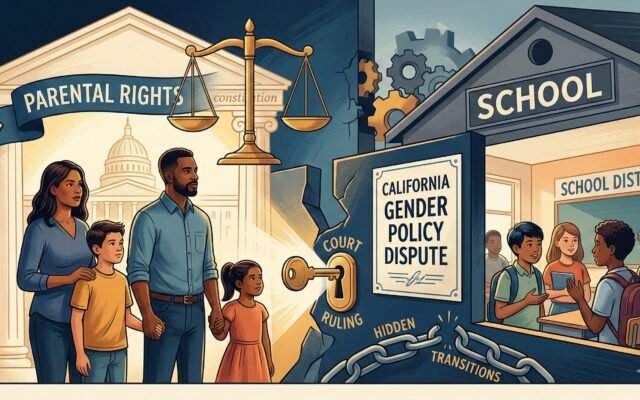
How does this compare to failure to disclose gender identity cases?
The Chaudhry ruling arrives amid a national legal shift regarding parent notification in schools. In cases like Foote v. Ludlow School Committee (2025), parents challenged school protocols that allowed students to change names and pronouns without parental notification. In Foote, the First Circuit initially dismissed parental claims, arguing that parents do not have a constitutional right to dictate administrative decisions of educators.
However, the Chaudhry case differs in a key legal aspect:
-
Active Concealment vs. Passive Response: In gender disclosure cases, parents often argue that schools have formal policies prohibiting staff from telling parents. In Chaudhry, the court found Thorsen acted individually and even encouraged the student to speak to her parents.
-
Constitutional Standing: The court in Chaudhry emphasized that “parents suffer no legal injury when their child uses his or her own free will and independent judgment” to change beliefs. This matches findings in cases like Mahmoud v. Taylor (2025), which explored the limits of teacher influence on young students.
What is the status of Thorsen’s defamation counterclaim?
The court denied summary judgment on Thorsen’s counterclaim for defamation per se. After the lawsuit was filed, the parents spoke to news outlets, using terms like “brainwashed,” “indoctrinated,” and “groomed”. Thorsen argues these statements damaged his professional reputation.
While the parents admit to using the word “brainwashed,” they claim “groomed” may have been the reporter’s interpretation. Judge Johnston ruled that a jury must decide:
-
Whether the parents actually published the word “groomed” to the media.
-
Whether “indoctrinating” or “brainwashing” a student is “substantially true” given Thorsen’s actions.
-
If these terms imply a lack of integrity in his professional duties.
Commentary
The court’s decision in Chaudhry correctly identifies the distinction between state coercion and individual mentorship. Under the First Amendment, a teacher does not lose their identity as a person of faith simply because they enter a public classroom. When a student initiates a conversation about religion, a teacher who provides honest answers is acting as a resource, not a state sponsored chaplain. The parents’ attempt to use the Establishment Clause as a sword to punish a teacher for a student’s independent change of heart was a bridge too far for the law.
The dismissal of the substantive due process claim also reinforces the reality that parental rights are not absolute once a child enters the public school system. The law protects parents from state mandated indoctrination, but it does not protect them from the marketplace of ideas that a high school naturally provides. If a teenager reads the Bible on her own and decides she prefers it to the Quran, the teacher who facilitated her access to that book has not stolen the child’s upbringing; he has merely assisted her in her own intellectual and spiritual inquiry.
The comparison to gender disclosure cases is where the legal tension becomes most apparent. We are seeing a divergence in how the courts treat social transitions, whether religious or gender based. While some courts are exploring notification requirements for gender identity changes, this district court found that a religious transition without immediate parental involvement did not rise to a constitutional violation. This suggests that the harm in gender cases is being viewed through a medical or psychological lens that the courts have not yet applied to religious choice.
The pending defamation trial will be the true reckoning. In the age of viral news, labels like “groomer” are professional death sentences. By allowing this claim to move forward, the court is sending a warning: parents have the right to sue, but they do not have a license to engage in character assassination when the facts do not support their narrative. The sting of those words will now be evaluated by a jury of peers.
Hypothetical Dissent*
*Not part of the court record, but provided here for educational purposes. Since this was at the trial level, it was one judge, but for the dissent we treat it like an appellate panel decision.
The court errs by minimizing the inherent power imbalance between a public school teacher and a teenage student. While the court characterizes Thorsen’s actions as a “passive response” to a student’s inquiry, the record shows a teacher who actively stepped outside his pedagogical role to facilitate a religious conversion in secret. By connecting a minor with external religious activists and providing sectarian texts behind her parents’ backs, Thorsen directly bypassed the domestic sphere where religious training belongs.
We must recognize that a teacher’s influence is a form of state power. When Thorsen used his position to validate one faith while questioning another, he crossed the line from educator to missionary. This is not merely answering a question; it is a targeted effort to reshape a child’s worldview using the prestige of the schoolhouse. The fact that the student “consented” is immaterial, as the state should not be in the business of recruiting minors for religious shifts.
The parental right to direct the religious upbringing of their children is a fundamental liberty interest that was substantially impaired here. The majority suggests that because the student was “questioning” her faith, the parents suffered no injury. This logic is dangerous. It implies that the state may intervene in the family unit whenever a child expresses doubt, effectively replacing the parent with a state actor as the primary moral guide.
Furthermore, the failure to notify the parents is a critical breach of trust. In the context of gender identity cases, courts are increasingly recognizing that parents have a right to know about significant shifts in their child’s social or mental state. Religion is no less significant. By hiding this process from the Chaudhrys, Thorsen ensured that the parents were unable to exercise their constitutional right to provide a counter perspective to their own child.
The equal protection analysis is also insufficient. Thorsen admitted that his decision to keep the parents in the dark was fueled by negative stereotypes regarding “honor killings” in the Islamic faith. When a state actor makes a discretionary decision based on such explicit bias, it is a textbook violation of equal protection. To say the parents were not “treated differently” when the teacher’s silence was motivated by his fear of their religion is to ignore the reality of discrimination.
Finally, the majority’s dismissal of the intentional infliction of emotional distress claim overlooks the profound mental anguish caused by this betrayal. The parents did not just lose a legal argument; they experienced the structural dismantling of their family’s spiritual heritage facilitated by a government employee. Because Thorsen’s conduct was willful and wanton in its disregard for parental authority, the state law claims should have proceeded to a jury.
Citations
-
Chaudhry et al v. Community Unit School District 300 Board of Education et al, Case No. 3:20-CV-50381 (N.D. Ill. Mar. 18, 2026).
Subscription Call: Like, share, and subscribe to ReligiousLiberty.TV for breaking news and case info. Subscribers get access to breaking news and case information.
Disclaimers: AI Disclaimer: This article was assisted by AI.
Legal Disclaimer: This does not constitute legal advice. Readers are encouraged to talk to licensed attorneys about their particular situations.