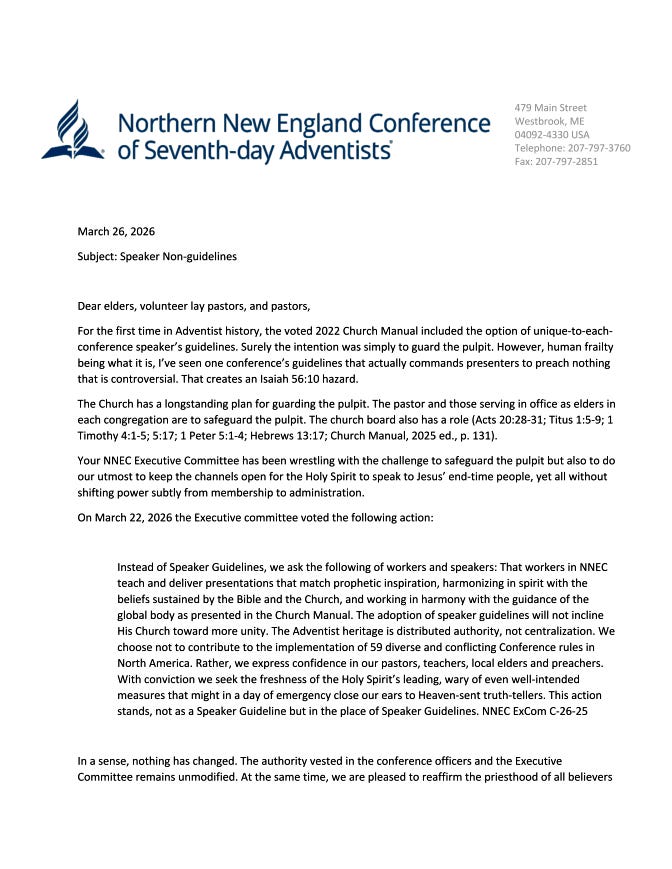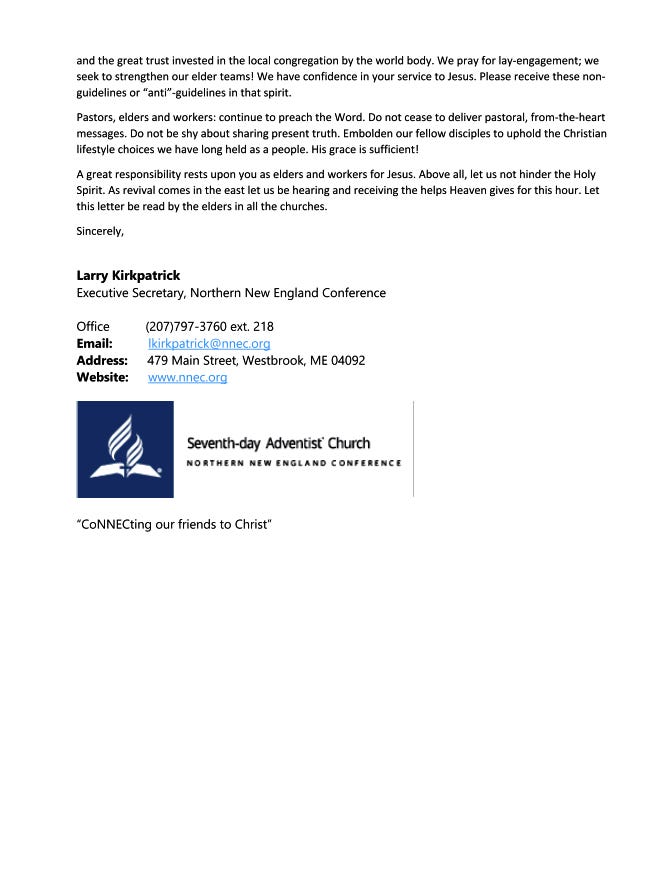
On March 26, 2026, Larry Kirkpatrick, executive secretary of the Northern New England Conference of Seventh-day Adventists, sent a letter to the conference’s elders, volunteer lay pastors, and pastors announcing a formal decision: NNEC would not adopt speaker guidelines. It would not circulate a list of approved or unapproved presenters. It would not, in effect, tell local congregations and their shepherds which voices were fit to enter the pulpit.
This is worth pausing over, because it cuts against the institutional grain. Since 2022, when the voted Church Manual gave conferences the option to create their own speaker guidelines, a number of North American conferences have done exactly that. Some have drawn up approval lists. Some have quietly made certain well-known Adventist ministers unavailable for local church events. And at least a few have adopted guidelines that, as Kirkpatrick’s letter put it, “actually command presenters to preach nothing that is controversial” — a requirement that would have disqualified the Advent movement’s own founders.
Kirkpatrick cited Isaiah 56:10, the passage about watchmen who are “dumb dogs” that cannot bark. The citation was pointed and precise. A speaker guideline that filters out controversy is not a safeguard for the pulpit. It is a muzzle on it.
The Creed Problem
Seventh-day Adventism emerged from the milieu of mid-19th century restorationism, a tradition that viewed formal creeds as instruments of ecclesiastical coercion. The early Adventist pioneers, drawing on their Methodist, Baptist, and Christian Connexion backgrounds, were united by a conviction that no human document should stand between a believer and the Bible. The famous phrase attributed to the movement, “No creed but the Bible,” was not a slogan. It was a position forged in direct reaction to the experience of being disfellowshipped, silenced, and expelled from other churches for following their reading of Scripture wherever it led.
A speaker approval list administered by a conference office is, in structural terms, a creed. It is a centralized authority deciding in advance which theological positions are safe for consumption by local church members. The congregation does not deliberate. The elders do not evaluate. The pastor does not exercise pastoral discernment. The conference has already decided, and the decision flows downward.
This is precisely the ecclesiological pattern the Adventist movement spent the 19th century resisting. The irony of re-creating it inside Adventist conferences, with speaker lists standing in for confessional statements, should not be lost on anyone who knows the denomination’s history.
What Other Conferences Have Done
The contrast with conferences like Michigan becomes instructive here. Michigan and several other conferences have moved to implement speaker guidelines that have functioned, in practice, to restrict access to ministers including Doug Batchelor of Amazing Facts and Stephen Bohr of Secrets Unsealed. Both men hold ministerial credentials. Both have decades of evangelistic work behind them. Both have arguably done more to bring new members into Adventist churches, and to retain members who might otherwise have left, than most conference-employed district pastors.
The objections to Batchelor and Bohr are of different views of theology within Adventism and stylistic, not ethical. Neither man has been credibly accused of moral failure or financial misconduct. The concern is that their preaching is too traditional, too confrontational, or insufficiently aligned with whatever the current conference administration considers the acceptable center of Adventist thought. That is a content-based objection, and when a conference encodes it into a speaker restriction policy, it is making a doctrinal ruling under the cover of an administrative procedure.
The case of Conrad Vine, former president of Adventist Frontier Missions, sharpens the point further. Vine preached at the Northern Maine Camp Meeting in August 2024, a lay-organized event within NNEC territory, and delivered a series of messages challenging church leadership’s COVID-era conduct and raising, in speculative terms, the prospect of a future lay network in the event of institutional compromise. Michigan Conference President Jim Micheff responded on Sept. 3, 2024, with a conference-wide ban prohibiting Vine from speaking in any Michigan church. That ban was subsequently extended to prevent Vine from speaking even at the Village Church in Berrien Springs, where he is a legitimately elected elder. When the Village Church held a business meeting, invited the conference to present its evidence, and voted not to place Vine under church discipline, Micheff issued a second edict. Then a third.
There is an acute irony in the geography here. Vine’s allegedly disqualifying sermons were preached in Maine, in the heart of the Northern New England Conference. The NNEC’s response in August 2024 was an unsigned letter from “conference leadership” that acknowledged the controversy without naming Vine and praised the camp meeting in the same breath. What the conference did not do was issue a ban. And what it voted in March 2026, a year and a half later, is a formal statement that it will not build the institutional machinery that made Michigan’s actions possible in the first place.
The Michigan situation also produced a significant collateral casualty: the pastor of the Village Church, Ron Kelly, was placed on ad0ministrative leave after Micheff concluded he was an obstacle to removing Vine from his church offices. A conference that came for a lay speaker ended up firing a past0or. The NNEC’s refusal to adopt speaker guidelines is, among other things, a refusal to hand conference administration that kind of lever.
The NNEC letter acknowledged this dynamic explicitly. The voted action from the conference’s Executive Committee on March 22, 2026 noted that Adventism’s heritage is “distributed authority, not centralization,” and that adopting speaker guidelines would not “incline His Church toward more unity,” the ostensible goal, but would instead contribute to a patchwork of 59 diverse and conflicting conference rules across North America. A minister vetted in one conference is effectively censured in another, without any formal adjudication, without due process, and without any doctrinal finding on the record. That is not accountability. It is administrative fragmentation dressed as it.
Trust the Local Church
The NNEC letter’s most durable argument is also its simplest: the local church is competent to evaluate what it hears. The pastor and the board of elders, the people who know their congregation and have responsibility before God for its spiritual welfare, are the appropriate gatekeepers for the local pulpit. The Church Manual has always said so. Acts 20:28-31, 1 Timothy 4:1-5, 1 Peter 5:1-4 — the texts Kirkpatrick cited — address pastors and elders directly. The authority to safeguard the pulpit is vested in the people closest to it, not in a committee in Westbrook, Maine, and certainly not in a conference office in Lansing.
Ideas that cannot survive scrutiny in a local Adventist congregation deserve to be challenged there. A congregation that hears a Batchelor sermon and finds it compelling is exercising exactly the kind of discernment the church claims to value. A congregation that hears one and finds it wanting can say so. The process works when the congregation is trusted to participate in it. It breaks down when a speaker list arrives from the conference and pre-empts the conversation before it begins.
This is not an argument for theological anarchism. Kirkpatrick’s letter was careful on this point: the NNEC is not telling its workers to ignore doctrine or to platform anyone who asks. The conference’s action asks that workers and speakers “teach and deliver presentations that match prophetic inspiration, harmonizing in spirit with the beliefs sustained by the Bible and the Church, and working in harmony with the guidance of the global body as presented in the Church Manual.” That is a substantive standard. It simply trusts the people responsible for each congregation to apply it.
What a Real Controversy Looks Like
The word “controversial” is doing a great deal of work in the conference speaker guideline debate, and it is worth examining what it actually means when conferences use it. In most cases, the controversial ideas being screened out are not departures from the 28 Fundamental Beliefs. They are positions on secondary issues, preaching styles that make administrators uncomfortable, or theological emphases that cut against whatever consensus the current conference leadership prefers.
By that standard, virtually every significant Adventist preacher in history was controversial. Ellen White was controversial. A.T. Jones was controversial. Desmond Ford was controversial — and when the church had an actual doctrinal dispute with him, it convened a formal process, made a finding, and acted on it. That is how the church is supposed to handle genuine theological controversy: openly, on the record, with the relevant parties present.
A speaker list is the opposite of that process. It produces the result of a doctrinal finding without the transparency or accountability of one. The minister whose name does not appear on an approved list has no hearing, no opportunity to respond, and no clear charge against him. He simply ceases to be invited. That is not church discipline. It is institutional avoidance, and it protects no one except the administrators who would rather not have the argument.
The Decision That Should Not Have Been Necessary
It is a mild absurdity that a conference had to formally vote not to adopt speaker guidelines. The default position should always have been trust in local pastoral leadership and confidence in the congregation’s capacity for discernment. The 2022 Church Manual change that created the option of conference speaker guidelines introduced a mechanism that, as the NNEC correctly observed, centralizes authority in a denomination whose entire heritage runs the other direction.
Kirkpatrick’s letter closes with a pastoral appeal to preach the Word, share present truth, embolden fellow disciples, and not hinder the Holy Spirit. “Let this letter be read by the elders in all the churches,” he wrote. It is the kind of thing a conference executive secretary might say in any generation of Adventist history. What is unusual is that it had to be said in response to a policy trend that would have struck most of those earlier generations as a capitulation to exactly the kind of institutional overreach they spent their lives pushing back against.
The Northern New England Conference got this right. The question is whether other conferences will notice.
Michael Peabody, J.D., is the founder, publisher, and editor of ReligiousLiberty.TV, a First Amendment and religious liberty journalism publication based in Los Angeles.
The full letter is available here: