
Turkish President Recep Tayyip Erdogan told the world Sunday, April 12, 2026, that Turkey could invade Israel.
“Just as we entered Karabakh, just as we entered Libya, we will do the same to them,” he said. “There is nothing to prevent us from doing it.” 
The remarks followed a Turkish court’s decision Friday to indict Netanyahu and 35 other Israeli officials for their role in the naval interception of the 2025 “Sumud” Gaza flotilla.  Turkey’s Foreign Ministry called Netanyahu “the Hitler of our time.”  Netanyahu fired back, accusing Erdogan of harboring Iran’s terror proxies. Defense Minister Katz called him a “paper tiger.” 
Loud week in the neighborhood.
The question worth asking before the prophetic analysis begins is whether Katz has a point. Is Erdogan a tiger at all, or simply a man who has learned that denouncing Israel plays well at home and across the Muslim world?
The honest answer is: both things are true, and that is what makes him interesting.
Turkey has the second-largest army in NATO, occupies a geographic linchpin between Europe and the Middle East, and carries significant economic weight.  Its Bayraktar drones have changed warfare across multiple theaters, and its military reach extends from North Africa to Azerbaijan and Pakistan.  With a pro-Ankara government now in power in Damascus following the fall of Assad, Turkey’s reach extends further into neighboring Syria, putting Turkish and Israeli forces in uncomfortable proximity over the Golan Heights.  Former Israeli Prime Minister Naftali Bennett, running for prime minister again and needing a threat to run against, has called Turkey “the next Iran,” arguing that Erdogan is building a Sunni axis that could prove more formidable than Iran’s Shia network. 
But there are serious reasons for skepticism. Chatham House analyst Yossi Mekelberg described Turkey as “so much noise” compared to Iran, warning that treating rhetorical friction as strategic threat risks making Turkey a genuine opponent through sheer threat inflation.  Scholars note that Erdogan is “a lot more pragmatic” and “a lot less ideological” than his Iranian counterparts: he condemned U.S.-Israeli strikes on Iran as a sovereignty violation, then in the same breath called Iran’s retaliatory missile strikes “unacceptable.”  This is not the behavior of a man driven by apocalyptic conviction. It is the behavior of a man playing multiple tables simultaneously.
His NATO membership is real leverage, but its limits are also real. Article 5 does not obligate members to respond with force; the treaty allows each state to take “such action as it deems necessary,” which can mean purely diplomatic gestures.  When Turkey had a military aircraft shot down by Syria in 2012, Ankara considered invoking Article 5 but ultimately settled for Article 4 consultations instead.  The alliance will not automatically go to war for Erdogan, and he almost certainly knows it. Meanwhile, U.S.-supplied NATO air defense systems recently intercepted Iranian ballistic missiles targeting Turkish territory, a reminder that for all his posturing, Erdogan still depends on the alliance he regularly antagonizes. 
So the invasion talk is almost certainly theater, calibrated for the Arab street and the Turkish electorate. What is not theater is the structural repositioning underneath it.
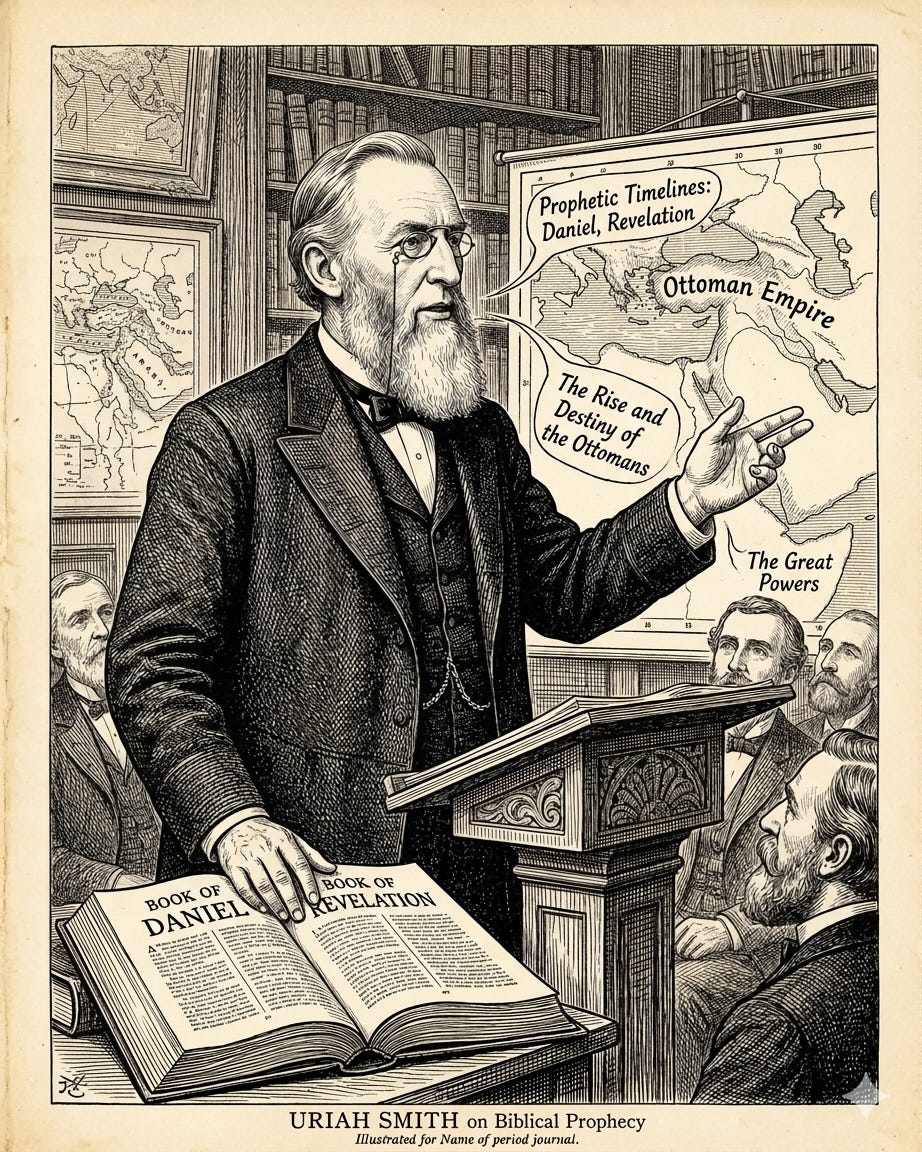
This is where a reader of Uriah Smith might want to sit down.
For most of the 19th century, Adventist expositors anchored Daniel 11:40-45 to Ottoman Turkey. The “king of the north” pressing toward the “glorious land” was, in Smith’s schema, the Turkish power centered in Constantinople. Ottoman decline became a prophetic marker. When the empire holding Jerusalem finally released its grip, the final crisis was near.
The Ottoman Empire collapsed in 1923. Most Adventist commentators moved on. Turkey secularized, joined NATO, briefly made peace with Israel. For decades that trajectory made Smith’s framework look like a relic of 19th-century newspaper exegesis.
Erdogan has spent twenty years complicating that comfortable conclusion.
Ankara halted all trade with Israel in 2024 and joined the genocide case against Israel at the World Court.  Erdogan has claimed Jerusalem belongs to Turkey. He shelters Hamas in Istanbul. He has deployed F-16s and air defense systems to Northern Cyprus.  He has threatened to block all NATO cooperation with Israel until Palestinian statehood is established.  These are not speeches. They are policy.
Here is where honest readers should pump the brakes, just slightly. Newspaper exegesis has a poor track record. Every generation since William Miller has been tempted to see its own crisis as the terminal one, and every generation has been partly wrong about the details while the broad arc continued. Precise prophetic mapping onto current events requires a humility that 19th-century Adventist editors did not always model.
The right posture is neither breathless certainty nor cultivated indifference.
What is observable, without forcing any schema onto it: a Turkish head of state, operating from an explicit Islamic civilizational framework, is threatening military action against the Jewish state, indicting its prime minister, extending military reach into Syria and Cyprus, and aligning diplomatically with the most openly apocalyptic government on earth. Unlike Iran, Turkey combines pragmatism with ideology, making it, in one analyst’s words, “both credible and unpredictable.”  That combination, a state with real military capacity, real NATO leverage, and a leader whose Islamic identity is genuine rather than performative, is arguably more significant than a purely ideological actor with a broken economy.
The editors who tracked Ottoman decline in the Review and Herald were not wrong to pay attention. They were wrong, sometimes, about the timing and the details. The instinct that events between the Euphrates and the Mediterranean carry prophetic weight was not a mistake.
Neither is it a mistake now.
Watch carefully. Hold conclusions loosely. Keep reading Daniel.