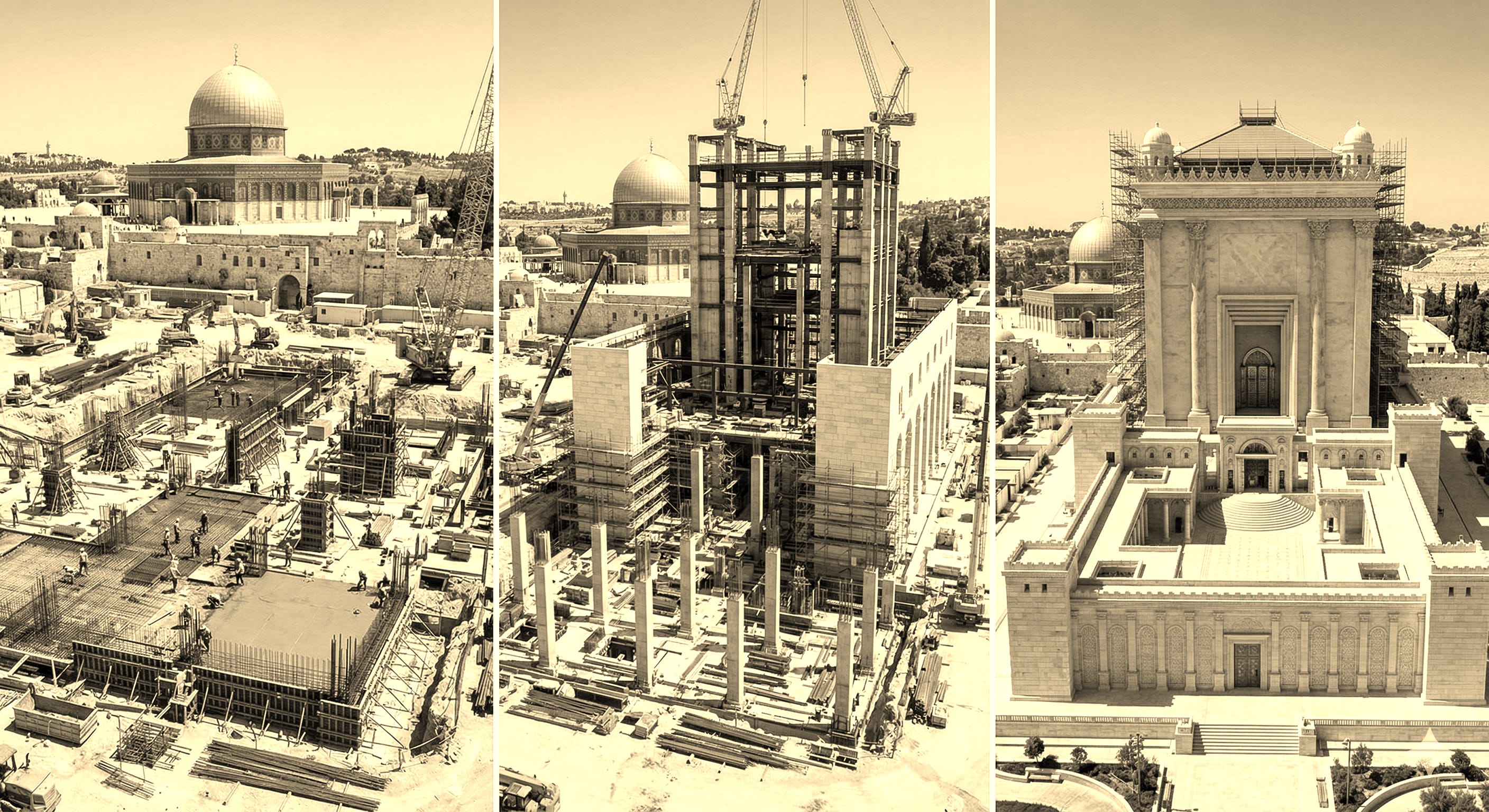
Editor’s Note: This article has been in development since early 2025, when ReligiousLiberty.TV first examined the Third Temple movement and its intersection with American politics. On February 28, 2026, Israel and the United States launched a joint military assault on Iran, an operation Israel codenamed “Lion’s Roar” and the Pentagon designated “Operation Epic Fury,” with strikes hitting Tehran, Isfahan, Qom, and other targets across the country. President Trump declared the objective was to destroy Iran’s military capabilities and ultimately topple the regime. Prime Minister Netanyahu called it the removal of an “existential threat.” Iran retaliated with missile strikes across the Gulf and against Israel. As smoke rises over Tehran and the region lurches toward wider war, the eschatological convictions explored in this article are no longer abstract theological curiosities. They are integrated with American foreign policy. The dispensationalist vision that requires the clearing of obstacles to a rebuilt Jewish Temple, the neutralization of Israel’s regional enemies, and the acceleration of prophetic timelines toward a final confrontation is not merely preached from pulpits. It is held by senior officials in the current administration, cheered by a political base that views Middle Eastern conflict through the lens of biblical prophecy, and enacted through military strikes that reshape the map of the region. Understanding the theology behind the Third Temple movement is now, more than ever, a matter of civic urgency.
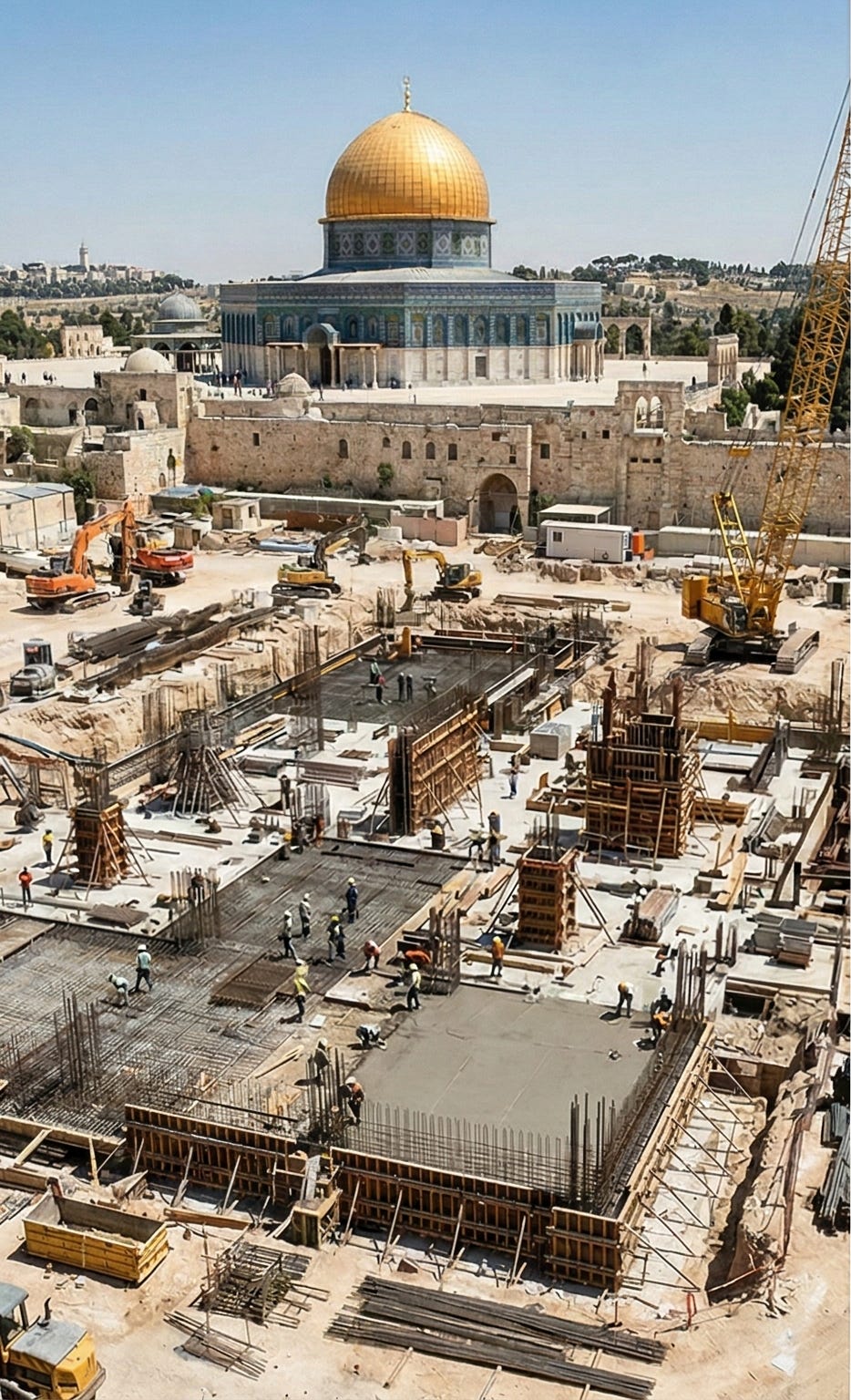
There is a peculiar species of friendship in which the benefactor is quietly planning your funeral. It smiles. It donates. It lobbies on your behalf in the halls of Congress. It ships cattle across oceans at great expense and whispers prayers for your prosperity. And yet, in the deepest chambers of its theology, it is convinced that the gift it gives you is a stage, not for your redemption, but for your destruction.
This is the friendship that a significant wing of American evangelicalism has extended to the State of Israel, and more specifically to the movement to rebuild the Third Temple in Jerusalem. To the casual observer (and, one suspects, to more than a few Israeli officials willing to accept political support from any quarter) this alliance looks like an uncomplicated expression of philo-Semitism. Christians who love Israel. Christians who stand with Israel. Christians who open their wallets and their voting booths for Israel.
But the theology beneath the surface tells a different story entirely. And it is a story that ought to unsettle anyone who pauses long enough to read the footnotes. As a previous investigation published by ReligiousLiberty.TV noted, the Third Temple movement represents a potential “collision between prophecy and realpolitik in the heart of the Holy Land,” one in which “what was once a fringe fantasy of religious zealots is increasingly voiced by influential figures” (see “The Third Temple: Prophecy, Politics, and the New Jerusalem Gambit,” ReligiousLiberty.TV, February 27, 2025).
The Seat of the Man of Sin
The scriptural passage that undergirds the entire evangelical fixation on a rebuilt Jerusalem temple is not a verse about hope, or glory, or the restoration of ancient worship. It is 2 Thessalonians 2:3-4, and it is a warning about catastrophe:
“Let no man deceive you by any means: for that day shall not come, except there come a falling away first, and that man of sin be revealed, the son of perdition; who opposeth and exalteth himself above all that is called God, or that is worshipped; so that he as God sitteth in the temple of God, shewing himself that he is God.”
Read that again. The temple that many evangelicals wish to see erected in Jerusalem is, in their own theological framework, the very place where the Antichrist will sit. Not Christ. Not the Holy Spirit descending in flames of Pentecost. The Antichrist, the “man of sin,” the “son of perdition,” enthroning himself in the Holy of Holies and declaring himself to be God.
This is not a marginal reading. It is the dominant eschatological position of dispensationalist Christianity, a theological system that has shaped the worldview of tens of millions of American believers through the writings of John Nelson Darby in the nineteenth century, the Scofield Reference Bible in the early twentieth, Hal Lindsey’s The Late Great Planet Earth in 1970, and Tim LaHaye and Jerry Jenkins’s Left Behind novels, which sold over 80 million copies and effectively became the systematic theology of American suburbia.
In the dispensationalist schema, the prophetic timeline runs as follows: Israel is regathered as a nation (1948, check), Jerusalem is recaptured (1967, check), the Temple is rebuilt (pending), the Antichrist rises to power, desecrates the Temple, the Great Tribulation commences, and finally Christ returns to put down evil and establish a literal thousand-year kingdom. The Temple is a necessary precondition for the apocalypse to proceed on schedule. Without a physical temple in Jerusalem, the “man of sin” has nowhere to sit.
This means that every dollar donated, every red heifer shipped from Texas, every political favor extracted from Washington to advance the cause of the Third Temple is, in the dispensationalist imagination, a step toward constructing a throne for the Beast.
The Dispensationalist Blueprint
The theological machinery behind this position did not exist before the 1830s. The early Church Fathers, from Irenaeus to Hippolytus to Augustine, held widely varying views on eschatology, but none of them proposed the elaborate timetable that dispensationalism now treats as self-evident biblical truth. The system was devised by John Nelson Darby, an Anglo-Irish clergyman who broke from the Church of Ireland and helped found the Plymouth Brethren movement. Darby’s innovation was to argue that God maintained two fundamentally separate programs, one for ethnic Israel and one for the Church, and that the prophetic clock for Israel had been paused at Daniel’s sixty-ninth “week” and would not resume until the Church was removed from the earth in a secret “rapture.”
This meant that the seventieth week of Daniel 9:27, which speaks of a prince who would confirm a covenant and then cause sacrifice and offering to cease, was not a prophecy fulfilled in the first century but an event still to come in the distant future. The “he” of Daniel 9:27 was reimagined as a future Antichrist who would broker a peace deal with Israel, permit the rebuilding of the Temple, and then, at the midpoint of a seven-year tribulation, enter the Temple and commit the “abomination of desolation” foretold by both Daniel and Jesus (Matthew 24:15).
C. I. Scofield embedded this framework in the margins of his enormously influential Scofield Reference Bible, first published in 1909. His footnotes effectively became as authoritative as the sacred text they glossed. By the mid-twentieth century, dispensationalism had become the default eschatology of Baptist, Pentecostal, and nondenominational churches across America. Hal Lindsey’s The Late Great Planet Earth, which sold over 28 million copies, translated Darby’s system into the language of Cold War anxiety and declared flatly that the generation alive in 1948 would see all these things fulfilled. The Temple was the next domino to fall.
It bears repeating: this theological tradition does not anticipate the Third Temple as a place where God will dwell in glory. It anticipates the Third Temple as a place where the Antichrist will declare himself to be God. The temple is not the climax of the story. It is the setup for the horror that precedes the climax.
Red Heifers from Texas and the Theater of Preparation
The most vivid illustration of how evangelical eschatological fervor has translated into concrete action is the matter of the red heifers. In September 2022, five red Angus heifers were flown from a ranch in Texas to Israel aboard an American Airlines Boeing 777, transported as “pets” to circumvent livestock shipping regulations. The operation was funded and organized by Boneh Israel, a joint Jewish-Christian organization, and overseen by Byron Stinson, a Texas businessman who describes himself as a Judeo-Christian and who splits his time between the United States and Israel.
The significance of the red heifer lies in Numbers 19:1-10, which prescribes that the ashes of an unblemished red cow, mixed with cedar wood, hyssop, and scarlet yarn and combined with spring water, are required to purify anyone who has come into contact with a dead body. Since all Jews living today are presumed ritually impure through contact with the dead, no priest can serve in a rebuilt Temple until this purification is performed. The red heifer is, in effect, the prerequisite to the prerequisite, the key that unlocks the door to temple worship, which in turn unlocks the door to the eschatological nightmare.
The Temple Institute in Jerusalem, led by Rabbi Chaim Richman, has spent decades preparing for the Third Temple. It has manufactured over seventy sacred vessels, including the golden menorah, the silver trumpets, and the gemstone-encrusted breastplate of the High Priest. It has trained Levitical priests. It has conducted architectural research. And it has searched, year after year, for a red heifer that meets the exacting biblical requirements: entirely red, without even two non-red hairs, never having borne a yoke, and free of any blemish.
The heifers from Texas were kept at the settlement of Shiloh in the West Bank, itself a site of profound biblical resonance, the place where the Tabernacle stood before David brought the Ark to Jerusalem. In July 2025, a practice ceremony was held on a remote hilltop in northern Israel, in which a heifer was burned on a pyre in preparation for the eventual official ritual on the Mount of Olives. The Temple Institute subsequently clarified that this was a training exercise and that the heifer burned did not meet the full biblical criteria. But the trajectory is unmistakable.
And here one must note the extraordinary irony that the evangelical Christians who have funded and facilitated much of this activity do not share the Temple Institute’s theological conclusions about what the Temple will mean. For the Temple Institute and its Orthodox Jewish supporters, the Third Temple represents the restoration of divine worship, the return of the Shekinah glory, and the dawn of the Messianic age. For the dispensationalist Christians writing the checks, the Third Temple is the stage upon which the most terrifying villain in all of Scripture will perform his blasphemous act.
As the theologian Craig Koester has observed, the dispensationalist system effectively defines prophecy as “history written in advance,” a script in which every actor must hit their mark. The Jews must rebuild the Temple, so that the Antichrist can defile it, so that Christ can return to destroy him. The Jews are not partners in this narrative. They are unwitting stagehands, assembling the set for their own betrayal.
Voices of Dissent: From Messianic Jews to Catholics
It is not only theologians in the abstract who have noticed this problem. Sandra Teplinsky, a Messianic Jewish author and founder of Light of Zion ministry, has written with rare candor about the discomfort that Israeli Messianic Jews feel toward evangelical enthusiasm for the Third Temple. In her article “Rebuilding Israel’s Temple: What Many Christians Do Not Know” (Light of Zion, May 2025), Teplinsky made a striking observation that many Christians overlook: “Whenever Scripture refers to a third temple, it is in connection with the anti-Christ. Nowhere in the Bible is there any clear indication that God will actually take pleasure in this particular temple.” She cited Daniel 9:25-27, Matthew 24:15, 2 Thessalonians 2:3-4, and Revelation 13:5-7 as the relevant texts, and noted that believers frequently confuse this third temple with the glory temple described in Ezekiel 40-47, which is architecturally and theologically a different structure entirely. The Ezekiel temple, Teplinsky pointed out, would measure approximately one square mile, while the entire Old City of Jerusalem currently measures only about one-third of a square mile. It cannot possibly fit on the present Temple Mount.
Teplinsky raised a further concern that goes to the heart of the evangelical-Jewish alliance: “When the temple is rebuilt and animal sacrifices resumed, they will think of Him as more irrelevant or inapplicable to them, the Jews, than ever.” In other words, a rebuilt temple does not bring Jews closer to Christ. It gives them reasons to look away from Him. She also observed that “religious Jews expect their messiah to be entirely human, not divine, and a charismatic man who achieves global peace,” a description that, she noted, fits the biblical profile of an end-times Antichrist. Her counsel to Christians was blunt: “We should neither strenuously support nor vigorously oppose the rebuilding of Israel’s temple,” but should instead pray for discernment, “especially for overly zealous believers who vigorously support rebuilding the temple in a mistaken attempt to hasten the Lord’s return.”
The Catholic tradition has been equally direct, if from a different theological vantage point. Catholic365.com published an analysis noting that for Catholics, “the Third Temple is already built, it’s the Catholic Church of the Apostles, Christ’s body,” and that to re-create a Jewish Temple with the sacrificial system would “signal that you don’t believe the Church is the Temple which offers the pure sacrifice of the Holy Eucharist” (”Why Some Christians Are Helping Build a Third Temple in Jerusalem,” Catholic365.com). The article noted the “weird alliance” between Jewish temple activists and dispensationalist Christians, both of whom are working toward the same construction project for diametrically opposed theological reasons.
The traditional Catholic site Catholicism.org went further, publishing a piece in February 2025 titled “Why Christians Cannot Support the Creation of a Third Temple in Jerusalem,” which argued that the construction of such a temple would constitute “an affront to heaven, rejecting the redemption offered by Christ.” The article summarized the theological case: Jesus redefined the concept of the temple by establishing his mystical body, the Church, as the place where God dwells within believers. A return to animal sacrifice and Mosaic ritual would represent not the fulfillment of prophecy but the repudiation of the Cross. The Catechism of the Catholic Church itself warns of a “supreme religious deception” before the Second Coming, in which the Antichrist brings about “a pseudo-messianism by which man glorifies himself in place of God” (CCC 675), and the article noted pointedly that no mention of a literal temple appears in this formulation.
These voices, from Messianic Jews, Catholics, and Adventists alike, converge on a single uncomfortable conclusion: the evangelical project of helping to rebuild the Third Temple is not the straightforward act of friendship to Israel that it appears to be, and it may not even be good theology by the standards of those doing the building.
Coming in Part Two: The theology is one thing. The politics are another. When the Secretary of Defense speaks of “miracles” leading to the Temple’s reconstruction, when a U.S. Ambassador insists on calling the West Bank by its biblical names, and when the most powerful military in human history acts in alignment with a prophetic timetable, the Third Temple ceases to be a matter of eschatology alone. It becomes a matter of foreign policy. Tomorrow: how the dispensationalist blueprint migrated from prophecy conferences to the Pentagon, what the Jewish community actually thinks about their evangelical benefactors, and the moral calculus of “stage-setting” for the apocalypse.