The Crooked Diamond: How Slave Traders Reshaped the Nation’s Capital
This article is part of ReligiousLiberty.TV’s ongoing series marking the 250th anniversary of the United States, examining the constitutional compromises, legal ambiguities, and democratic deficits that have shaped American governance from the founding to the present.
By Michael Peabody –
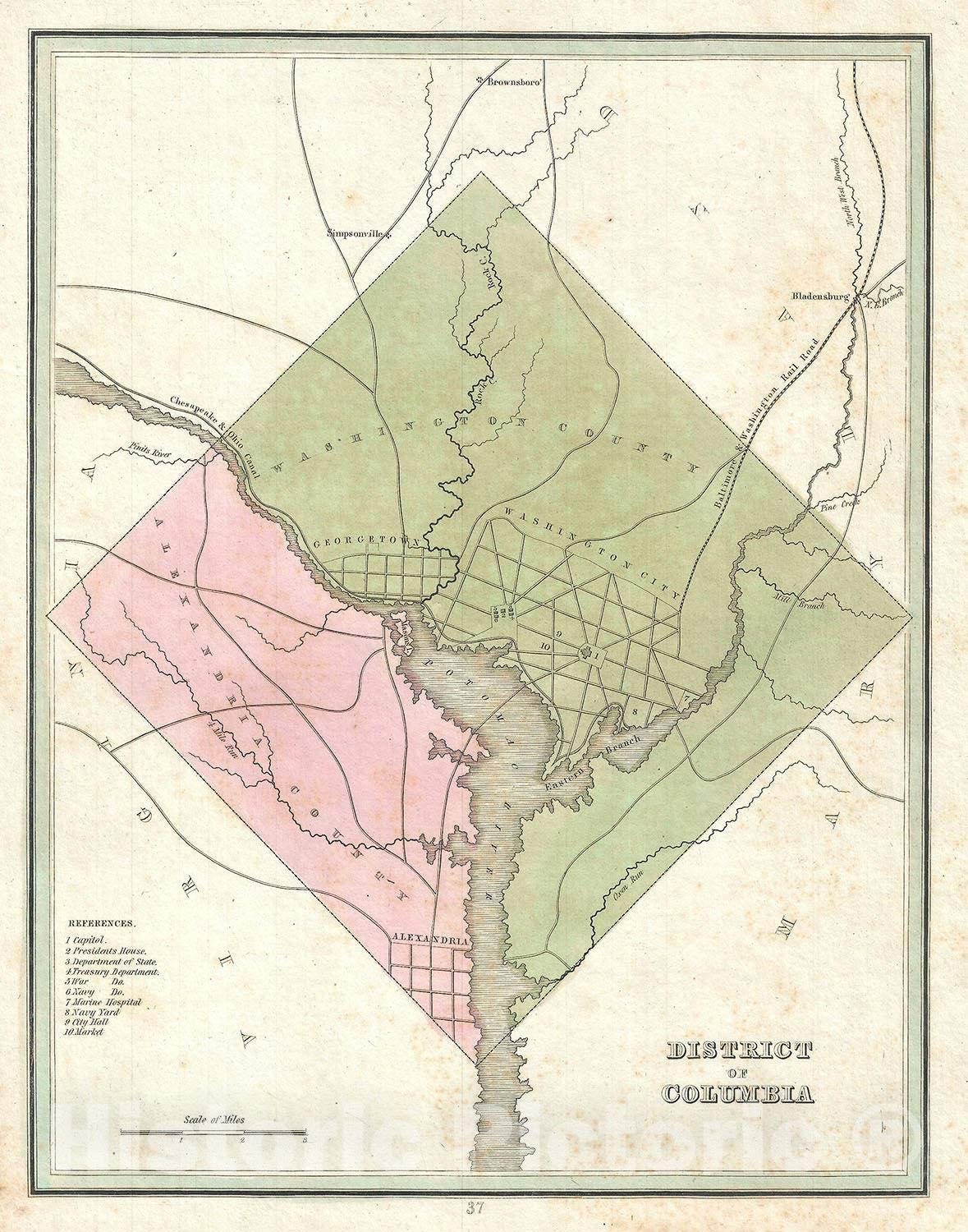
Washington, D.C., is shaped like a diamond with a chunk missing from the lower-left corner. Most Americans have never noticed. The ones who have tend to assume it was always that way. It was not.
The original federal district, authorized by the Residence Act of 1790 and surveyed beginning in 1791, was a perfect 10-mile square straddling the Potomac River, 100 square miles drawn from both Maryland and Virginia. The Maryland side contained the city of Washington and the port of Georgetown. The Virginia side contained Alexandria and what would become Arlington County. The framers envisioned a capital of imperial scale. What they got was a municipality that, within two generations, had quietly surrendered a third of its territory and never asked for it back.
The Virginia retrocession of 1847 was not a crisis. It was a real estate transaction dressed in constitutional language. Virginia’s portion of the district had been promised a federal arsenal, a national university, and a commercial waterfront to rival Georgetown. None of it materialized. Alexandria merchants watched federal development flow north and east. Slave traders in Alexandria, meanwhile, had a more pressing concern: the district had banned the slave trade within its borders in 1802, and abolitionists in Congress periodically threatened to abolish slavery in the district entirely. A return to Virginia, where the institution was entrenched and the legislature sympathetic, offered insurance against that threat.
Congress complied. By a simple act of legislation, with no constitutional amendment and no popular referendum in the district itself, approximately 31 square miles reverted to Virginia on July 9, 1847. The affected residents of Alexandria and Arlington had voted narrowly in favor. The residents of Washington proper, whose city would be permanently disfigured, were not consulted.
The constitutional basis for retrocession was, and remains, contested. Article I, Section 8 of the Constitution grants Congress exclusive jurisdiction over a district “not exceeding ten Miles square,” language that contemplates the district’s creation but says nothing about its dismemberment. The framers did not anticipate that Congress would give territory back. Legal scholars who have examined the question generally conclude that what Congress can create, Congress can modify, and that the retrocession was valid if irregular. No court has ever ruled otherwise, in part because no court was ever asked to.
The question today is whether the retrocession should be reversed, and here the politics are considerably messier than the history. Arlington County is now one of the wealthiest jurisdictions in the United States, home to the Pentagon, Amazon’s second headquarters, and a Democratic-leaning electorate that, in a certain irony, probably agrees with the politics of district statehood more than it agrees with returning to a district that cannot vote in Congress. Alexandria, similarly, has transformed from a slave-trading port into a prosperous Virginia city with its own identity, its own government, and little enthusiasm for re-annexation.
The district statehood movement has never seriously pursued retrocession reversal as a strategy, and for obvious reasons. The path to statehood runs through Congress, not through Virginia’s General Assembly. Retrocession reversal would require Virginia’s consent, congressional legislation, and a plausible argument that the move serves some contemporary public interest beyond historical symmetry. None of those conditions currently exist.
There is, however, a narrower argument worth taking seriously. The district’s permanent non-voting status in Congress, the condition that statehood advocates rightly call a democratic anomaly, was made structurally worse by the 1847 retrocession. Had the Virginia cession remained, the district’s population would be larger, its economic base broader, and the political case for representation harder to dismiss. The crooked diamond is not merely an aesthetic curiosity. It is a monument to a decision made, in part, to protect human bondage, and its jagged edge still marks where democratic accountability was quietly traded away.