I. When the Music Stopped
Picture the garden at that moment.
Not when everything was good. After. The moment after.
Adam and Eve walked east. And you notice they did not run. Nobody runs when everything behind them is being taken away. You walk. The way you walk away from a grave. Slowly. Because there is nowhere to go fast to.
The garden they had called home stood behind them like a room where someone had turned out all the lights.
And at the eastern gate, God placed something He had never placed there before.
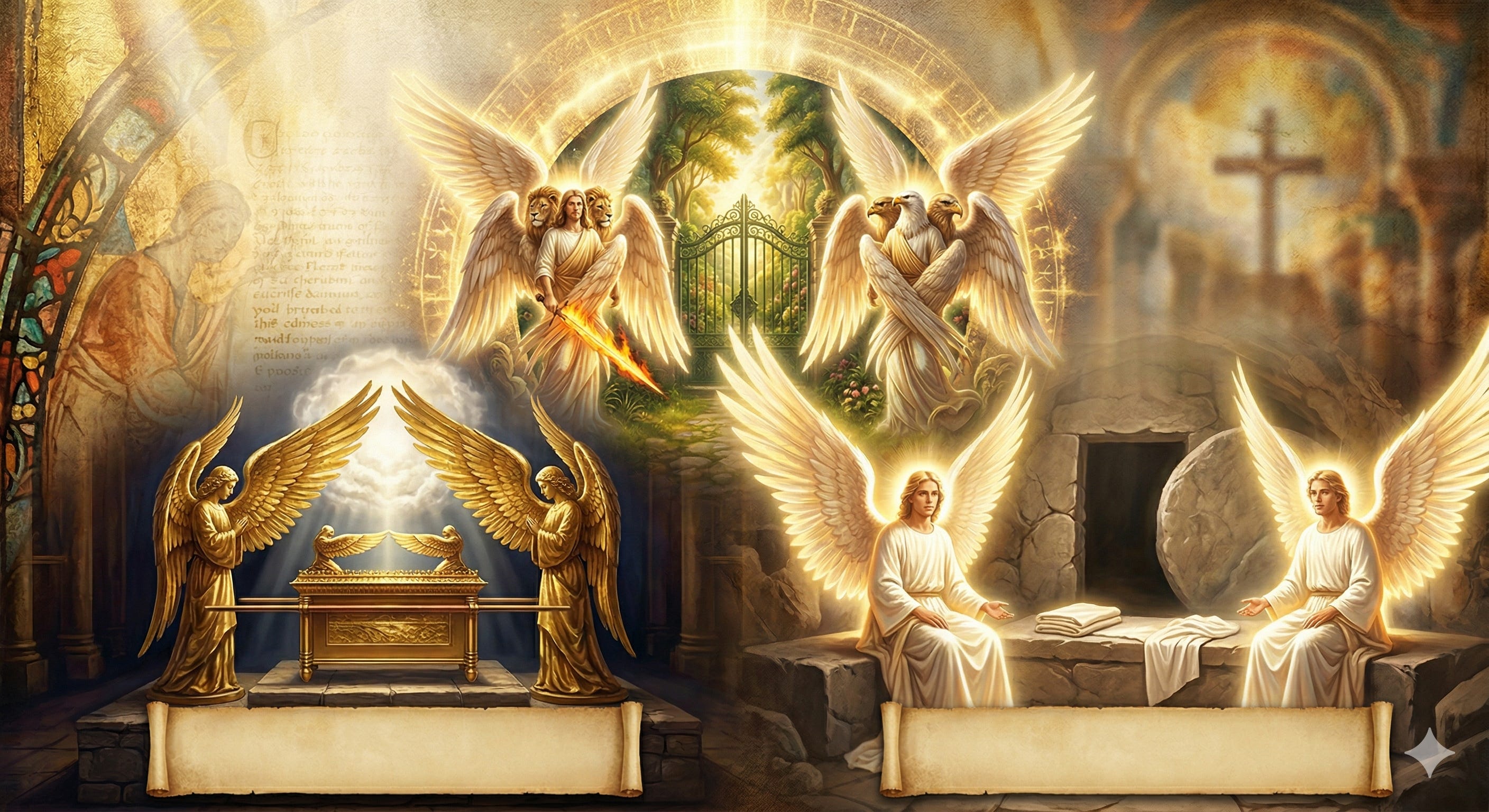
He drove out the man, and at the east of the garden of Eden he placed the cherubim and a flaming sword that turned every way to guard the way to the tree of life. (Gen. 3:24)
Two cherubim. A sword of fire, spinning, covering every angle. No gap. No unguarded hour. No dark corner where someone desperate might slip through.
Now, you could read that as punishment. Most of us do. But I want you to look again. Look at what He is actually guarding. Not the garden. Not His own dignity. He is guarding the Tree of Life, the source of immortality itself. And His stated concern in verse 22 was not that human beings had grown too powerful. His concern was something more heartbreaking than that. He was concerned that they might eat from that tree and live forever in their broken condition. Carrying their wounds into eternity. The fracture dragging on without end, with no possibility of healing.
The flaming sword was not His anger. It was His mercy, dressed in fire. It was a promise wearing the face of a warning. It said: Not yet. Not like this. Not until the wound can be healed.
The cherubim at Eden were not God’s fury made visible. They were His love on guard duty. And the sword kept turning in the dark.
II. Between the Wings
Centuries went by. Nations rose and collapsed. And then Moses came down a thunderstruck mountain carrying stone.
The Law. The full record of what God required and what humanity had already failed to keep.
God gave instructions for a box to hold those stones. Acacia wood, overlaid with gold. And on the lid, two hammered-gold cherubim, wings spread upward, faces turned toward each other, looking down at the surface between them. That surface had a name. Kapporet. The mercy seat.
There I will meet with you, and from above the mercy seat, from between the two cherubim that are on the ark of the testimony, I will speak with you. (Ex. 25:22)
Read that address carefully. From between the two cherubim. The God of the universe, the One who called the galaxies by name, chose a specific address on earth where His voice would be heard. Not the summit of Sinai. Not the open sky. Here. This lid. Between these two gold figures.
But do you understand what is inside the box? Directly underneath that mercy seat? The Law. Every commandment broken. Every promise unkept. The full indictment, stored directly under the place where God would meet with His people.
Once a year, the high priest walked into the Most Holy Place. Trembling, I am sure. He carried blood, not his own, the blood of a sacrifice, and he sprinkled it across the mercy seat. Over the Law. Covering the record. The whole camp held its breath outside until he came back out alive.
Year after year. The same ritual. The same hush. The same long exhale of relief.
The cherubim on the mercy seat were a signpost, not the destination. The location was right. The moment had not yet come.
III. A Weight the Legs Could Not Hold
Solomon built God a house.
Seven years. Thirty thousand laborers. Cedar and cypress and stone quarried and cut and fit together. Gold pressed onto everything you could see with your eyes.
In the innermost room, the Most Holy Place, Solomon placed two cherubim of olivewood. Not small figures. They stood fifteen feet tall, with wingspans stretching thirty feet combined, tips reaching from wall to wall, one unbroken canopy of wood and gold across the entire room.
And then the day came to dedicate it all.
A cloud filled the house of the LORD, so that the priests could not stand to minister because of the cloud, for the glory of the LORD filled the house of the LORD. (1 Kings 8:10–11)
The priests had to leave. Not because they were frightened or unwilling. They had to leave because the glory of God filled that room with a weight human legs simply could not support. They walked out on shaking knees, and I think at that moment they finally understood what they had built.
The cherubim faced outward, toward the worshipers making their way in from the nave. And their posture communicated what no sermon needed to say: You are approaching something your body was not designed to withstand.
For centuries, the cherubim kept watch from the darkness of the inner room, wings spread wide, still delivering the same message Eden had delivered, the same message the mercy seat had been delivering:
Not yet.
But something was coming.
IV. The Day the Sword Finally Falls
One Friday, He hangs on a cross.
The One the mercy seat had been pointing toward for a thousand years is now fulfilling what that mercy seat could only shadow. Not the blood of an animal carried in trembling hands, but His own. In His own body. Applied once. The writer of Hebrews will say it plainly: once for all. No repetition necessary. No next year’s Day of Atonement required.
Matthew tells us that at the exact moment He breathed His last, the veil of the Temple, that thick curtain that had stood between the Most Holy Place and the world for a thousand years, tore from top to bottom. Not from the bottom up, which is how a man tears something. From the top down. God tore it Himself.
The cherubim’s long vigil as gatekeepers ended in that moment. Not yet became now. The flaming sword that had been turning at the gate of Eden since the day it was lit, it had been waiting for precisely this.
The price was paid that Friday. Sunday is when the receipt arrives.
V. The Morning the Guard Came Down
Her name was Mary. She came to a tomb before sunrise.
She had been there when they took Him down from the cross. She had watched the stone roll into place with a sound that seemed to close not just a tomb but an entire world. She had endured the longest Sabbath of her life, waiting for Sunday for no better reason than there was nothing else left to wait for.
When she arrived, the stone was already moved. Peter and John ran ahead of her, looked inside, and left in confusion. The burial cloths were lying there undisturbed, still holding the contour of the body that had passed through them the way light passes through glass. And John adds one detail so precise it could only come from someone who actually saw it: the face cloth had been folded and set to one side.
Folded.
This is not what a tomb robbery looks like. Thieves don’t fold.
Mary stood outside and wept. Then she bent down and looked in.
She saw two angels in white, sitting where the body of Jesus had lain, one at the head and one at the feet. (John 20:11–12)
Two angels. One at the head. One at the feet.
Can you feel that echo?
One at the head, one at the feet. Flanking a sacred space. Marking a threshold. Two heavenly beings, positioned at the holiest ground on the planet.
At Eden, two cherubim flanked the way to the Tree of Life, and a sword of fire turned between them, and no one passed. At the Ark, two cherubim of hammered gold faced each other across the mercy seat, and only blood made entry possible. At Solomon’s Temple, two cherubim of olivewood spread their wings over the glory, and the priests could not stand.
And now, in a garden tomb, two angels sit quietly. One at the head. One at the feet. No sword. No fire. No blood in trembling hands. No glory so heavy it drives you to your knees.
Just a folded cloth. An empty shelf. And two angels who are not guarding anything, because there is nothing left to guard.
Death came here. Death is gone.
Here is something I want you to notice. In all of Scripture, no guardian ever speaks to a human approaching the threshold. The cherubim at Eden did not ask Adam why he was walking away. The cherubim at the Ark did not address the trembling priest. The cherubim in the Temple were silent in the dark. Guardians do not need words. Their presence is the message: Stay back. Not yet. Come no closer.
But these two asked Mary why she was weeping.
Because the guard had come down. Because not yet, after all the centuries and all the blood and all the long, patient waiting, had finally become now.
VI. What the Empty Tomb Is Saying
Mary turned from the angels and saw a man she assumed was the gardener.
The gardener. Standing in a garden. On the morning the world began again.
The first garden had a gardener too, and his name was Adam, and he walked east past the cherubim and never came back. And now in this garden, the second Adam stands in the morning mist. And when He speaks her name, just that, Mary, she knows.
The cherubim of Eden had said: the Tree of Life is closed to you. The risen Christ says: I am the resurrection and the life.
The cherubim on the Ark had said: you come here only through blood, once a year, in fear. The risen Christ says: It is finished.
The cherubim in the Temple had said: the glory in this room will put you on your knees. The risen Christ says: Do not be afraid.
We forget. That is the honest truth about us. The world still feels like the east side of Eden. Still feels like exile. Still feels like something heavy we cannot push through on our own. The people we love get sick. The nights get long. The years don’t pause.
But the guard has come down. The sword is sheathed. The veil is gone. The mercy seat has been satisfied, once and finally. And the stone wasn’t rolled away to let us into the tomb. It was rolled away to show us He was already out.
The tomb is not a tragedy with a surprise ending. It is a promise that took time to be delivered. The cross is the cost. Easter is the receipt. And on a Sunday morning, in a garden, the delivery arrived.
Two angels. One at the head. One at the feet.
Not guarding the way in.
Witnessing the way out.
And in that difference, friend, is everything.