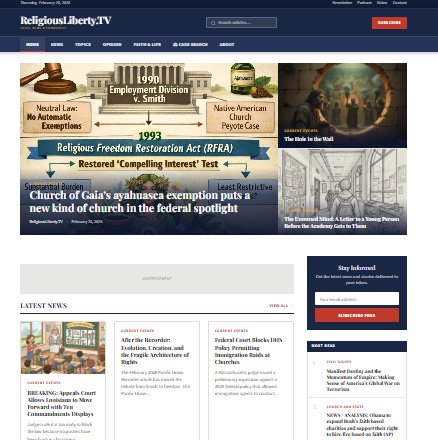

You’ve been reading our coverage for years. You know that religious liberty law moves fast — a circuit court ruling in the Ninth, a SCOTUS cert grant, a fresh employment discrimination case working its way up from a state court. Each story matters. But keeping track of how they connect — which cases cite which precedents, which ruling opened the door for the one you’re reading about today — that’s always been the hard part.
We decided to do something about it.
Over the past several weeks, we’ve been quietly building a set of tools directly into ReligiousLiberty.TV (our website – not the Substack that you’re reading) that we believe will change how you research, read, and follow this area of law. Today we want to tell you what we’ve built, invite you to explore it, and be honest with you about where it’s going.
What’s New
A Legal Case Library, built from our own coverage
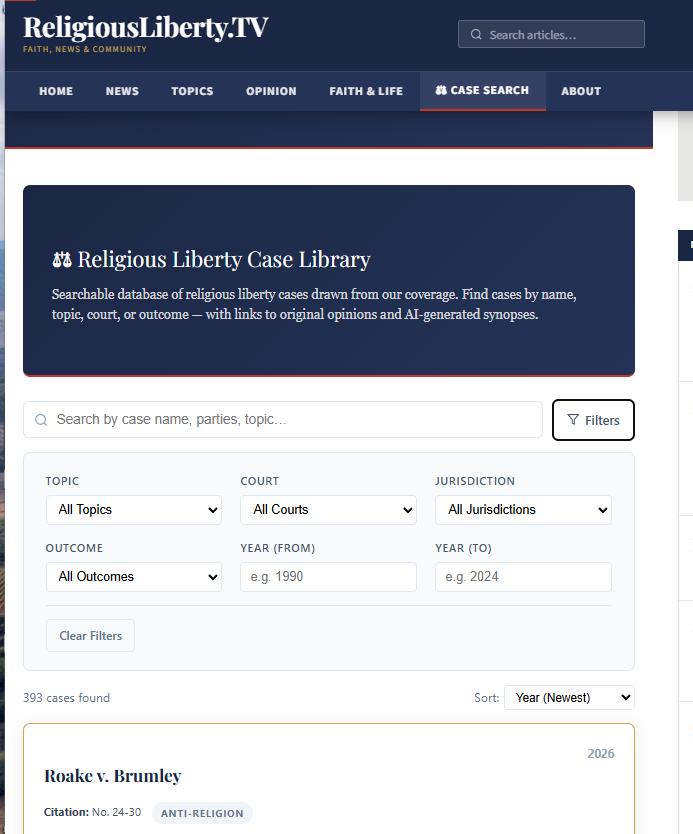
Every article we’ve ever published has now been scanned for legal case references. The result is a growing database of cases — SCOTUS decisions, circuit court rulings, district court opinions, state court decisions — each with its own dedicated page on the site.
Each case page includes:
-
The official case name and citation
-
The court that decided it and the year
-
A one-sentence holding
-
Links to the original opinion — the actual PDF or official text from CourtListener, Oyez, Justia, or the Supreme Court’s own website
-
The outcome, described in plain terms: Claimant Prevailed, Government Prevailed, Split Decision, and so on — not editorialized, just accurate
-
A list of every article on our site that covers or references the case, with a label telling you whether that article is primary coverage of the case or simply cites it as context
-
An AI-generated synopsis you can pull up on demand — structured as Background, Legal Question, Holding, and Significance
You can search the entire library by case name, filter by topic (Free Exercise, Establishment Clause, Workplace Accommodation, Healthcare & Conscience, and more), filter by court, jurisdiction, outcome, and year range. It is, as far as we know, the only religious liberty case reference built directly from a publication’s own editorial archive.
“Cases in This Article” — at the bottom of every post
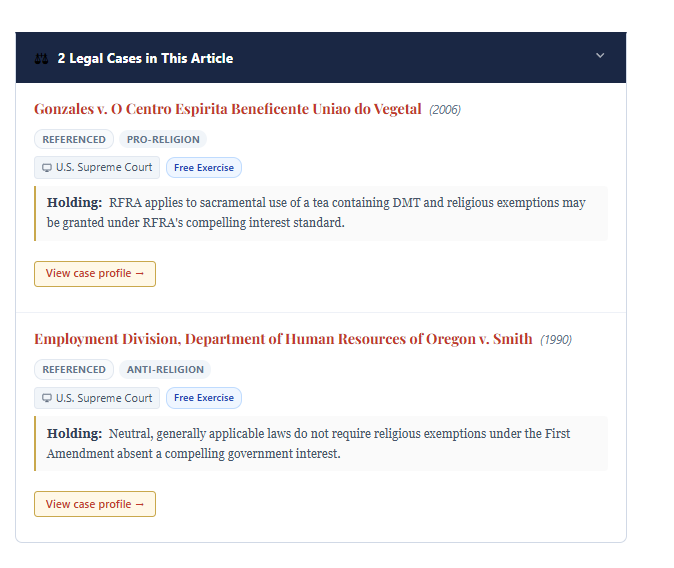
When you finish reading an article, you’ll now see a panel listing every legal case identified in that piece. For each case, you can see its holding, links to the official documents, and — this is the part we find most useful — a list of every other article on the site where that case appears, with a label indicating whether those articles cover the case directly or reference it in passing. It turns every article into an entry point into the deeper archive.
Popular Cases Widget
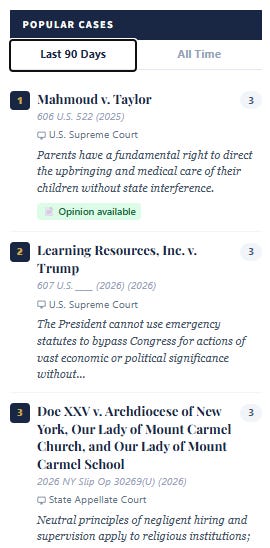
In the sidebar, you’ll find a live-updating list of the most frequently referenced cases on the site — both for the last 90 days and for all time. If a case is suddenly showing up in five articles in a single month, you’ll see it climb the recent list. It’s a quick way to track what’s legally active right now versus what’s historically significant
.
Why We Built This
Religious liberty litigation is cumulative. Burwell v. Hobby Lobby doesn’t make sense without Employment Division v. Smith. 303 Creative doesn’t make sense without Masterpiece Cakeshop. A ruling out of the Fifth Circuit this month may echo a district court decision we covered three years ago that most readers never connected to this moment.
Journalists and advocates who work in this space carry those connections in their heads. Most readers can’t be expected to. We wanted to give readers the same connective tissue — the same ability to follow a legal thread across years of coverage — that researchers and attorneys take for granted.
We also wanted a resource that doesn’t require a law degree to use. The case synopses are written in plain English. The outcome labels are descriptive, not political. The document links go to primary sources, not summaries of summaries.
Where Things Stand — And Where They’re Going
We want to be straight with you: these features are currently in testing.
The case extraction is automated and while it’s quite good, it isn’t perfect. Some cases may have incomplete metadata. Some document links may not resolve. You may find a case attributed to the wrong circuit, or a holding that needs a human editorial eye. We’re working through the archive and correcting as we go.
It also does not include cases that we did not cover.
If you find an error — a wrong citation, a missing document, anything that looks off — please tell us. You will be helping build something that serves every reader who comes after you. There are some links that aren’t working yet, but we’re working the bugs out.
The website is for general information, not for legal research or for writing a brief or pleading. If you’re an attorney filing a brief and rely on this information without doing https://religiousliberty.tvprimary research, you’re on your own.
A note on access and membership
The case library is bandwidth-intensive to run. Searching thousands of cases, generating AI synopses on demand, surfacing document links from multiple external databases — it adds up. Right now, everything is free and open to all visitors as we test and refine the system.
In the future, we may move the full case library and legal research tools behind a paid membership tier. If that happens, free readers and free subscribers will retain access to our articles and the case panels at the bottom of each post. The deeper research tools — full library search, on-demand synopses, document access — may become part of what makes a paid subscription worth having.
We haven’t made that decision yet. But we want you to know it’s coming so you can try the features now, while everything is open, and so you understand why we might eventually need to make that call.
How to Explore It
Start with the Case Library. Head to religiousliberty.tv/case-library and search for any case you know — Hobby Lobby, Trinity Lutheran, Fulton v. City of Philadelphia. See what we’ve built around it.
Read an article and scroll to the bottom. Any recent article will now show you the cases it references and where they appear across the rest of the site. It changes how an article reads.
Watch the sidebar. The Popular Cases widget will tell you what’s legally active right now.
Subscribe to our Substack if you haven’t. Free subscribers get every article by email. That’s not changing. If we do introduce a paid tier for the research tools, subscribers will hear about it first and will have the option to lock in early.
We’ve spent years covering this beat because we believe religious liberty is one of the defining legal questions of our era — and that most people who care about it deserve better tools than a Google search and a Wikipedia summary. This is our attempt to build something better.
Come explore it. Tell us what you find. Tell us what’s broken and what you wish it did. We’re listening.
ReligiousLiberty.TV covers First Amendment religious liberty law, RFRA litigation, and conscience rights across the United States and internationally. Our archive spans more than a decade of case coverage, commentary, and original reporting.
To subscribe — free or paid — visit religiousliberty.tv or click the button below.
