Before the Beginning
Nearly everyone arguing about Genesis has misread it. The physical universe existed before Day One, formless and dark, already present when the Spirit hovered over the waters. The angelic order was already constituted, already rebellious, already singing when the earth’s foundations were laid. Genesis 1:1 is not the first act of Day One but a prior origination of raw matter, and the six days that follow are not a manufacturing record but a planting record: the deliberate establishment on this earth of what an infinite God was not constrained to have invented here first. The serpent in chapter three is not a creature making an unfortunate first choice. He is a veteran of a war that began in heaven before humanity existed. Read carefully, Genesis is not primitive mythology. It is a cosmological framework of striking precision, and understanding it changes every conversation you will ever have about it.
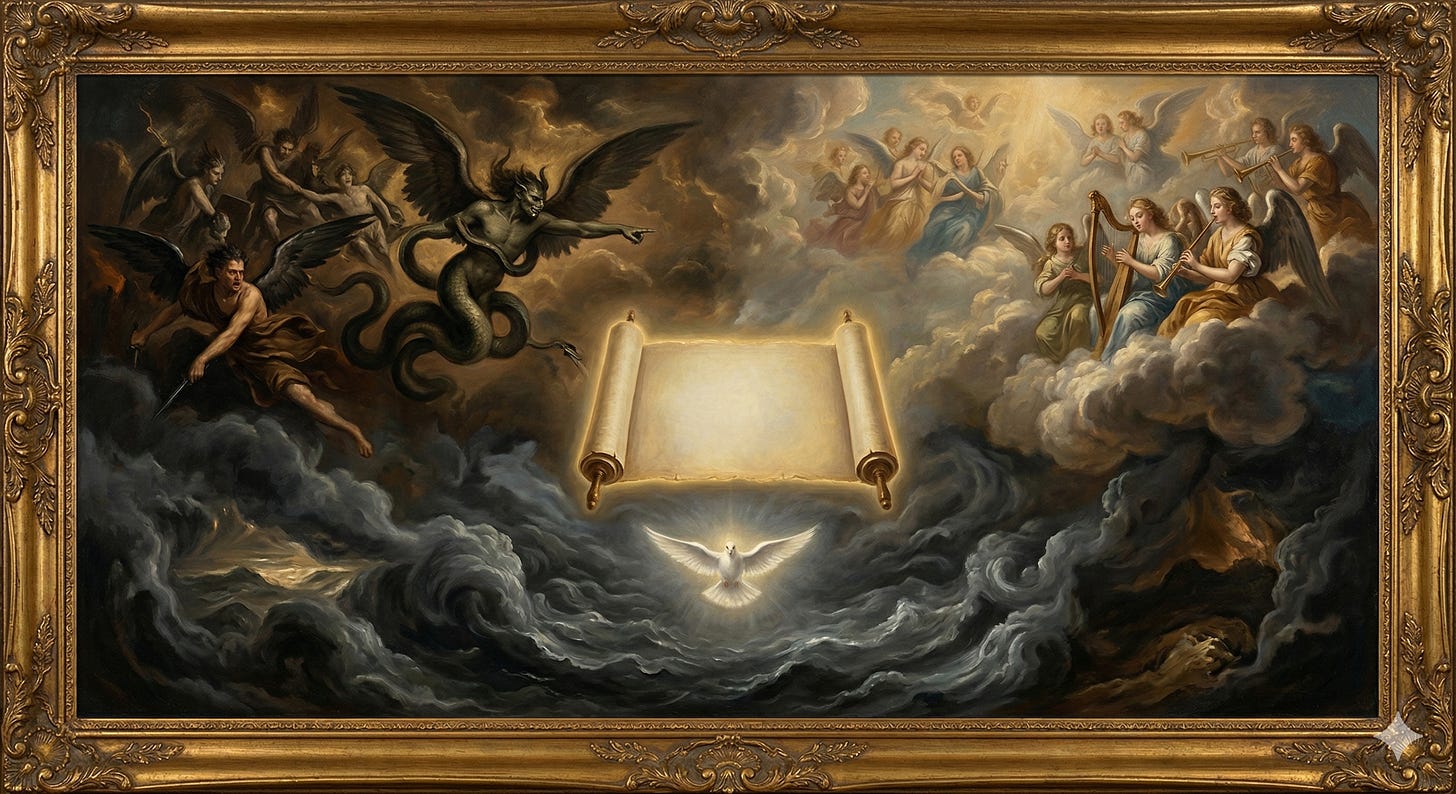
Heaven and earth were the first; after them was created light; the day had been distinguished from the night, then had appeared the firmament and the dry element. The water had been gathered into the reservoir assigned to it, the earth displayed its productions, it had caused many kinds of herbs to germinate and it was adorned with all kinds of plants. However, the sun and the moon did not yet exist, in order that those who live in ignorance of God may not consider the sun as the origin and the father of light, or as the maker of all that grows out of the earth. That is why there was a fourth day, and then God said: “Let there be lights in the firmament of the heaven.”
THE BOOK OF ST. BASIL ON THE SPIRIT HOMILY VI p. 82
Why This Matters
At some point, almost every Christian who takes their faith seriously will find themselves in a conversation they were not prepared for. It might be a skeptical college roommate who has read a little Dawkins and feels equipped to prosecute the universe’s origins. It might be a family member at Thanksgiving who has decided that science has rendered Genesis quaint. It might be a coworker who genuinely wants to know, without malice, how an educated person can still believe that God made everything in six days when the universe is 13.8 billion years old.
The average Christian in that moment reaches for one of two responses. The first is a defensive retreat into faith as a category that simply does not engage with evidence: “I believe it because the Bible says so, and that’s enough for me.” That answer satisfies no one, including, if they are candid with themselves, the person giving it. The second response is an anxious accommodation: “Well, the days might be long periods of time, and maybe evolution was God’s method.” That answer tries to make peace with everyone and ends up satisfying no one either, because it concedes the frame entirely to the critic and leaves the biblical text hanging in the wind.
There is a third option, and it requires actually knowing what Genesis says. Not what your church tradition has told you it says. Not what the atheist strawman version says. What the text, read carefully in its own structure and vocabulary, actually claims about the origins of the physical universe, the nature of the creation week, and the cosmological context in which humanity was placed.
That knowledge matters for at least three reasons that any apologist should be able to articulate.
First, the most common objections to Genesis are objections to a reading of Genesis that the text itself does not require. The critic who says “science has disproved the creation story” is almost always attacking a flat, literalistic reading that ignores the distinction between verse one and verse three, that treats the six days as the totality of divine creative activity, and that assumes the universe had no prior existence before Day One. A Christian who understands the text can meet that objection on its own terms: the physical universe was already present before the first day began, formless and dark, which is not a description that conflicts with the existence of prior cosmic history. The argument shifts the moment the apologist stops defending a cartoon and starts explaining a text.
Second, the question of where life came from is not answered by Genesis in the way that critics assume. The text does not claim that God manufactured organisms from scratch on the days assigned to them. It claims that he established them here, on this earth, in a deliberate sequence. A God of infinite creative capacity, operating across a cosmos whose full extent Genesis does not pretend to describe, is not constrained to have invented every form of life at the moment it first appeared on this particular planet. The nursery and the garden are different places. The critic who demands to know how complex biological systems could arise in a single day is answering a question the text was not asking.
Third, and most important for the apologist, the Genesis cosmology is not intellectually thin. It is one of the most sophisticated accounts of origins in ancient literature, and it holds up under close examination better than its detractors have generally been willing to acknowledge. Heaven predating earth, a prior angelic order, an adversary already active before humanity was formed, a creation week structured on the logic of domain and inhabitant, a humanity bearing the image of a relational God and placed as stewards over a contested creation: these are not primitive guesses. They are a coherent framework, and the apologist who can walk a skeptic through that framework with precision and confidence is doing something considerably more productive than retreating to bumper-sticker theology or surrendering the field to a critic who has not read the source material either.
What follows is the material for that conversation.
The serious reader of Genesis does not arrive at the text looking for comfort. They arrive looking for truth, which is a considerably more demanding and less predictable quarry. What they find, if they read with the precision the text deserves, is not the sentimental creation narrative of Sunday school illustration or the shallow target that its cultured despisers prefer to attack. They find a cosmological architecture of remarkable coherence: a universe with a prehistory, a creation with a prior audience, a garden planted on ground already contested, and a humanity made in the image of a God who had already watched his own court fracture before the first human breath was drawn.
This is not a comfortable account. It was never meant to be. The text does not open with innocence. It opens with the assumption of an order already constituted, an adversary already formed, and a conflict already underway. The six days of creation are not the beginning of the story. They are the opening of a new theater in a war whose first engagements belong to eternity.
What follows is a reading of Genesis that takes its Hebrew vocabulary seriously, its narrative structure as deliberate, and its cosmological claims as something other than the debris of prescientific imagination. The claims are four: heaven, as the habitation of God and the angelic order, predated the ordering of the physical universe. Genesis 1:1 is not the first act of Day One but a distinct originating event that produces physical matter, unformed and dark, before the ordered six-day sequence begins. The six days are literal, sequential, and composed with an architectural logic that rewards the kind of attention serious readers give to serious texts. And what those six days describe is not the invention of life and form from nothing but their establishment on this particular earth, by a God whose creative capacity was not exhausted by, or confined to, a single planet.
Part One: The Creation That Preceded Creation
An Audience Before the Stage Was Built
The Nicene Creed confesses God as the maker of all things “visible and invisible.” The visible half of that confession has occupied Christian theology for the better part of two millennia. The invisible half, the angelic order, the heavenly court, the spiritual hierarchy that the New Testament catalogs with surprising structural specificity, is mentioned in creeds and ignored in cosmologies. This is not a minor oversight. The invisible creation is not decorative. It is the context within which the visible was made, and it was already fully constituted before the physical universe had been given any form at all.
Consider what the text of Job actually says about the moment of the earth’s founding. God, in a speech that should be read as one of the great literary confrontations in any ancient literature, turns on Job and demands to know where Job was when the foundations of the earth were laid.
Job 38:4-7“Where were you when I laid the foundation of the earth? Tell me, if you have understanding. Who determined its measurements, surely you know! Or who stretched the line upon it? On what were its bases sunk, or who laid its cornerstone, when the morning stars sang together and all the sons of God shouted for joy?”
The “sons of God” and the “morning stars” are not figures of speech. They are the angelic host, and they were present, conscious, and celebrating at the moment the physical earth was established. They did not arrive with it. They preexisted it. Heaven, as their constituted domain and as the dwelling of God, was already fully formed when the work narrated in Genesis 1 began. The angelic order had a history before the material universe had a first day.
The letter to the Colossians makes the theological structure explicit. Christ is identified as the agent through whom all things were created, and the list includes “thrones or dominions or rulers or authorities”: the New Testament’s precise vocabulary for the hierarchies of the angelic order. These were made before the material sequence. They are the invisible half of the creed, and they are not an afterthought.
Colossians 1:16-17“For by him all things were created, in heaven and on earth, visible and invisible, whether thrones or dominions or rulers or authorities, all things were created through him and for him. And he is before all things, and in him all things hold together.”
The six-day account in Genesis is therefore not the creation account. It is the account of the material creation, set within a larger cosmological context that it assumes rather than establishes. The narrative begins in medias res, as the great epics do, because the author expects the audience to know that the drama was already in progress.
The Catastrophe That Preceded Eden
There is something that demands to be said before we proceed to Genesis 1, and it is something that preachers tend to omit because it raises questions their congregations are unprepared to answer. Before the first human being was formed from dust, before the garden was planted, before the serpent appeared in chapter three, a catastrophe had already occurred in the order of creation. Something that was very good had become very wrong, and it had happened in heaven, not on earth.
The serpent does not walk into Genesis 3 as a curious creature making a first experiment in moral reasoning. He arrives with a fully formed adversarial theology, a precise understanding of what God has commanded, and a strategy for subverting it. He is, in the language that the rest of Scripture uses to describe him, already fallen. Isaiah 14 and Ezekiel 28 describe, in the elevated register of cosmic poetry, a being of extraordinary glory and proximity to God who was expelled from the heavenly court through pride: “You said in your heart, I will ascend to heaven; I will raise my throne above the stars of God.” Jesus, in a statement his followers have never fully reckoned with, tells the disciples: “I saw Satan fall like lightning from heaven” (Luke 10:18). He is not predicting. He is remembering.
The psychological weight of this is enormous, and it is weight the text intends us to feel. The first thing the Bible establishes about evil is that it does not originate with humanity. We are not the authors of our own corruption. Humanity inherits a world already infected at its spiritual foundations, encounters an adversary already skilled in the art of accusation and deception, and falls in a garden that was contested territory before the first human being ever arrived in it. This is not an excuse for human failure. It is the correct diagnosis of human failure, which is a different thing entirely. The physician who misidentifies the pathogen does not help the patient. Genesis identifies the pathogen with precision.
The God of Genesis, on this reading, is not introducing evil into a neutral universe when he creates the physical cosmos. He is giving form and order to physical matter that already existed, within a conflict already underway in the spiritual realm. The material world, as unordered as it was before the first day, was already there. What the six days add is not matter but meaning: structure, inhabitant, purpose. And that work is performed on contested ground.
Part Two: The Architecture of Genesis 1:1
What the Opening Verse Actually Claims
“In the beginning, God created the heavens and the earth.” This sentence is among the most famous in any literature. It is also, in terms of what it is routinely taken to mean, among the most consistently misread. The standard reading treats it as the opening act of Day One. The text does not support that reading.
Genesis 1:1-2“In the beginning, God created the heavens and the earth. The earth was without form and void, and darkness was over the face of the deep. And the Spirit of God was hovering over the face of the waters.”
Verse one describes an act of origination. The Hebrew verb is bara, and it matters enormously that we attend to it. The Old Testament uses bara exclusively with God as its subject, consistently and without exception, to describe the bringing of something into existence from nothing. This is not the verb for rearranging, ordering, or shaping what already exists. It is the verb for origination. In verse one, God originates the physical heavens and the earth. What results is physical matter: real, present, and dark. The cosmos before Day One is not an invisible or spiritual state. It is a physical one, formless and unordered, waiting.
What he originates is tohu va-vohu: formless and empty. The phrase carries the weight of a desolate waste, a void without structure or inhabitant. The earth exists, but it has no form and no content. Darkness covers the primordial deep. The Spirit of God hovers over the surface of the water. Nothing has been commanded. No light exists. No day has begun.
There is a further implication here that the standard reading tends to suppress. If what Genesis narrates across six days is the ordering and inhabiting of this particular earth, then the question of where the raw materials and forms originated is left deliberately open. The text does not say that light, vegetation, animal life, and humanity were invented from scratch on the days assigned to them. It says they were established here, on this earth, in this sequence. The distinction matters. A gardener who plants a garden does not create the seeds. The seeds exist. The gardener brings them to a specific plot of ground, places them in order, and tends what grows. The six-day account reads, on careful attention, less like a manufacturing log and more like a planting record: the establishment on this earth of conditions and creatures that a God of unlimited creative capacity had already developed. Creation elsewhere, ordered here. The nursery precedes the garden.
This condition described in verse two is not the continuation of the creative act in verse one. It is the result of it, a snapshot of what the originating creation looks like before any ordering work has been done. The Creator has produced raw material. He has not yet begun the six-day work of giving it form, content, and purpose.
The First Day Begins in Verse Three
Day One does not begin in verse one. It begins in verse three, with the first divine speech-act of the ordered sequence.
Genesis 1:3“And God said, ‘Let there be light,’ and there was light.”
The evening-morning formula that closes each of the six days, “and there was evening and there was morning, the first day,” defines a day by the alternation of light and darkness. Before the creation of light, there is no such alternation. Before alternation, there is no day. Light is created in verse three. Verses one and two precede that creation. They therefore precede Day One.
This is not a strained reading. It is the reading that attends to what the Hebrew text says and refuses to import a tidier structure than the text provides. Verse one is a distinct creative event: the origination of the physical cosmos as unformed matter. Verses three through thirty-one are the six-day process of ordering that matter. The two are related, as foundation is related to building, but they are not the same act, and conflating them is the error that generates most of the subsequent confusion about the chapter.
The legal mind recognizes the structure immediately. Verse one establishes the jurisdiction: God creates the physical heavens and earth. Verse two enters the facts as they stand: formless, empty, dark. Beginning in verse three, the proceedings open. Each day is a distinct act, recorded with the precision of a formal record, closed with the formula that marks its completion. This is not mythological meandering. It is composed, deliberate, and sequential.
Which Heavens Does Verse One Create?
The obvious question is whether verse one’s reference to “the heavens” contradicts the prior claim that heaven as God’s dwelling predated the material creation. It does not, and the reason is linguistic rather than theological.
The Hebrew shamayim carries multiple referents depending on context. It can describe the atmospheric sky, the astronomical expanse, or the divine dwelling place. In Genesis 1:1, given the immediate context of what the narrative then proceeds to describe, “the heavens” refers to the physical cosmos above the earth: the domain God will divide on Day Two, furnish with luminaries on Day Four, and fill with birds on Day Five. The material heavens are what verse one creates, not the eternal throne room, which was already constituted and already occupied.
The text is not confused on this point. The failure is in readers who treat shamayim as a term with a single fixed meaning and then discover a contradiction that the text itself does not contain.
Part Three: Six Days
The Precision of the Literal Reading
The young-earth reading of Genesis, whatever its difficulties when set against the findings of geology and cosmology, is the reading that takes the text most seriously on its own terms. This observation does not resolve the empirical questions. It does require that those who dismiss the literal reading explain what textual warrant they have for the alternative.
The Hebrew word yom, “day,” when accompanied by an ordinal number or by the evening-morning formula, refers to a literal day in every comparable instance across the Old Testament. There is no case in the Hebrew Bible where this grammatical construction means an era, an epoch, or a geological age. The interpretive move that converts the six days of Genesis into vast stretches of time requires importing a meaning the word simply does not carry. The text has been stretched to accommodate a conclusion that was reached on other grounds, which is a procedure more familiar from legal advocacy than from honest exegesis.
But the six days are not merely a duration. They are a structure, and the structure is worth dwelling on. Days one through three establish domains: light, the expanse of sky and sea, dry land and vegetation. Days four through six populate those same domains in identical sequence: luminaries for the light, birds and sea creatures for the sky and sea, land animals and humanity for the dry land. The parallelism is precise. The first three days ask the question: what kind of world is this? The second three answer: and here is what it is for. A world given form in the first half, given meaning in the second.
It is worth noting, further, what the text does not say. It does not say God invented light on Day One as if light had never existed in his universe. It says God called for light within this domain, separated it from darkness, and named it. The primary verb of origination, bara, appears only three times in the six-day account: at the creation of the physical heavens and earth in verse one, at the creation of sea creatures and birds on Day Five, and at the creation of humanity on Day Six. The remainder of what God does across the six days is commanding, separating, gathering, filling, and naming. These are the actions of one who is ordering and establishing, not manufacturing from nothing. The patterns, the principles, the forms of life were available to an infinite Creator before this earth became the subject of his attention. What Genesis records is their deliberate installation here. Creation elsewhere. Order established here. The nursery precedes the garden, and the gardener knows exactly what he is planting.
Bara, Asah, and the Planting Record
The Hebrew vocabulary of Genesis 1 has generated a century of debate, and most of it has been conducted in bad faith on at least one side. Young-earth advocates have tended to flatten the verbal distinctions entirely, arguing that bara and asah are essentially interchangeable and that the creation account describes a single undifferentiated week of supernatural manufacture. Old-earth accommodationists have gone the other direction, claiming that bara means ex nihilo creation while asah merely means rearranging pre-existing material, and using that distinction to insert billions of years between verse one and the six days. Both readings are wrong, and both are wrong in the same way: they are recruiting the Hebrew vocabulary to serve a conclusion reached on other grounds.
bara (בָּרָא, to create)
asah (עָשָׂה, to make or do)
The honest account of the two words is more precise and more interesting than either camp has been willing to acknowledge. Bara is used exclusively with God as its subject throughout the Old Testament. No human being baras anything. The word carries the weight of divine origination, the bringing into existence of something that did not exist in that form before. Asah is the ordinary Hebrew verb for making or doing, used of human craftsmen, of God, of fruit trees producing fruit. It describes the working of existing material into new form, the shaping and assembling of what is already present. A carpenter asahs a table. God asahs the expanse of the sky, the luminaries, the land animals.
The three occurrences of bara in Genesis 1 are therefore not random. God baras the physical heavens and earth in verse one: absolute origination, the bringing of matter into existence from nothing. God baras the great sea creatures and birds on Day Five: a new category of animate life, the first creatures with the breath of life, introduced into a domain that had been physically constituted but not yet inhabited in this way. God baras humanity on Day Six: the image-bearer, a category of being that had not existed anywhere in the material creation before that moment. Each bara marks a genuine threshold, a point at which something categorically new enters the creation.
Everything between those three moments is asah. God asahs the expanse on Day Two. God asahs the luminaries on Day Four. God asahs the land animals on Day Six before turning to humanity. The verb in each case is the verb of working existing material into new arrangement. The expanse is shaped from the already-existing waters and atmosphere. The luminaries are set in place in a sky that already contained light. The land animals are formed from a ground that already existed. The pattern is not accidental. Where bara appears, something genuinely new is being introduced into the creation. Where asah appears, the existing creation is being given further form and order.
Genesis 2 adds a third verb that sharpens the picture. When God forms the man from the dust of the ground in verse seven, the verb is yatsar, the potter’s word, the verb of shaping a specific form from material already present. The same God who barad the cosmos asahd the order of its days and yatsard the particular body of the first human being. Three verbs, three modes of divine action, each carrying a distinct semantic weight that the translation “created” obscures when applied uniformly across all three.
The implication for the planting record reading is direct. The six-day account does not consist exclusively, or even primarily, of bara events. It consists mostly of asah events: the working of already-existing matter into ordered, inhabited, purposeful form. The light that God calls forth on Day One, the luminaries he sets in place on Day Four, the land animals he forms on Day Six before the bara of humanity: these are acts of ordering and establishing, not acts of origination from nothing. A Creator of infinite capacity, who barad the cosmos itself and barad the first animate life and barad humanity, was clearly operating with materials and forms that did not require fresh origination at each step. The nursery reading is not imposed on the text. It is what the text’s own vocabulary, read with precision, invites.
This is not primitive cosmogony assembled by campfire. This is a composed account, and its composer understood something about the relationship between structure and purpose that a great deal of subsequent theology has failed to recover. The world, on this reading, is not a stage on which meaning is imposed from outside. It is a world whose very architecture encodes the direction of its intended development. Order first, then inhabitant. Framework first, then purpose.
Exodus 20:11“For in six days the LORD made heaven and earth, the sea, and all that is in them, and rested on the seventh day. Therefore the LORD blessed the Sabbath day and made it holy.”
Exodus 20:11 closes the question of authorial intent. The Sabbath command in the Decalogue rests explicitly on the pattern of the creation week. If those days were not literal days, the command rests on an analogy that does not hold, and one of the ten cardinal commandments of the Mosaic law is grounded in a figure of speech. That is not a reading the Torah invites.
Humanity and the Image
On the sixth day, after the land animals have been created, the narrative does something it has not done before. It slows down. The speech-act formula that has driven the sequence gives way to deliberation: “Let us make man in our image, after our likeness.” The plural is not a grammatical accident or a vestige of polytheism awkwardly preserved. It is the mark of a decision made within the divine nature, a counsel taken within the one who is, in Christian understanding, irreducibly relational at his own core.
The image of God, the imago Dei, is among the most consequential assertions in the history of human thought. Every claim to human dignity, every argument against the reduction of persons to instruments, every insistence that individual human life carries weight that cannot be dissolved by the convenience of the collective, draws its most coherent grounding from this verse. Humanity is not the cleverest animal. We are not the most adaptable primate. We are the creatures made to represent, in the material order, the nature of the one who made us. The dominion mandate that follows is not a license for exploitation. It is a job description for a steward accountable to the owner of the property.
And the fall, when it comes, is catastrophic precisely because of what the image meant. The administrators of the created order do not merely make a poor personal choice. They transfer their allegiance to the adversary who had already attempted to overthrow the government of heaven. The rebellion that began in the angelic order finds its earthly continuation in the garden. The two events are not separate catastrophes. They are consecutive acts in the same drama, and Genesis, read carefully, makes the connection plain.
The weight of that drama is psychological before it is theological. Every human being who has ever lived has inherited a nature bent toward the same failure: the conviction, whispered by the same voice that spoke in the garden, that the authority above us is withholding something we deserve, that we would be better served by our own judgment than by submission to a purpose larger than ourselves. The serpent’s argument is not exotic. It is the oldest argument in the world, and it works because it addresses something genuinely present in human experience: the suspicion that obedience costs more than it returns. Genesis does not deny that suspicion. It traces it to its source.
The Shape of the Whole
Read as a composed text rather than a contested banner, Genesis 1 describes a creation of extraordinary precision. The material cosmos originates in a single act before the first day is counted. The first day begins with light, not with the originating act, and proceeds through six ordered stages that move from domain to inhabitant, from framework to purpose, from the world as structure to the world as home. The angelic order predates the whole sequence. It had already experienced its own catastrophe before the first human being arrived to experience theirs.
The garden is not an experiment in innocence. It is an outpost in contested territory, planted by a God who knew exactly what the adversary was capable of, populated by creatures bearing his own image, and given a single boundary whose crossing would prove whether the image-bearers could hold what their angelic predecessors had not. They could not. The drama that follows is the attempt, across the entire length of Scripture, to recover what was lost.
None of this is simple. It was not meant to be simple. The text that describes the origins of the cosmos also describes the origins of human failure, and it does so with a psychological penetration that should give pause to anyone who has dismissed it as primitive mythology. The serpent knew what he was doing. The man and the woman knew what they were being offered. The God who permitted the encounter knew what would happen. The question the rest of Scripture attempts to answer is what a God of that nature does next.