Dear Reader,
You already know this publication. You’ve been reading it, sharing it, and relying on it to make sense of one of the most contested areas of American law. But you may not know the full story of what makes ReligiousLiberty.TV genuinely different from every other source covering this beat — and why, in this particular moment in American history, that difference matters enormously.
We’re asking you to share this with someone who needs it. Forward this email. Post it. Text it to the attorney, the pastor, the professor, the journalist, or the concerned citizen in your life who is trying to understand what is happening to religious freedom in America right now. We think that after reading this, they’ll want to subscribe.
Here’s why.
The Problem With Everyone Else
There is no shortage of organizations covering religious liberty. There are well-funded law firms, denominational offices, advocacy groups, think tanks, and legal blogs. They produce enormous amounts of content.
Almost none of them are independent.
The Becket Fund litigates. It covers the cases it takes and frames them the way a plaintiff’s firm frames things. It is the best religious liberty law firm in the country — and it is a law firm, with clients to protect, donors to satisfy, and a victory record to maintain. First Liberty is the same model. The Alliance Defending Freedom is explicit culture-war advocacy with a legal arm attached. The USCCB’s religious liberty office speaks for the Catholic hierarchy. Religion News Service reports the news but doesn’t analyze doctrine, track case patterns, or provide legal depth.
Every one of these sources is excellent at what it does. Not one of them is independent.
They have constituencies. They protect those constituencies. And when the interests of their constituency conflict with the principle of religious liberty itself — as they sometimes do — their coverage reflects that conflict. Quietly. Without acknowledging it.
ReligiousLiberty.TV has no clients. It wins no cases. It takes no positions on behalf of any denomination, any advocacy organization, or any political faction. It is operated by Michael D. Peabody, Esq., an attorney in Southern California who has been covering this beat continuously since 2008, under the nonprofit Founders’ First Freedom, and whose only institutional loyalty is to the principle itself.
That independence is rarer than you might think. In practice, it means coverage that most outlets in this space won’t touch.
We Cover Religious Liberty When It Cuts Against Our Own
Most publications cover religious liberty cases that their audience wants to win. We cover the ones that are true, regardless of who they implicate.
When military commanders allegedly began invoking Armageddon theology to frame Operation Epic Fury, telling troops that President Trump had been “anointed by Jesus to light the signal fire in Iran,” we had the theological vocabulary to explain exactly what doctrinal tradition was being deployed, why it is constitutionally dangerous when it enters the chain of command, and how the First Amendment applies to coerced religious speech by government officers. We had been tracking the eschatological architecture behind that moment for over a year before the bombs fell.
When the Becket Fund, widely considered the gold standard of religious liberty law, argued that Jewish plaintiffs challenging Indiana’s abortion law held “insincere” religious beliefs, we noticed. When the Religious Liberty Commission, chaired by Dan Patrick, removed a member for questioning Zionist policy during a hearing on antisemitism, we covered the contradiction.
Religious liberty does not belong to the powerful. It was invented for the outnumbered. That is the lens through which we read every case, every ruling, and every legislative development — and it is a lens that very few outlets in this space are willing to use consistently.
Seventeen Years of Continuous Coverage Nobody Else Has
ReligiousLiberty.TV launched in June 2008. That means we covered Hosanna-Tabor before it became a landmark. We followed Hobby Lobby from cert grant to opinion. We tracked Fulton v. City of Philadelphia through district court, the Third Circuit, and the Supreme Court. We reported Mahmoud v. Taylor before the Court granted cert and after it became a 6-3 precedent reshaping parental rights in public education.
No publication that launches today can buy that archive. It compounds. It creates connections across cases that no other source is drawing, because no other source has been watching the same field for the same duration with the same editorial continuity.
That archive is now searchable in a way it has never been before.
A Research Tool Built Into the Publication Itself
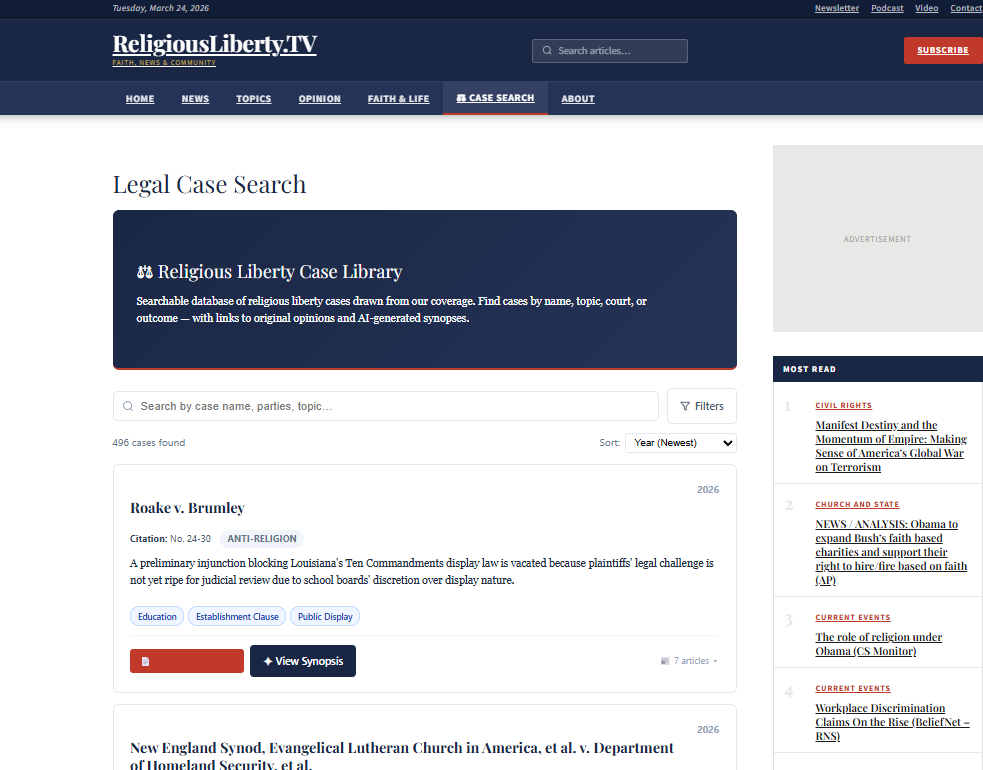
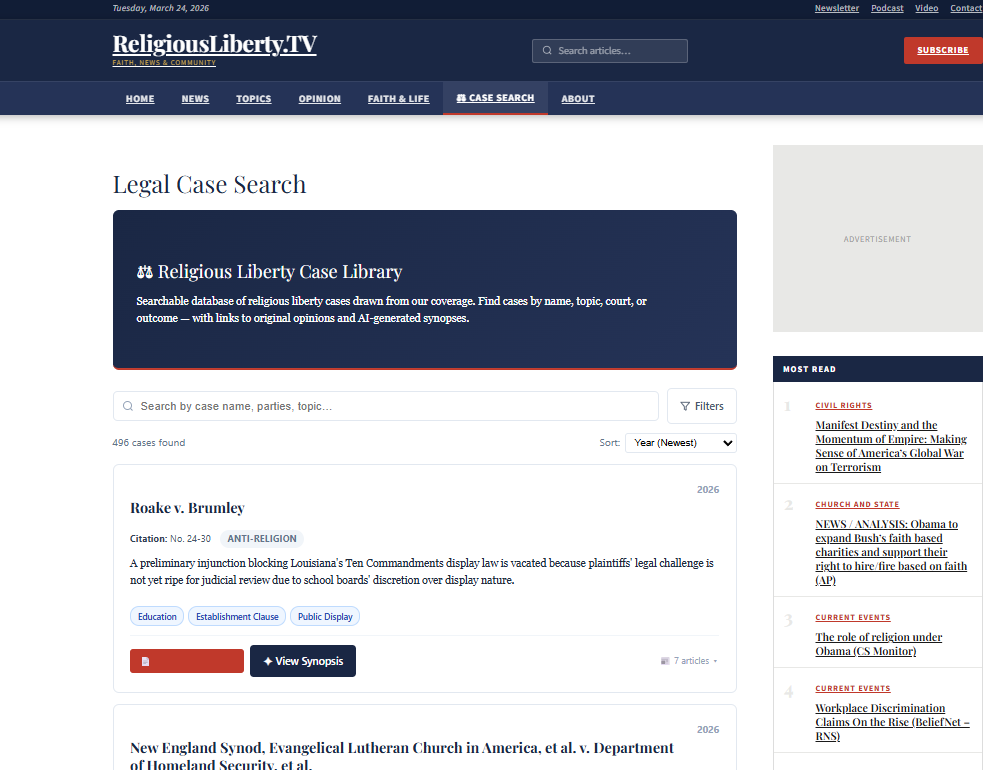
Earlier this year, we rebuilt ReligiousLiberty.TV’s case library from the ground up — and what we built is, as far as we know, the only religious liberty case reference in existence built directly from a publication’s own 17-year editorial archive
.
Here is what that means in practice.
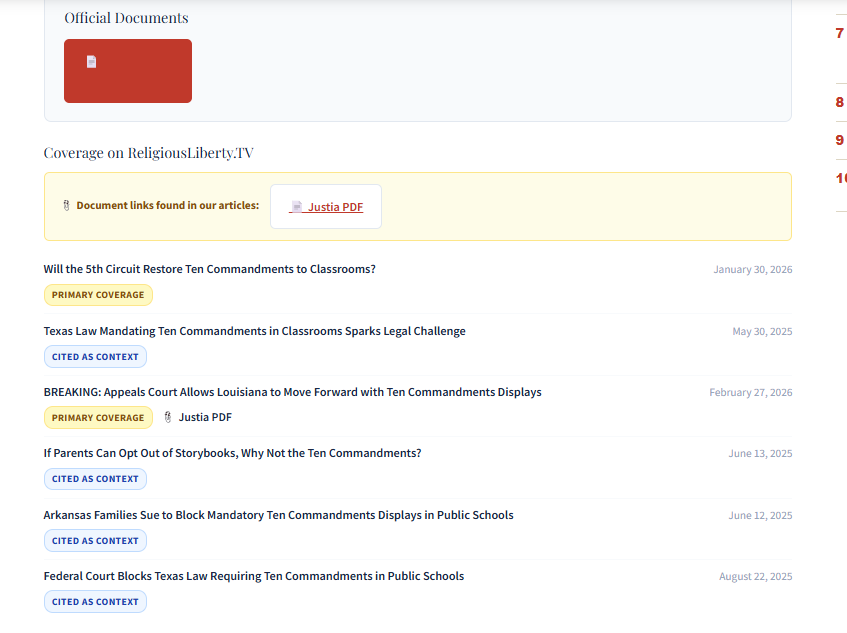
Every article we have ever published has been scanned for legal case references. Every case those articles touch has been given its own page in the library. On that page, you will find:
-
The holding — what the court actually decided, in plain language
-
An AI-generated synopsis on demand, structured as Background, Legal Question, Holding, and Significance
-
Links to official documents — opinions, briefs, oral argument transcripts
-
Every article on this site that covers or references the case, labeled by whether that article is primary coverage or a passing citation
You can search the entire library by case name, filter by topic — Free Exercise, Establishment Clause, Workplace Accommodation, Healthcare and Conscience, and more — filter by court, jurisdiction, outcome, and year range
.
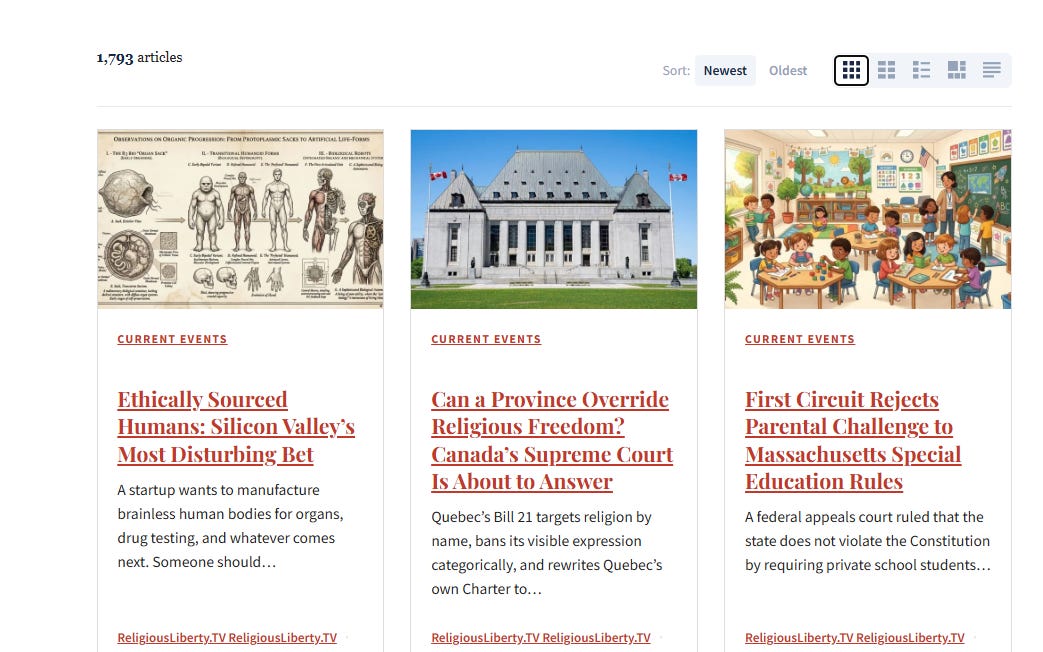
Read an article and scroll to the bottom. Any recent piece on the site will now show you a panel listing every legal case identified in that article, where to find the official documents, and where that case appears across the rest of our 17-year archive. Every article becomes a doorway into the larger archive. Every case becomes a thread you can follow across decades
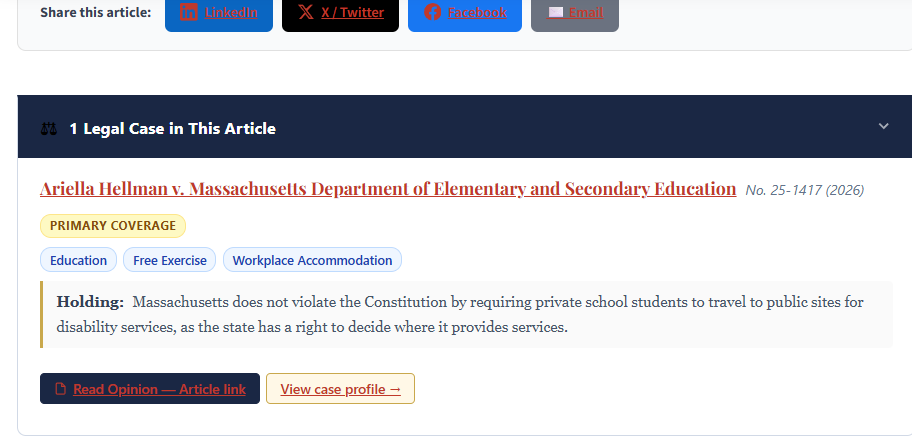
.
The Popular Cases widget in the sidebar shows you, in real time, which cases are appearing most frequently in our current coverage versus historically. If Landor v. Louisiana suddenly climbs the recent list, you know it is legally active right now. If TWA v. Hardison dominates the all-time list, you understand why workplace accommodation law looks the way it does today.
Westlaw costs thousands of dollars a year and does not do journalism. Journalism outlets do not build legal research tools. We are doing both, in the same place, for free.
The Theological Lens That Nobody Else Brings
Here is a thing that requires some explanation, because it is genuinely unusual.
The editorial tradition behind ReligiousLiberty.TV is Seventh-day Adventism. That matters — not because the site is denominational (it isn’t), but because Adventists have a 150-year track record of defending religious liberty for minorities, not majorities, rooted in their own experience as the outnumbered group.
Sunday law. Sabbath accommodation. Conscientious objection to military service. Institutional compulsion. These are not abstract doctrinal concerns for Adventists — they are lived history. The denomination has filed more First Amendment amicus briefs than almost any other religious body in U.S. history, and has done so consistently on behalf of people of all faiths because the Adventist position is simple: the principle protects everyone or it protects no one.
That tradition produces an editorial instinct that is structurally different from Becket’s Catholic natural law framework, or First Liberty’s evangelical free exercise orientation, or the ACLU’s separationist framework. It asks, by default: who is the outnumbered party here, and does this ruling protect them or expose them?
That question catches things that the other frameworks miss. It caught the military commanders’ apocalyptic combat briefings as a compelled religious speech problem before most legal commentators had framed it that way. It caught the denominational self-suppression story as a religious liberty story inside a religious institution. It caught the euthanasia-and-conscience-rights story as the next front in the institutional compulsion fight years before it reached U.S. courts.
Nobody else brings this lens to this beat. We do, every week, for free.
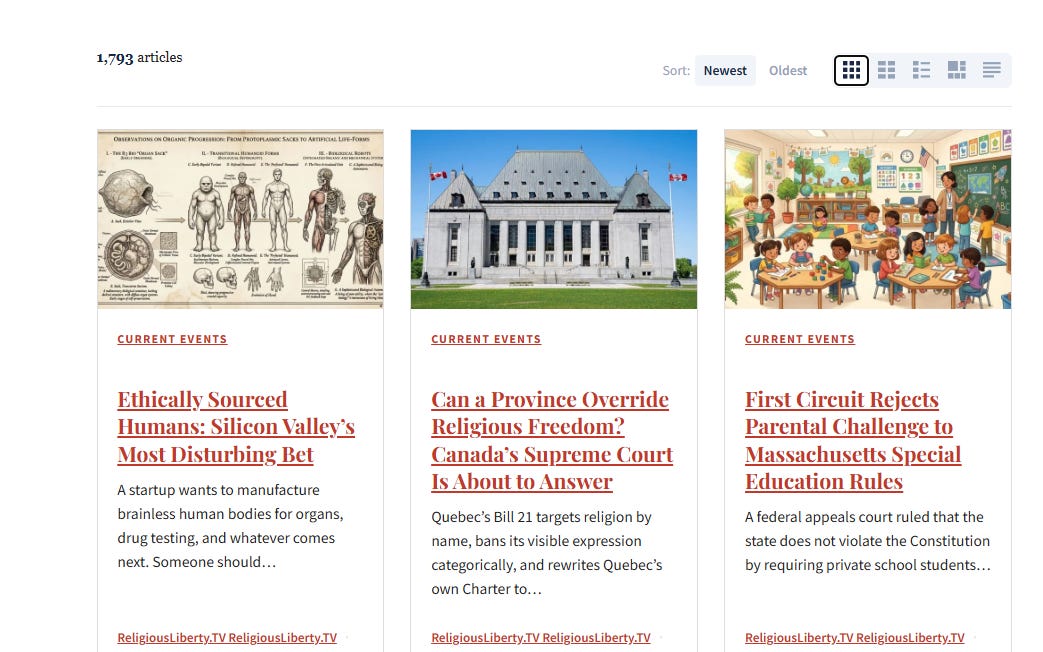
What We Cover That Nobody Else Covers Together
Consider the range of stories we have published in recent months alone:
-
The Iran war and Armageddon theology in the Pentagon — the constitutional implications of commanding officers framing combat orders in end-times prophetic language
-
The Dutch psychiatrist who euthanized teenagers — and why the same ideology driving that story is already in litigation against Catholic hospitals in Canada
-
Speaker Mike Johnson’s misreading of Jefferson’s Danbury Baptist letter — and why the half he got wrong is the half that protects religious minorities
-
The USCIRF 2026 Annual Report — 53,000 dead in Nigeria and U.S.-funded early-warning systems quietly dismantled
-
The Harvest Christian Fellowship misconduct — $4 million in alleged misappropriated funds, and Romanian orphanage abuse documented in an internal audit that was apparently ignored for twenty years
-
Wyoming’s abortion fight — as a proxy for the unresolved fetal personhood question that neither Roe nor Dobbs actually answered
No other publication connects these stories. No other publication has the editorial range, the theological vocabulary, the legal training, and the institutional independence to treat all of them as religious liberty stories — because they are.
Here Is the Ask
We are a nonprofit. We are independent. We are free to subscribers.
We do not have the budget of Becket or First Liberty. We do not have the institutional backing of a denomination or a law school. What we have is 17 years of continuous work, a searchable legal archive unlike anything else in this niche, and an editorial commitment to following the principle wherever it leads — including when it leads into uncomfortable territory for our own tradition.
The way a publication like this grows is through readers who care about it telling other readers about it.
If this work has value to you, please share this article, and share ReligiousLiberty.TV. Forward it to the attorney who argues First Amendment cases. Send it to the seminary professor who assigns Hobby Lobby in class. Give it to the journalist covering the religion beat who doesn’t have a legal background and needs a resource they can trust. Share it to the friend who keeps asking what’s really going on with the Iran war and Armageddon and the White House Faith Office and whether any of it is constitutional.
The subscription is free. The archive is open. The work is independent.
Subscribe at religiouslibertytv.substack.com
Explore the case library at religiousliberty.tv/case-library
Thank you for reading,
Michael Peabody, Esq.
ReligiousLiberty.TV is a publication of Founders’ First Freedom®, a California-based 501(c)(3) nonprofit organization. Edited by Michael D. Peabody, Esq. We have been covering First Amendment religious liberty law since June 2008.
