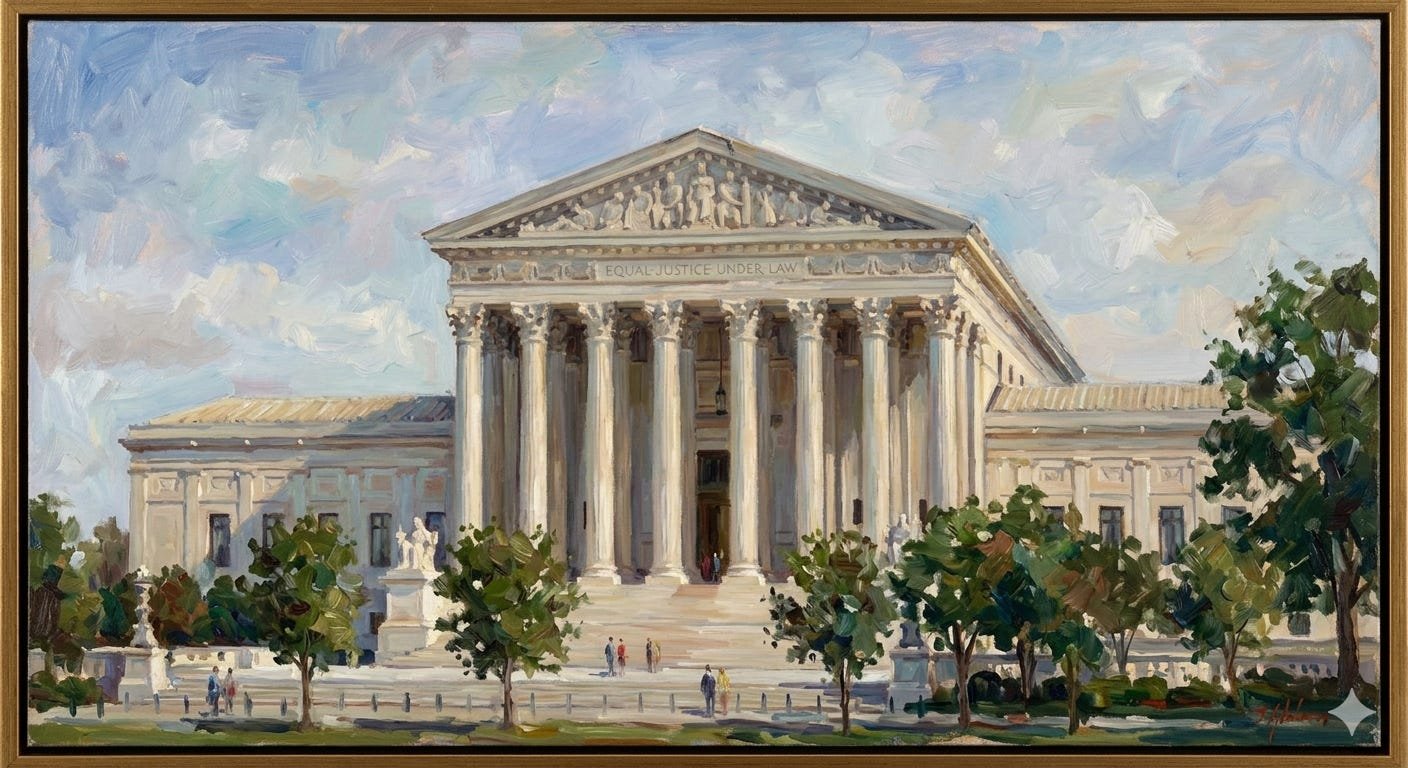
The Supreme Court ruled 8-1 on March 31, 2026, in Chiles v. Salazar. The decision holds that Colorado cannot ban licensed counselors from using talk therapy to help minors address sexual orientation or gender identity in accordance with their own stated goals. Justice Neil Gorsuch wrote for the majority, concluding that the Colorado law regulates speech based on viewpoint rather than professional conduct. The law violates the First Amendment by permitting counselors to affirm gender transition and identity exploration but forbidding speech that seeks to help a client align with biological sex or reduce unwanted attractions. Justice Elena Kagan, joined by Justice Sonia Sotomayor, concurred, agreeing that the law is unconstitutional since it is not viewpoint-neutral, but arguing that states retain the power to regulate professional speech through neutral rules. Justice Ketanji Brown Jackson dissented alone, arguing that the state has authority to regulate medical treatments for minors. The ruling protects faith-based counselors and sets a new national standard for professional speech under the First Amendment.
Case Information
Case Caption: Chiles v. Salazar, No. 24-539, 607 U.S. ___ (2026)
Court: Supreme Court of the United States
Decided: March 31, 2026
Decision: https://www.supremecourt.gov/opinions/25pdf/24-539_fd9g.pdf
The Supreme Court ruled that Colorado’s ban on conversion therapy talk counseling with minors violates the First Amendment. The 8-1 decision holds that a therapist’s words are speech, not conduct, and that states cannot silence professional conversations based on viewpoint without satisfying strict scrutiny. Any state law that permits counselors to affirm one set of beliefs about sexual orientation or gender while forbidding the opposing view must now clear the highest constitutional bar.
This ruling arrives as states across the country have passed laws restricting what licensed counselors may say in session. The decision in Chiles v. Salazar resolves a circuit split and gives therapists, religious organizations, and state regulators a clear constitutional framework. It matters now as courts, legislatures, and licensing boards reckon with where professional speech ends and government censorship begins.
What Did the 8-1 Majority Decide in Chiles v. Salazar?
• Justice Gorsuch wrote the majority opinion, joined by Chief Justice Roberts and Justices Thomas, Alito, Sotomayor, Kagan, Kavanaugh, and Barrett.
• The majority found that Colorado’s law targets the communicative content of a therapist’s speech, making it subject to strict scrutiny.
• Viewpoint discrimination: The law allows counselors to express acceptance and support for gender transition but forbids any speech that attempts to reduce unwanted attractions or help a client align with biological sex.
• The Court rejected Colorado’s argument that it can relabel speech as “conduct” to avoid First Amendment review.
• Citing National Institute of Family and Life Advocates v. Becerra (2018), the Court reaffirmed that licensed professionals hold the same First Amendment rights as any other speaker.
• The majority held that the Tenth Circuit applied the wrong standard. Rational-basis review cannot sustain a viewpoint-based speech restriction.
• The Court reversed and remanded the case to the Tenth Circuit with instructions to apply strict scrutiny.
• The ruling does not protect physical interventions. It applies specifically to talk therapy.
Chiles v. Salazar, slip op. at 11-17 (Gorsuch, J.) (“Her speech does not become ‘conduct’ just because a government says so or because it may be described as a ‘treatment’ or ‘therapeutic modality.'”)
What Was the Focus of Justice Kagan’s Concurring Opinion?
• Justice Kagan, joined by Justice Sotomayor, agreed that Colorado’s law must fall but wrote separately to limit the majority’s reach.
• Her core argument: the law fails not because all professional speech is beyond state reach, but because the law is not viewpoint-neutral.
• Colorado permitted counselors to affirm one side of a contested debate while silencing the other. Kagan called that a fundamental flaw.
• Kagan did not accept the majority’s broader suggestion that all talk therapy receives robust First Amendment protection against any state regulation.
• She left open the possibility that a more carefully written, neutral law governing all forms of counseling equally could survive constitutional review.
• Her opinion signals that four of the eight majority justices (those who joined her concurrence) may apply a narrower rule in future professional speech cases.
Why Did Justice Ketanji Brown Jackson Dissent?
• Justice Jackson was the lone dissenter. She argued the state has a valid and historic power to regulate medical treatments provided to children.
• In her view, Colorado’s law regulates the provision of health care, not protected speech, and the First Amendment does not apply.
• Jackson contended that accepting the majority’s framework would endanger a wide range of public health regulations that restrict what licensed professionals may do in clinical settings.
• She argued that licensed professionals, once they enter a clinical relationship, are subject to state-imposed standards of care.
• Jackson read her dissent from the bench, a signal of strong disagreement, stating the majority creates a “First Amendment Free Zone” argument that she found overbroad.
Who Is Kaley Chiles and What Was Her Claim?
• Kaley Chiles holds a master’s degree in clinical mental health and a Colorado state counseling license.
• She does not begin counseling with predetermined goals. She listens to each client’s stated objectives and tailors her approach accordingly.
• Some of her clients, including minors, come to her seeking help to reduce unwanted same-sex attractions, change sexual behaviors, or grow in alignment with their biological sex.
• She uses only talk therapy. She does not prescribe medication, use aversive techniques, or engage in physical treatments.
• Colorado’s 2019 law threatened her with fines, probation, or loss of her license if she engaged in any counseling that “attempts to change” a minor’s sexual orientation or gender identity.
• She filed suit seeking a preliminary injunction before the law was enforced against her. Both the district court and the Tenth Circuit denied the injunction.
• The Supreme Court granted certiorari to resolve a conflict among the federal circuits on how the First Amendment applies to talk therapy bans.
How Does Colorado’s Law Treat Different Counseling Viewpoints?
The Court found this disparity central to its ruling. Under Colorado Revised Statute section 12-245-202(3.5), the law permits:
• Permitted speech: “Acceptance, support, and understanding for the facilitation of an individual’s identity exploration and development” (Colo. Rev. Stat. sec. 12-245-202(3.5)(b)(I))
• Permitted speech: “Assistance to a person undergoing gender transition” (Colo. Rev. Stat. sec. 12-245-202(3.5)(b)(II))
The law prohibits:
• Forbidden speech: “Any practice or treatment that attempts to change an individual’s sexual orientation or gender identity” (Colo. Rev. Stat. sec. 12-245-202(3.5)(a))
• Forbidden speech: Any “effort to change behaviors or gender expressions or to eliminate or reduce sexual or romantic attraction or feelings toward individuals of the same sex” (id.)
The majority concluded that this structure is the definition of viewpoint discrimination. One side of a contested debate receives state sanction. The other side receives state punishment.
What Happens Next in the Chiles Case?
Chiles v. Salazar now returns to the Tenth Circuit Court of Appeals. The lower court must reconsider Colorado’s law under the strict scrutiny standard. That review will determine whether Colorado can show a compelling interest narrow enough to justify the specific viewpoint restrictions the law imposes.
Colorado may attempt to revise its statute to meet Justice Kagan’s narrower test: a neutral, viewpoint-blind rule applying equally to all forms of talk therapy regardless of message. Whether such a revision would survive strict scrutiny under the majority’s framework remains an open question.
A final ruling from the Tenth Circuit on remand is expected by late 2026. Other states with similar conversion therapy bans, including California, New Jersey, and Illinois, will face immediate legal challenges under the new standard.
Commentary
The Constitution does not have a professional speech exception. The First Amendment protects your right to speak your mind. This is true whether you are a baker, a lawyer, or a therapist. Colorado tried to invent a new rule. The state claimed that once a counselor takes a license, the government owns the conversation. The Supreme Court correctly rejected that argument. Licensing regulates qualifications. It does not give the state a script to enforce.
Justice Gorsuch focused on the text of the law. Colorado did not ban a physical procedure. It banned a message. Tell a minor to embrace a new identity, and you are free. Tell a minor to wait, or to follow a religious tradition, or to seek alignment with biological sex, and you face fines and license revocation. That is viewpoint discrimination. Under Rosenberger v. Rector and Visitors of University of Virginia(1995), it is the most offensive category of censorship the Constitution recognizes.
Justice Kagan reached the same result through a narrower path. She saw the bias in the law. A government cannot referee a contested debate by only blowing the whistle on one team. Her concurrence leaves room for neutral, evenhanded professional regulation. But it closes the door firmly on any law that picks sides in a debate about human identity and silences those on the disfavored side.
The 8-1 margin tells a story of its own. Across a Court divided on many questions, eight justices agreed on one principle: the government cannot silence a counselor by calling speech “treatment” and treatment “conduct.” Your rights do not end when you enter a professional office. This decision keeps the state out of private conversations between a therapist and a client who came seeking help on their own terms.
Citations
Chiles v. Salazar. No. 24-539, 607 U.S. ___ (2026). Supreme Court of the United States, 31 Mar. 2026. https://www.supremecourt.gov/opinions/25pdf/24-539_fd9g.pdf.
National Institute of Family and Life Advocates v. Becerra. 585 U.S. 755 (2018). Supreme Court of the United States.
Rosenberger v. Rector and Visitors of University of Virginia. 515 U.S. 819 (1995). Supreme Court of the United States.
Reed v. Town of Gilbert. 576 U.S. 155 (2015). Supreme Court of the United States.
Stay Informed
Like, share, and subscribe to ReligiousLiberty.TV for breaking news and case information. Subscribers get access to breaking news and case information as courts across the country apply the Chiles standard.
Disclaimers
AI Disclaimer: This article was assisted by AI.
Legal Disclaimer: This does not constitute legal advice. Readers are encouraged to talk to licensed attorneys about their particular situations.
Supreme Court, First Amendment, Chiles v. Salazar, Religious Liberty, Free Speech
Holding: The Supreme Court heard oral arguments on whether Colorado's prohibition on conversion therapy for minors violates the First Amendment by restricting protected speech or constitutionally regulates professional conduct.
