
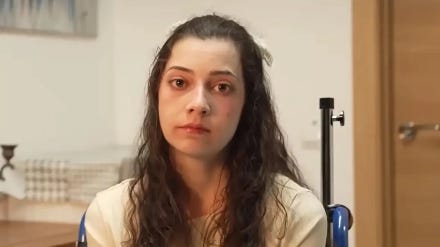
Noelia Castillo during her interview on television in Spain
Noelia Castillo’s death on March 26, 2026, was legal under Spanish law – and that is precisely the problem.
Dear Readers:
I started ReligiousLiberty.TV because I believe every human life carries a worth that no court, no commission, and no government panel has the authority to declare expired. My faith, my concern for the mentally ill and vulnerable, and my years watching legal systems fail the people they were built to protect are not separate convictions. They are one conviction. Noelia Castillo was 25 years old, psychiatrically disabled, and in the custody of a state that had already failed her once. Her father begged six separate courts to fight for her life. Every one of them said no. When a legal system hands a young psychiatric patient death by lethal injection and calls it compassion, something foundational has broken. And when that happens, it does not stop with one case. It becomes precedent. It becomes policy. It becomes the answer a doctor gives to the next patient who says the world looks dark.
This publication will not let that happen in silence. Euthanasia and assisted suicide are being written into law across Europe, across Canada, and the pressure is building in the United States. The people advancing these laws call it dignity. What happened to Noelia Castillo is not dignity. It is a civilization that looked at a suffering young woman and chose the cheaper answer. We are going to report on every case, challenge every legal framework that abandons the vulnerable, and name what is happening plainly and without apology, until the people who can stop this choose to act. Share this story. Subscribe to ReligiousLiberty.TV. Do not let this world go silently in the direction of death.
Michael Peabody
On March 26, 2026, Spanish authorities administered lethal drugs to Noelia Castillo Ramos, age 25, at a healthcare center in Sant Pere de Ribes near Barcelona. Castillo had been diagnosed with obsessive-compulsive disorder (OCD) and borderline personality disorder (BPD) since adolescence. She had a state-certified 74% psychiatric disability rating at the time of her death. Her father, supported by the Catholic legal organization Abogados Cristianos (Christian Lawyers), fought the euthanasia approval through Catalonia’s High Court, Spain’s Supreme Court, the Constitutional Court, and the European Court of Human Rights. Every court rejected his appeals. Critics argue Spanish law contains no mandatory psychiatric treatment requirement before authorizing euthanasia in mental illness cases. The case raises a direct constitutional question: can a state lawfully facilitate the death of a person whose suffering is rooted entirely in treatable psychiatric illness?
What Happened to Noelia Castillo?
Spain administered euthanasia to a 25-year-old psychiatric patient on March 26, 2026 – over the sustained legal objections of her father and multiple advocacy organizations. Noelia Castillo Ramos held a 74% state-recognized disability rating for mental illness at the time of her death. She had never received the psychiatric treatment that critics say should have been a legal prerequisite. Every court in Spain, and the European Court of Human Rights, ruled against her father’s attempts to stop the procedure.
That is not an account of a patient receiving a medically appropriate death. That is an account of a legal system that chose efficiency over treatment, and finality over care.
Why this case. Why now. Spain legalized euthanasia in 2021 under the Organic Law Regulating Euthanasia. Castillo’s case is the first to reach every level of the Spanish judiciary and the European Court of Human Rights simultaneously, and it ended in the subject’s death. The legal framework that permitted it has no mandatory psychiatric treatment gateway. That gap is not a technicality. It is a constitutional failure that other nations – including those watching euthanasia expansion debates in Canada, Belgium, and the Netherlands – should examine closely.
What were the facts of Noelia Castillo’s case?
Noelia Castillo Ramos was born on November 14, 2000. Her parents separated when she was 13, and she entered the care of the Spanish state. While under state guardianship, she was subjected to sexual assault. She was subsequently diagnosed with OCD and BPD.
The following events are drawn from court records, reporting by EWTN News, the Associated Press, and Wikipedia’s documented case summary:
• 2022: Castillo attempted suicide by jumping from a balcony. She sustained injuries that left her unable to use her legs, permanently confining her to a wheelchair. Her disability rating rose to 74%.
• 2024: A Catalan medical and legal committee approved her euthanasia application, finding that she met the statutory criteria: a serious, chronic, and disabling condition with severe suffering.
• 2024-2025: Her father, represented by Abogados Cristianos, filed appeals through Catalonia’s High Court of Justice (TSJC), arguing his daughter lacked legal capacity to make a free and informed decision.
• September 2025: The TSJC upheld the euthanasia authorization but permitted further appeal.
• January 29, 2026: Spain’s Supreme Court rejected the father’s appeal.
• February 2026: Spain’s Constitutional Court dismissed the Constitutional appeal.
• March 24, 2026: The European Court of Human Rights rejected a request for interim measures, declining to halt the procedure pending a full merits review.
• March 25, 2026: Castillo gave a televised interview on Antena 3. She said: “I have no desire to do anything – not to go out, not to eat, not to do anything at all.”
• March 26, 2026: Castillo died by euthanasia at a healthcare center in Sant Pere de Ribes, Province of Barcelona. She was 25.
Her mother requested to be present. Castillo chose to die alone.
What does Spanish euthanasia law actually require?
Spain’s Organic Law Regulating Euthanasia, enacted in 2021, sets the following statutory criteria for an applicant:
• The person must be of legal age.
• The person must be mentally capable and fully conscious at the time of the request.
• The person must be a Spanish citizen or legal resident of more than 12 months.
• The person must be suffering from a serious and incurable disease, or a serious, chronic, and disabling condition, as certified by the attending physician.
Nowhere in that framework does the law require that a patient with a psychiatric condition first undergo a course of psychiatric treatment. It requires certification of suffering. It does not require proof that treatment was attempted and failed.
This is the central legal gap the Castillo case exposed. Castillo’s condition was psychiatrically rooted. Her father’s lawyers, and the Abogados Cristianos organization, argued before multiple courts that the state had an obligation to try to treat her before authorizing her death.
The courts disagreed. Castillo herself chose not to pursue treatment. That personal choice deserves weight. But the law’s silence on treatment prerequisites means the state, as an institution, exercised no independent safeguard on that point.
What did Spain’s courts and the European Court of Human Rights actually decide?
No court at any level ruled that Castillo’s psychiatric condition was irrelevant. The courts ruled consistently that under the existing legal framework, her application met the statutory criteria. That is a narrower ruling than it may appear.
None of those courts were asked to rule on whether the law itself was constitutionally adequate. The Constitutional Court had previously addressed euthanasia standards in Ruling STC 94/2023, which – per Abogados Cristianos – states that euthanasia cannot be administered when the source of suffering is a mental illness and that the state carries an obligation to protect such individuals from self-harm. The organization argued before multiple courts that Castillo’s case violated that ruling. Every court rejected that framing.
The European Court of Human Rights declined to issue interim measures on March 24, 2026 – two days before Castillo’s death. The ECHR did not rule on the merits. Its denial of interim relief means only that it found insufficient grounds to halt the procedure pending review. The case on the merits has not been adjudicated.
That distinction matters. The ECHR’s refusal to act is not a ruling that Spain acted lawfully under the European Convention on Human Rights. It is a procedural posture.
Was Castillo legally capable of consenting to euthanasia?
This is the question around which the entire two-year legal battle turned, and it remains genuinely contested.
Her father and Abogados Cristianos argued that a person with a 74% psychiatric disability rating, who had attempted suicide twice and reported no goals or objectives for the future, could not exercise the kind of free and informed decision that a euthanasia statute demands. In their view, the suffering Castillo described was the symptom of her illness, not an independent basis for a death decision.
Spanish courts – including the Supreme Court – ruled that the evaluation process met the statutory standard. Two medical evaluators initially authorized the procedure. When those evaluators appeared to feign disagreement to escalate the review, the Supreme Court took note of that conduct in its ruling.
Castillo herself, in her final television interview, described her condition in terms that critics argue are diagnostic of treatable depression:
• “I have no desire to do anything.”
• “Even before requesting euthanasia, I viewed my world as very dark.”
• “I had no goals, no objectives – nothing at all – and I still have no goals, no objectives.”
Those statements describe hopelessness. They are also textbook presentations of major depressive disorder, which is treatable. The law did not require the evaluating physicians to distinguish between suffering that is treatable and suffering that is not.
What is the religious liberty and human dignity argument against this outcome?
The religious liberty dimension of this case is structural, not incidental. Spain’s euthanasia law was opposed on religious and moral grounds when it was enacted in 2021. Abogados Cristianos is a Catholic legal organization. The father’s opposition was grounded in a conviction that his daughter’s life retained inherent worth regardless of her own assessment of it.
That is a position rooted in natural law and Catholic social teaching. It holds that a state may not facilitate the death of a person whose suffering is psychiatric in origin, because the state has a prior duty to treat, and because mental illness by its nature compromises the capacity for fully autonomous decision-making.
Whether or not one shares that religious framework, the legal argument it generates is serious. Constitutional Court Ruling STC 94/2023, which the Abogados Cristianos organization cited repeatedly, was decided by Spain’s own court. If that ruling does establish a state duty to protect mentally ill individuals from euthanasia, then Spain’s approval of Castillo’s death may be a domestic constitutional violation that the courts refused to enforce.
The ECHR’s refusal to issue interim measures does not foreclose that question. It deferred it.
What about claims that Castillo was gang-raped by migrant minors?
This claim was amplified by Vox leader Santiago Abascal and originated from what Castillo’s father’s lawyers described as information from a relative. Multiple Spanish fact-checking organizations reviewed it.
The Wikipedia case summary, drawing on those fact-checks, states: Castillo was 21 when she attempted suicide days after a group sexual assault, and she had already left state care more than three years before that assault.
The documented facts are that Castillo was sexually assaulted while under state guardianship as a minor. The specific framing advanced by her father’s representatives appears to be inaccurate on the timing and circumstances. Readers should consult primary fact-check sources for the full record.
What happens next?
Noelia Castillo is dead. No appeal can reverse that. What remains procedurally:
• Abogados Cristianos filed a complaint in September 2025 against seven members of the Guarantees and Evaluation Commission for conflict of interest, and against former Catalan Health Minister Josep Maria Argimón for appointing them. Those proceedings remain pending.
• The ECHR declined interim measures but did not rule on the merits of the case. A full merits review under the European Convention on Human Rights remains a possibility.
• Spain’s parliament has not amended the Organic Law Regulating Euthanasia to include psychiatric treatment prerequisites. No legislative action is currently scheduled.
The family’s legal fight ended in the death of their daughter. The legal questions it generated have not ended with her.
Commentary
The law did its job. That is the indictment.
What Spain’s courts confirmed, over and over, is that Noelia Castillo’s euthanasia was procedurally correct under Spanish law. The evaluations were conducted. The criteria were met. The commissions convened. Every appellate step was taken. The European Court of Human Rights declined to intervene. By every metric the system had, this was a lawful death.
That conclusion should disturb anyone who thinks carefully about what law is for. Law is not merely a mechanism for applying criteria. It is a structure that reflects a society’s judgments about human worth and state obligation. When a legal system applies its criteria correctly and the result is the euthanasia of a 25-year-old with a 74% psychiatric disability rating who described no goals, no desires, and a world seen entirely in darkness, the law has not succeeded. The law has failed at the level of design.
The design flaw is specific and correctable: Spain’s euthanasia statute contains no mandatory psychiatric treatment gateway. A person whose suffering is rooted entirely in a diagnosable and potentially treatable mental illness can satisfy the statutory criteria without ever having been treated. That is not a safeguard. It is an open door. Every country watching euthanasia expansion debates, including Canada, Belgium, and several U.S. states with right-to-die frameworks, should look at what Spain built and ask whether their own frameworks have the same hole.
The father’s argument – that a mentally ill person cannot exercise the kind of free and informed consent euthanasia requires – was rejected by every court. That rejection is at least defensible on narrow legal grounds. But the broader moral point it contains is harder to dismiss. If a law permits a state to facilitate the death of a person whose primary condition is psychiatric, without first exhausting treatment options, then the law is not protecting personal autonomy. It is ratifying despair.
Citations
1. Noelia Castillo Euthanasia Case. Wikipedia, March 2026.
If this story matters to you, subscribe to ReligiousLiberty.TV.
Subscribers receive breaking news and case information as courts issue rulings – before the mainstream press catches up. Like this article, share it, and help us keep independent legal journalism alive. Subscribe at ReligiousLiberty.TV.
This does not constitute legal advice. Readers are encouraged to talk to licensed attorneys about their particular situations.
