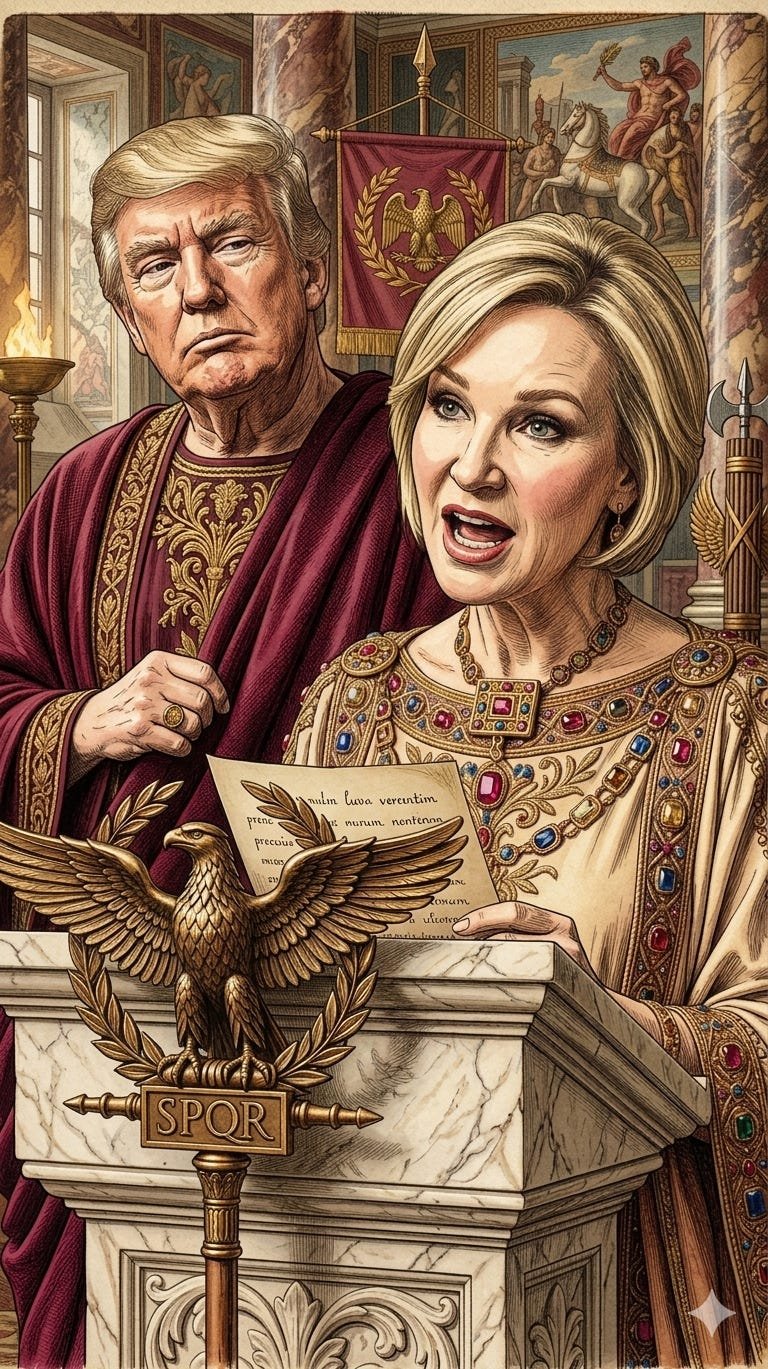
Paula White compared Trump to Jesus on April 1. Hours later, Trump threatened to bomb Iran back to the Stone Age. The two statements belong to the same news cycle. They do not belong to the same God.
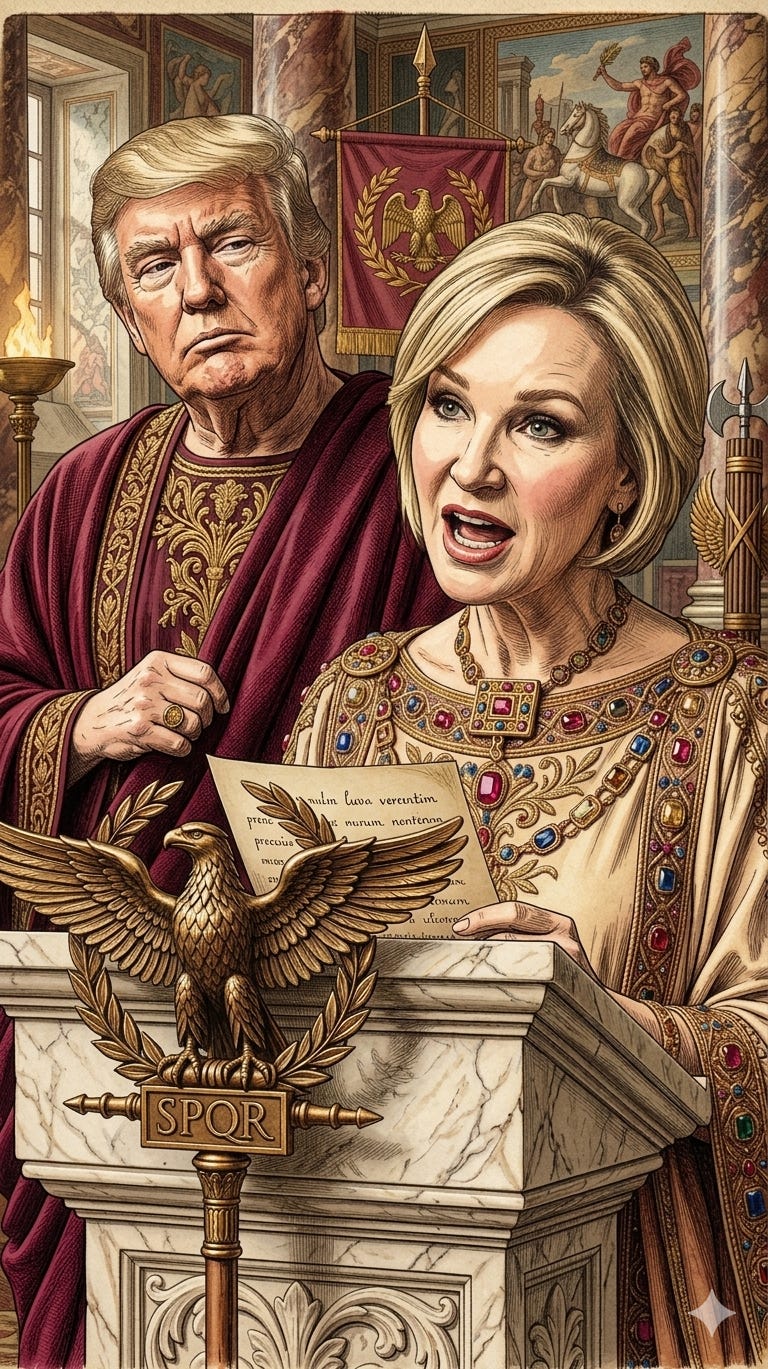
By Michael Peabody | ReligiousLiberty.TV
On April 1, pastors, bishops, and reverends gathered in the East Room of the White House for Easter prayers with President Donald Trump. Paula White-Cain, the president’s spiritual advisor and director of the White House Faith Office, turned from scripture to the man seated before her and told him that no one had paid the price like he had paid. She walked the room through the Passion narrative, betrayal, arrest, false accusation, and said it was a pattern the president would recognize personally. Because of Christ’s resurrection, she told him, he too had risen.
That evening, in a prime-time address, Trump told the nation the United States would hit Iran extremely hard over the coming weeks. “We’re going to bring them back to the Stone Ages, where they belong,” he said of a country of 93 million people. Defense Secretary Pete Hegseth reinforced it within minutes on social media: “Back to the Stone Age.”
Within a single calendar day, the president had been compared to the suffering, self-sacrificing Son of God and had threatened to erase a civilization. The tension between those two things is the most revealing aspect of the moment.
White Had a Point, Up to a Point
To be fair to White, the surface narrative she drew on has a certain political plausibility. After the 2020 election, Trump’s career appeared, by any conventional measure, to be finished. He left office under a cloud, faced four criminal indictments, and was convicted by a jury of his peers. Most politicians do not survive one of those. He survived all of them and won back the presidency. As a story of political resurrection, the arc is genuinely remarkable, and White is not the first observer to reach for dramatic language to describe it.
The problem is the category error. A political comeback, however improbable, is a political event. It has explanations rooted in voter sentiment, prosecutorial overreach, opponent weakness, and the structural advantages of incumbency and name recognition. Identifying it with the resurrection of Christ collapses the distinction between what is historically contingent and what Christians hold to be cosmically unique. Trump’s return to power may be explained by any number of factors. The resurrection of Jesus is not on that list. Conflating them does not honor the political achievement. It diminishes the theological one.
An Old Pattern With a Bad Track Record
Wrapping political authority in divine sanction is among the oldest political instincts in recorded history, and the record of where it leads is instructive. Roman emperors eventually demanded to be addressed as dominus et deus, lord and god, in their own lifetimes. Early Christians were martyred for refusing to burn incense before the imperial image. Egyptian pharaohs governed as literal gods, which meant dissent was not political opposition but sacrilege. The Byzantine doctrine of caesaropapism gave emperors effective control of the church, and the church reliably said what the emperors wanted to hear. The divine right of kings took centuries of conflict, and in England a literal regicide, to finally dismantle.
The American founders were students of that history. The First Amendment’s prohibition on religious establishment was not hostility to religion. It was a recognition that fusing divine authority to political office creates a power that ordinary democratic accountability cannot check. Once a leader is identified with sacred narrative, criticism acquires the character of impiety. Opposition becomes not just politically inconvenient but spiritually suspect.
Civic Religion Has Limits
America has always maintained what sociologist Robert Bellah called a civil religion, a shared vocabulary of sacred symbols drawn from Christianity and the founding documents that gives public life a quasi-religious character. At its best, that tradition calls the nation to account. Lincoln’s second inaugural applied divine judgment to both sides of the Civil War equally, which is why it still reads as moral rather than partisan.
The tradition curdles when divine sanction stops calling leaders to account and starts insulating them from it. When a policy is advanced not as a persuasive argument for the common good but as an expression of divine will, the democratic process breaks down. You cannot vote against God. You cannot cross-examine scripture. You cannot amend a policy identified with the Almighty’s purposes. Religious authority introduced into secular policy debates to end deliberation rather than inform it is not civic religion. It is its corruption.
Two Gods, One News Cycle
The God invoked by White at the Easter prayer event is, by any recognizable Christian account, the God of the Sermon on the Mount. The Passion narrative she drew on is specifically the story of a figure who, when he had the power to call down legions of angels, declined to use it. The theological point of the crucifixion, in orthodox Christian understanding, is that redemption came through absorbing violence rather than inflicting it.
The God implied by the Stone Age threat is a different figure. To bomb a nation back to a primitive state means the destruction of hospitals, schools, water systems, and power grids serving a civilian population. Oxford security professor Janina Dill noted that targeting structures characterizing modern society “would be illegal because it implies directing attacks against civilian objects.” Whether or not the threat is carried out in full, it describes punitive, indiscriminate destruction of a civilian population.
That is not a picture of the God of Easter morning. It is closer to the imperial deities of antiquity who demanded tribute in blood. One can argue the Iran campaign is strategically necessary without invoking religion at all. But when the morning’s sermon has identified the president with the Prince of Peace, and the evening’s address threatens to obliterate a civilization, the theological messaging sends a signal to the watching world, including the Muslim world against whose co-religionists these bombs are falling, about what the Christian God endorses. That is not an advertisement for Christianity. It is a liability for it.
The Literary Precedent, and Why This Is Different
The Christ figure is one of literature’s most durable devices, and it is worth naming before judging White too quickly. Hemingway used it in “The Old Man and the Sea,” where Santiago’s bleeding hands, extended arms, and solitary struggle carry unmistakable Passion imagery without a word of religious commentary. Mel Gibson built the climax of “Hacksaw Ridge” around Desmond Doss lowering wounded men through the night, his sacrifice framed in transparently sacrificial terms. Neither Santiago nor Doss is presented as divine. The device works because it is implicit, earned by narrative, and offered at a remove. Crucially, in both cases the Christ figure is defined by renunciation, not victory.
What White did on April 1 was structurally different. The comparison was explicit. It was delivered to the subject’s face as affirmation. And it came from a government official at a government event, on a platform the White House controls and initially broadcast on White House channels before quietly deleting the footage.
Defenders of her remarks will also note, correctly, that the idea of God raising up rulers appears in Romans 13, in Daniel, and throughout the Hebrew prophets. White herself clarified in 2017 that she held the same providentialist view of Obama and would have of Clinton. The theological tradition is real. But that tradition generally stopped short of mapping a specific president’s biography onto the Passion of Christ, point by point, in his presence, while he smiled and mouthed a quiet thank you. The sharpest pushback came not from the secular left but from within Christian conservatism, including Catholic commentator Taylor Marshall, who called it insanity, because the orthodox objection is substantive: the crucifixion and resurrection are not a template available for application to legal indictments and election outcomes.
What It Costs
The April 1 juxtaposition does not merely create a logical contradiction. It raises a question that believers and skeptics alike are entitled to ask: which version of God is actually being served here, and whether either invocation of the divine is doing anything beyond providing emotional cover for decisions made on entirely different grounds.
