
Resurrection is not only a historical claim. It is a present-tense reality playing out in hospital rooms, in prison cells, in the quiet moment when a person finally stops running and tells the truth about who they have been.
The Christian tradition holds that on a Sunday morning in first-century Jerusalem, an executed man walked out of a sealed tomb. That event is the cornerstone of the faith, the claim on which everything else depends. But the power of resurrection was never meant to stay locked inside a single moment in history. It was meant to keep moving, keep finding its way into lives that look, by every reasonable measure, finished.
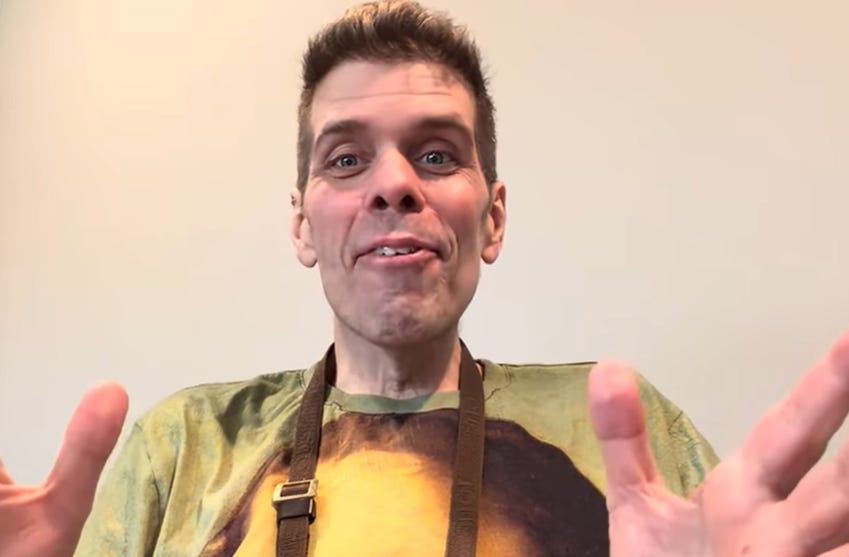
Perez Hilton looked finished, in his own way. Not dead, but hollowed out. For two decades, the celebrity blogger had built an empire on cruelty, his famous website a machine for sharp-tongued commentary that cut through careers and reputations with practiced ease. Then, in the spring of 2026, his flu became an ulcer, his ulcer became a perforation, and his perforation became sepsis. He spent 21 days in a Las Vegas hospital while his body, slowly and systematically, fell apart. Perez Hilton – YouTube
What he did not expect was what happened next. Fully conscious, not dreaming, not medicated into a fog, he encountered God. He came back from that experience a different man, one who issued a public apology for the harm he had caused, who vowed to have dinner with his children every night, who announced plans to take his kids to church and enroll them in Catholic school. “I had my heart open before,” he said. “I wanted to believe, and now I don’t have to hope to believe. I know now.”
This is resurrection language. Not metaphor borrowed loosely from the Easter story, but the actual shape of the thing: death and return, ending and beginning, the person you were and the person you are becoming.

There is another layer to this story. Seventeen years before Hilton’s hospitalization, he sat as a judge at the Miss USA 2009 pageant and asked contestant Carrie Prejean a pointed question about same-sex marriage. When she answered honestly, stating her belief that marriage should be between a man and a woman, Hilton attacked her publicly and viciously, calling her a vulgar name and declaring her answer the worst in pageant history. Prejean’s response, offered in the middle of that storm, was simple. “I can only say to him that I will be praying for him. I feel sorry for him, I really do,” she said. “I think he’s angry, I think he’s hurt.” HuffPost She did not retaliate. She prayed.
Whether Carrie Prejean was still praying for Perez Hilton seventeen years later is something only she knows. But the theology of intercessory prayer holds that prayers do not expire. They are planted, sometimes for years, sometimes for decades, before the ground is ready to receive what they were asking for. The man she prayed for in 2009 met God in a Las Vegas hospital in 2026. The timing is not provable as connection. But it is the kind of thing that makes a person wonder.
The theological claim of Easter is that death does not have the final word. Not the death of the body and, by extension, not the death of a marriage, a reputation, a sense of purpose, a relationship with God that was abandoned years ago and assumed to be beyond recovery. The resurrection of Jesus is the Father’s declaration that endings are not always what they appear to be. That what looks irreversible can be reversed. That the stone can be rolled away from any tomb, including the ones we build for ourselves.
Here is the gospel in its simplest form: every human being carries the weight of choices made against God and against others, a condition the Bible calls sin, and that weight produces a separation no amount of self-improvement can close. God’s answer was not a program or a philosophy. It was a person. Jesus Christ lived the life none of us could live, died the death all of us deserved, and rose from the grave on the third day to prove that his sacrifice was accepted and that death itself had been defeated. The invitation extended from that empty tomb is open to anyone: confess your need, believe that Jesus is who He claimed to be, and receive the forgiveness and new life that His resurrection made available.
This is why the resurrection retains its power across centuries and cultures. It speaks directly to anyone who has ever looked at their own life and concluded that too much damage has been done, that the person they used to be or the person they wanted to become is simply gone. The answer, from the empty tomb outward, is that nothing is simply gone in the hands of a God who specializes in returning what was lost.
The pattern requires honesty first. Stillness. A willingness to surrender the version of yourself that got you this far, because that version is the thing that needs to die before the new one can emerge. Transformation cannot be manufactured, but it can be received. It tends to arrive in the lowest moments, because those are the moments when a person finally stops defending themselves against it.
Perez Hilton met God at the bottom of a health crisis. The disciples met the risen Christ in a locked room, paralyzed by grief and fear. And somewhere in between, a woman he had mocked and humiliated was quietly praying for him, trusting that the same God who raises the dead could reach a gossip blogger who had not yet stopped running.
Every person who has ever lived has fallen short of God’s perfect standard, choosing their own way over his, and the Bible is clear that the consequence of that separation is death (Romans 6:23). But God, who is rich in mercy, did not leave us there. He sent his Son, Jesus Christ, fully God and fully man, to live the life we could not live and to die the death we deserved. On the cross, Jesus took the full weight of human sin upon himself, and three days later he rose from the grave, defeating death and proving that his sacrifice was sufficient (1 Corinthians 15:3-4). The offer extended from that empty tomb is available to anyone, regardless of what they have done or how far they have wandered. Scripture promises that if you confess with your mouth that Jesus is Lord and believe in your heart that God raised him from the dead, you will be saved (Romans 10:9). That is the whole gospel: not a program to complete or a standard to reach, but a person to receive. As John 3:16 puts it, God so loved the world that he gave his only Son, so that whoever believes in him should not perish but have eternal life. The invitation is open. The tomb is still empty. And it is never too late to say yes.
