The House That Time Forgot: American Adventism and the Weight of Mid-Century Structures
There is nothing dishonest about the loyalty. That needs to be said at the outset, because what follows could easily be mistaken for contempt, and it is not that. The people who built the conference offices and the academy dormitories and the church sanctuaries that now sit half-full across the American landscape built them at genuine cost. They gave sacrificially. They believed in something. They were not wrong to build, and they were not foolish to sacrifice, and the tradition they handed forward contains a message of such urgency and beauty that the only appropriate response to receiving it is to ask, with everything you have, how to carry it further.
But sentiment, however sincere, is not an argument. And loyalty, however warranted by what was given, does not answer the question now being pressed upon this tradition from every direction simultaneously: whether the structures built to carry the Advent message are carrying it, or whether they have quietly become the thing being carried, sustained by the offerings of a people too faithful to stop giving and too loyal to ask where the money is actually going.
It is worth pausing to understand exactly who built what is now being maintained, and for whom they built it. The physical infrastructure of American Adventism, its churches, its academies, its college campuses, its conference offices, was constructed largely by the Greatest Generation, the men and women who had survived the Depression and the war and who brought to their institutional life the same qualities they had brought to everything else: discipline, sacrifice, deferred gratification, and an almost ferocious confidence in the value of permanent structures. They built in concrete and brick because they had learned in the hardest possible school that nothing worth having comes without cost. They built large because they were building for a future they fully expected to arrive, for their children and their children’s children, for the baby boom generation that was already filling the nurseries and the Sabbath School rooms and that would, they trusted, fill the sanctuaries and the academies and the college dormitories in the decades ahead.
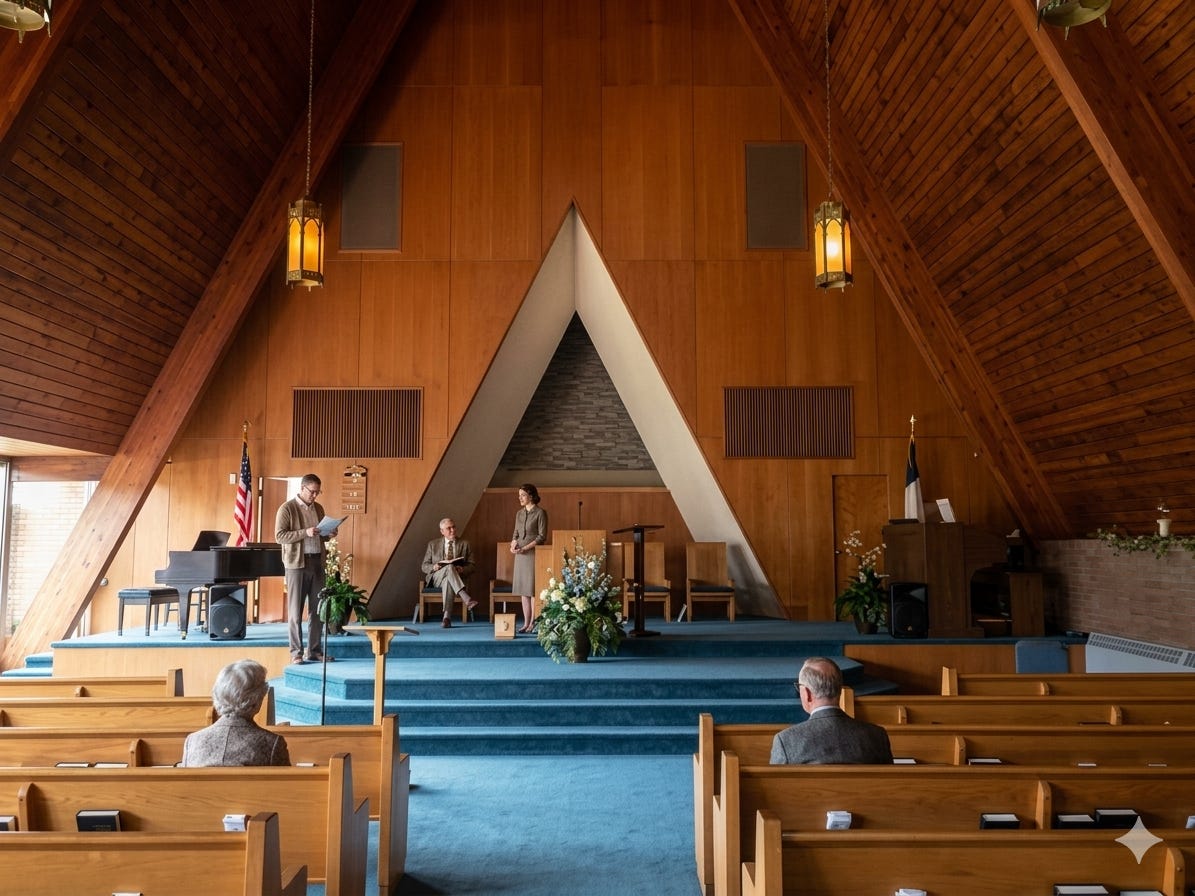
The boomers did arrive. For a time, the institutions filled. The academies enrolled. The colleges grew. The conference machinery hummed with the energy of a tradition that believed it was approaching the culmination of its mission. And then, with the particular cruelty that history reserves for confident institutions, the future that had been built for did not continue in the direction anticipated. The boomers aged. Their children made different choices. The sanctuaries that had been built for three hundred began seating sixty. The academies that had been designed for two hundred began graduating thirty. The infrastructure remained. The people who had filled it did not.
What the Greatest Generation built for the boomers is now being maintained by the boomers for a generation that is not coming, at least not in the numbers and on the terms that the mid-century architecture assumed. And the boomers who are maintaining it are themselves aging out, taking with them both the institutional memory that sustains the old structures and the giving that funds them. When they are gone, which actuarial tables suggest will happen within the next fifteen to twenty years at the level of meaningful congregational participation, the question of what to do with the buildings they inherited and maintained will fall to a generation that did not build them, does not have the same emotional attachment to them, and does not have the financial capacity to sustain them even if it wished to. The clock is not a metaphor. It is a demographic projection, and it is running.
The answer, available to anyone willing to read the denomination’s own data without the customary institutional optimism applied as a filter, is not encouraging. In 2024, the North American Division collected $2.03 billion in tithe and offerings from its membership, making it by far the most financially productive religious division on earth. That extraordinary sum passed through the extraordinary machinery of conferences and unions and division offices and General Conference remittances, and at the end of its journey it had retained regular attendance from approximately 215,703 of 1,287,739 official members. Fewer than one in six. You are invited to consider what a secular organization would say about an enterprise that processes two billion dollars annually and retains the active participation of seventeen percent of its stated constituency. You are invited to consider what the investors would do. In the church, we call the other eighty-three percent backsliders and trust that December giving will cover the shortfall.
The buildings tell the story before the balance sheets do. The 1950s were a decade of extraordinary religious construction across America. The U.S. population grew from 150 million to 180 million in a single decade, the baby boom was filling Sabbath School rooms, and the suburban expansion of postwar America was building neighborhoods that expected a church on the corner as surely as a grocery store. Adventism built into that boom with the same confidence as every other denomination, sustained by rising postwar income and by a genuine belief that what was being constructed would serve the mission for generations. Drive through almost any American town with an Adventist presence and the physical evidence remains: functional, institutional, mid-century modern, built for a world of stable families and denominational confidence that no longer describes the landscape.
And the buildings are not merely dated. They are crumbling. A crisis of deferred maintenance has been arriving in slow motion at mid-century religious infrastructure for decades, and the bill is now coming due with the particular cruelty of compound interest. The mathematics are documented and unambiguous: every dollar of maintenance deferred generates four dollars of capital renewal needs, and a repair delayed until the point of failure can cost thirty times what early intervention would have required. Redoing the central air conditioning of a 50,000-square-foot facility costs north of a million dollars. Sealing brick exteriors runs into the tens of thousands. A leaky roof climbs into the six figures.  These figures are not projections. They are the quotes currently sitting on the desks of church board treasurers in buildings constructed in 1957 and 1963 and 1971, presented to congregations that peaked in the Johnson administration and have been declining, with intermittent moments of hope, ever since.
This is where the argument becomes one that institutions prefer not to have in public, because it forces a choice that cannot be managed with a strategic plan or dissolved with a prayer. You can direct your resources toward mission, or you can direct them toward deferred maintenance, but you cannot, with integrity, claim to be doing both simultaneously when the building budget is consuming the ministry budget year after year. Most churches already spend between 20 and 30 percent of their total budget on facilities and operations annually , before a single person is reached, a single school is subsidized, or a single evangelistic effort is funded. When the roof finally fails or the HVAC system surrenders after thirty years of emergency patches, that percentage does not negotiate. It simply rises, and the mission absorbs the loss. What analysts have begun calling the Great Mismatch, small aging congregations meeting in large deteriorating buildings, is eroding houses of worship across denominations and regions.  Adventism is not exempt from this pattern. It is, given the concentration of its mid-century building stock and the demographics of its North American membership, among its more exposed participants.
The administrative overhead above those buildings compounds what the buildings have already cost. Of the tithe flowing through the North American Division, approximately 37.5 cents of every dollar goes to pastoral salaries, 14.9 cents to operating expenses across the division, union, and conference administrative layers, and 14.5 cents to retirement obligations for the mid-century workforce now aging out of service. Retirement funding alone consumes nearly as much as education. One might pause on that sentence. A tradition that exists to prepare people for eternity is spending nearly as much on the retirement of its past workers as on the education of its future members, and spending both from the same tithe dollar that its members believe they are giving to finish the gospel commission. By 2005, the cost per convert in North America had reached approximately $41,000, against roughly $5,500 in 1913, adjusted for inflation. That sevenfold inflation is not a sign of spiritual inefficiency. It is the precise and measurable price of a mid-century machine operated in a post-mid-century world, paid without public acknowledgment of what it represents by people of genuine and sacrificial faith.
The educational numbers close the case. Elementary enrollment across the NAD collapsed from between 100 and 160 students per 1,000 members in 1960 to below 60 per 1,000 by 2010. Academy enrollment fell from 30 students per 1,000 members in 1980 to 8.6 per 1,000 by 2020, a 71 percent decline in forty years. Total enrollment across the 13 remaining Adventist colleges and universities dropped from 26,819 students in 2012 to 20,573 in 2023. More than 250 primary and secondary schools have permanently closed in the past decade, their buildings sold or emptied, their pipelines to the colleges severed. The educational vision that animated this tradition from its founding is not in question. The institutions built to carry that vision are losing the race against their own balance sheets, in large part because the resources that might reverse the trend are occupied elsewhere, servicing a past that the future cannot afford to keep funding.
This is the transaction that is not named plainly enough in any denominational report or year-end meeting: every dollar spent maintaining a building that was designed for a congregation three times the current size is a dollar that does not go to the young family in the apartment complex two miles away who has never heard a coherent presentation of the gospel. Every retirement obligation paid to sustain the conference structure assembled in 1962 is a dollar not available to the church planter trying to build something in a city where Adventism has no institutional presence whatsoever. The Greatest Generation built generously and well for a future they could see. That future has changed. Continuing to fund the infrastructure they built, at the expense of the mission that infrastructure was meant to serve, is not faithfulness to their legacy. It is a failure of nerve dressed in the language of honor.
What is required is not a strategic initiative or a year-end emphasis on sacrificial giving. What is required is the kind of honest institutional reckoning that this tradition applies with great rigor to the prophecies of Daniel and almost none to its own organizational arrangements. The conference structure was not handed down at Sinai. The mid-century building was not consecrated by apostolic authority. The administrative layer that consumes nearly 15 cents of every tithe dollar before a single soul is reached was assembled by well-meaning people in a particular historical moment, for particular historical reasons, and it can be reassembled differently without a single doctrine being altered or a single fundamental belief being compromised. Change of this magnitude will be resisted, as all institutional change is resisted, by those whose identity and livelihood are woven into the existing arrangements. That resistance is understandable. It is also, given the data, a luxury the mission can no longer afford.
The hope is genuine. There are communities within Adventism already doing something different, not by abandoning the tradition but by refusing to let institutional inertia masquerade as faithfulness. Church plants in co-working spaces and living rooms, where the absence of a 1962 sanctuary is freedom rather than poverty. Educators carrying Ellen White’s integrative vision in hybrid and micro-credential models that serve students the legacy building cannot reach. Administrators willing to ask, out loud, whether the structure assembled for 1969 is the right structure for now. These are not peripheral experiments. They are previews of what a reconfigured Adventism could look like if the resources currently consumed by the past were redirected toward them.
But the hope must be proportionate to the challenge, and the challenge is generational in both directions. The Greatest Generation built for the boomers. The boomers maintained what they inherited. The generation now coming of age in this tradition, the generation that will determine whether Adventism in North America is a living movement or a managed decline, will not maintain what the boomers maintained. They will not do it because they cannot afford to, and they should not be asked to, because the mission of this church is not the preservation of mid-century institutional arrangements. It is the proclamation of a gospel that this tradition has always believed is the most urgent message in human history.