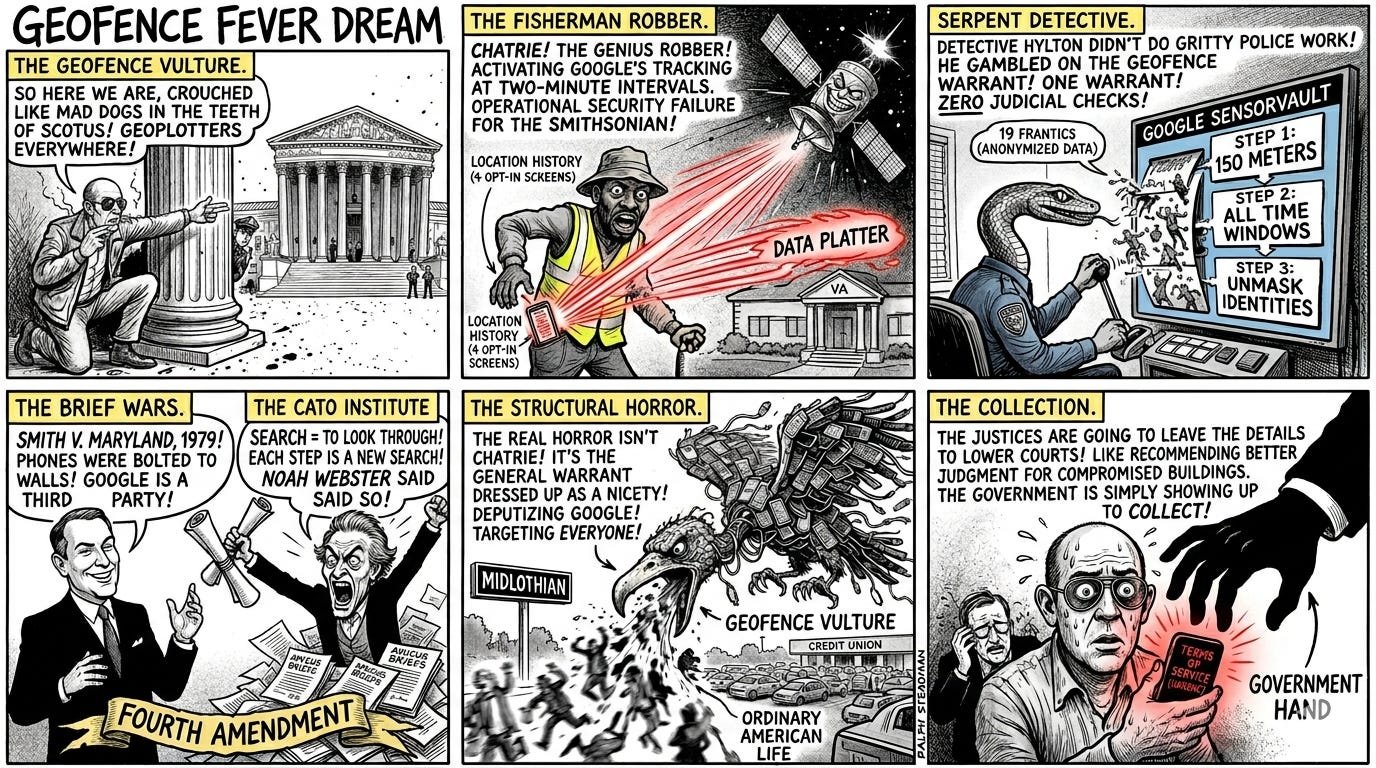
A reader asked us to cover Chatrie v. United States, and when our readers ask, we answer. That is the covenant. That is what separates this publication from the marble-lobbied information cartels that decide what the public deserves to know approximately three weeks after it stops mattering. They know who they are. But here we are, in the teeth of oral argument day, crouched outside the Supreme Court of the United States like a man who knows the building contains something important and cannot quite get anyone inside to confirm it.
Let me tell you about Okello Chatrie. He robbed a credit union in Midlothian, Virginia, at gunpoint, in May 2019, while carrying a smartphone enrolled in Google’s Location History service. This is the kind of operational security failure that deserves its own exhibit at the Smithsonian, behind glass, with a placard that reads: Do Not Do This. He wore a fisherman’s hat and a traffic vest to the job. He handed the teller a demand note referencing hostages he did not have. He forced the manager to open a safe, took $195,000 in banded bills, and walked out into the Virginia afternoon while Google’s infrastructure silently logged his every movement at two-minute intervals, beaming his coordinates to a server farm that would eventually hand him to the federal government on a documented platter.
The man committed armed robbery with a tracking device in his pocket that he personally activated through four separate opt-in screens. There is a Dostoevsky novel in here somewhere, and it ends the same way.
This is, to be perfectly clear, the sympathetic petitioner asking the Supreme Court to reconstruct Fourth Amendment jurisprudence for the digital age.
Now here is where it gets strange. And it gets very, very strange, very fast, in ways that should concern every American who has ever carried a phone into a parking lot while innocent of any crime whatsoever.
To find Chatrie, Detective Joshua Hylton did not canvas witnesses. He did not shake down informants. He did not do much of anything resembling the gritty, shoe-leather police work that fills the first forty minutes of every procedural drama that has ever aired on American television. What he did was file a geofence warrant – a legal instrument that did not exist in recognizable form when most sitting Justices were clerking for judges who believed the telephone was a sufficiently new technology – directing Google to query its Sensorvault database, which at the time held location records for hundreds of millions of accounts, and hand over anonymized data on every device within 150 meters of the bank during the robbery window. This produced 19 accounts. The warrant then authorized investigators to expand the time window to two hours and drop the geographic fence entirely for a subset of those accounts. Then, if the detectives liked what they saw, to unmask whichever identities struck their professional instincts as promising.
Three steps. One warrant. Zero return trips to the magistrate.
The Solicitor General’s brief arrives in the manner of a man in an excellent suit who has already reserved the table and pre-selected the wine. Chatrie opted in. He assumed the risk. Smith v. Maryland settled this in 1979, when the republic was young and phones were bolted to kitchen walls. Google is a third party. The data went to Google. The government asked Google. The argument is internally coherent, well-constructed, and describes a surveillance apparatus that the authors of the Bill of Rights would not have recognized as a free country.
The Cato Institute, which files amicus briefs the way some organizations send Christmas cards, showed up in support of Chatrie and argued that the word “search” meant in 1791 exactly what Noah Webster said it meant in 1828: to look through something for the purpose of finding something. What the government did here, Cato argues, was a search. What the government did at step two was another search. What the government did at step three was a third search. Each one required independent probable cause. Independent magistrate review. Independent authorization. The warrant that was actually issued authorized one escalating expedition with no checkpoints, which is the constitutional equivalent of a hall pass that also covers the parking lot, the gymnasium, and whatever is behind the door marked Authorized Personnel Only.
The government’s response to the property argument – that users actually own their Location History records under state law and Google’s own contractual language – is essentially that American law does not recognize data ownership in any form the Fourth Amendment would dignify, that Google built and processed these records for its own commercial purposes, and that whatever Chatrie thought he owned, he owned nothing beyond what a curious passerby could have observed with functioning eyes. This is true in the way that many deeply troubling things are, technically, true.
The real horror hiding inside this case is not about Chatrie at all. Chatrie is guilty. He confessed. The money was in his bedroom wrapped in the victim teller’s bands. The horror is structural. Investigators did not target Chatrie. They targeted everyone within 150 meters, which on a Tuesday afternoon near a functioning credit union is a description of entirely ordinary American life. The geofence warrant is a general warrant with a three-act structure and a minimization requirement dressed up as a constitutional nicety. It deputizes Google as the investigator, instructs it to build a suspect list from its planetary database, and allows law enforcement to decide at each stage, with no judicial check, how far to proceed into the lives of people who did nothing except exist in a public space at an inconvenient moment.
Based on this morning’s argument, the Justices appear likely to hold that geofence warrants can be constitutionally drafted, rejecting the Fifth Circuit’s categorical ban, and leave the details to lower courts.  This is the judicial equivalent of observing that a building is structurally compromised and recommending that future architects exercise better judgment.
The good-faith exception will almost certainly preserve the conviction regardless of what constitutional language the Court produces. Chatrie goes back to prison. The doctrine advances three inches toward clarity and retreats two inches into ambiguity. And somewhere right now, in a database maintained by a company whose terms of service nobody has read in full, someone’s movements are being recorded at two-minute intervals because they wanted better traffic updates and clicked the wrong button on a Tuesday morning six years ago.
That is the deal that was offered. Everyone signed it. The government is simply showing up to collect.
