Most of us learned it before we knew what we were learning – small voices doing our best with a melody that felt like it had existed forever:
Red and yellow, black and white, all are precious in His sight.
It is probably the second most sung children’s hymn in America, after “Jesus Loves Me.” Most people who have known it their whole lives have no idea where it came from, or why.
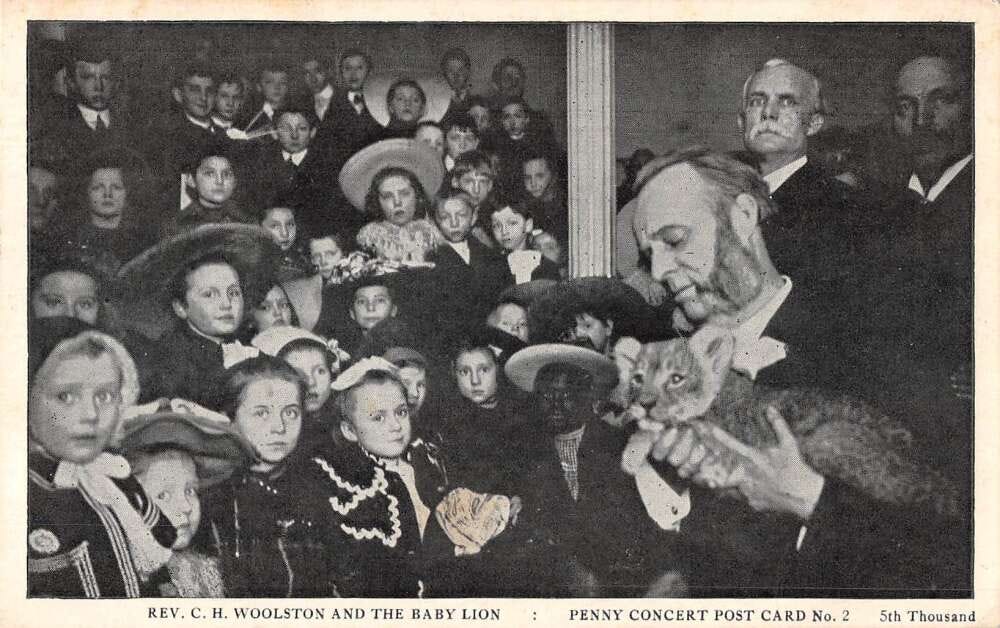
Clarence Herbert Woolston was a Baptist minister in the Kensington neighborhood of Philadelphia in the early 1900s, a preacher who had discovered that the best way to reach children was to meet them where they were. He ran what he called Penny Concerts, services priced at one cent admission, and he filled them with magic tricks, object lessons, and the occasional exotic animal. A postcard survives of Woolston holding a baby lion.
The children came in off the streets, shabbily dressed, from every background the city had to offer, and they sat in the pews of East Baptist Church and paid attention.
One Sunday morning, children of multiple races and nationalities came through the doors. The congregation’s welcome had limits. Woolston watched his own church pull back from the very children he had invited in. He saw the discomfort, the subtle withdrawal, the polite but unmistakable signal that the love being preached from the pulpit applied more comfortably to some than to others.
He went home and wrote a song.
The tune he chose was George Frederick Root’s “Tramp! Tramp! Tramp!,” a Civil War marching song written in 1864 for Union prisoners of war. Root had composed it to give hope to men in captivity, men waiting for rescue, men holding on to the belief that something better was coming. Woolston took that melody, steeped as it was in suffering and longing, and turned it toward the children sitting in pews where they were not entirely wanted.
The hymn was published in 1913 with three full stanzas. Editors eventually stripped it to the refrain alone, which turned out to be the part that mattered:
Jesus loves the little children, all the children of the world. Red and yellow, black and white, all are precious in His sight. Jesus loves the little children of the world.
What Woolston understood, and what makes the song quietly extraordinary, is that he did not write it as a rebuke. He wrote it as a fact. Jesus loves the little children. All of them. The statement does not argue or plead. It simply declares what is true and leaves the listener to reckon with the distance between that truth and what they have just witnessed, or practiced, or quietly believed.
The children who sang it did not need to understand its history to receive its message. That was the point. Woolston had spent his ministry learning that simple things, when they are true, have a way of outlasting complicated ones. A magic trick that illustrated grace. An animal that made a child laugh and then listen. A refrain short enough for a five-year-old to memorize that carried, underneath its cheerful melody, a claim about the nature of divine love that the adults in the room had apparently not yet absorbed.
Woolston died in 1927. The song was already in dozens of hymnals. It has been translated into languages spoken on every inhabited continent. It has been sung by children who had no idea what prejudice was, and by children who knew exactly what it felt like to be on the wrong side of it.
Jesus loves the little children. All the children of the world. Not the ones who look right, or come from the right families, or sit quietly in the right pews. All of them.