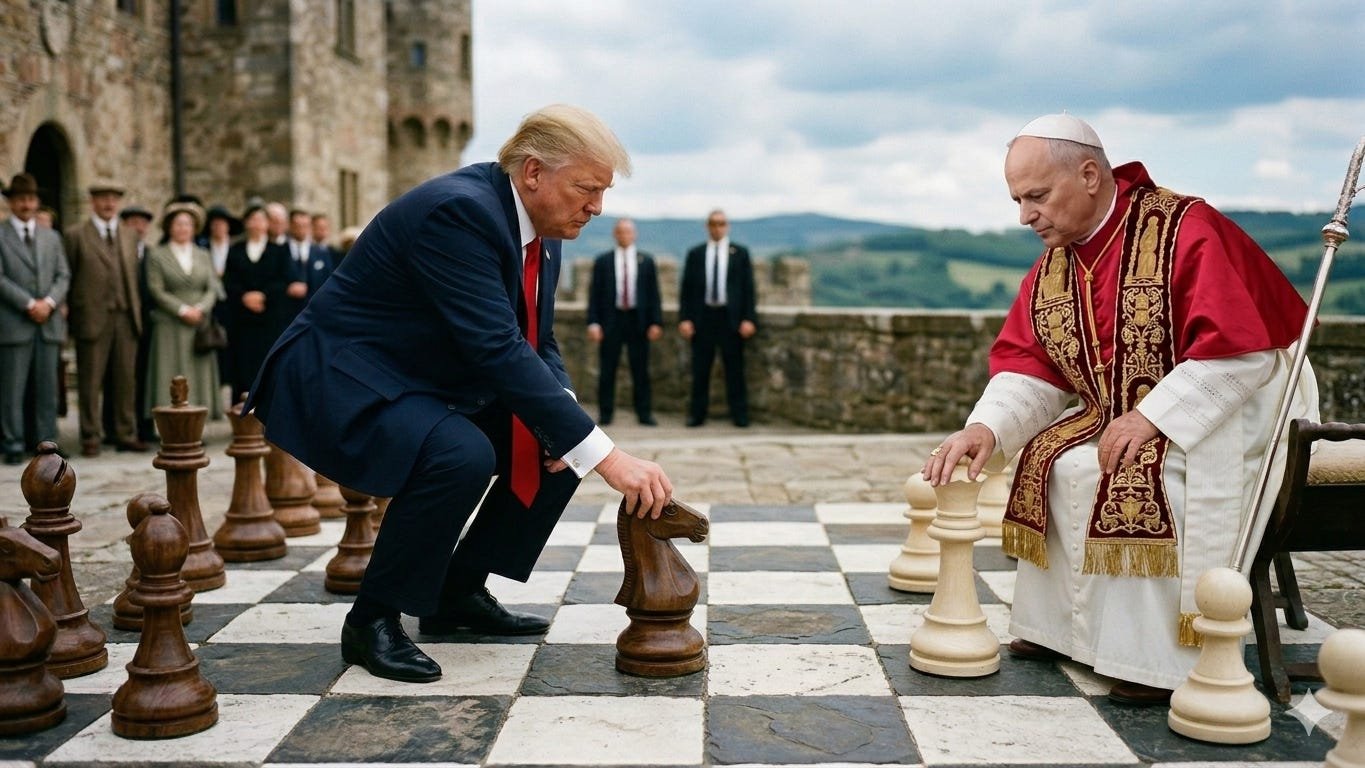
The fight between Donald Trump and Pope Leo XIV is not a personality clash. It is a contest over who gets to define what comes next, and beneath it runs a fault line older than the republic itself
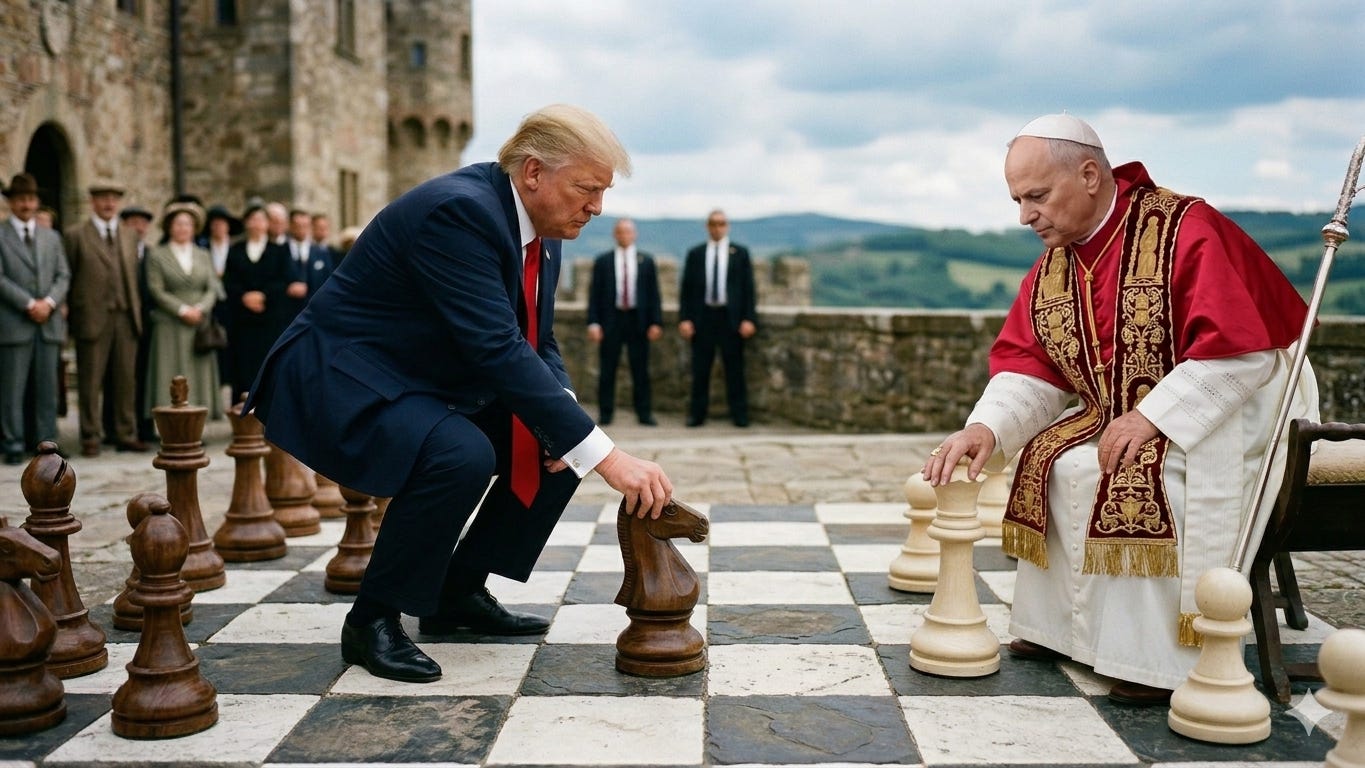
TLDR: Trump attacked the first American pope as “weak” and “terrible,” posted an AI image of himself as Jesus Christ, then turned on Italian Prime Minister Giorgia Meloni after she called his assault on Leo XIV “unacceptable” — fracturing his own coalition in real time. Beneath the headlines, two competing theologies are fighting for control of a collapsing world order: one that believes God blesses American military power, and one that insists no nation gets to speak for God at all. The Reformation never resolved that argument. It is being relitigated right now, at the Pentagon and at the Vatican, with bombs in the air over Iran.
Something is being born, and no one agrees what it is.
The postwar architecture of American-led multilateralism is no longer pretending to function. The Trump administration discarded what it called the “sprawling architecture of global governance,” signaling that American foreign policy would no longer sustain international order but advance narrowly defined domestic restoration.  China is filling the vacuum, expanding into the very multilateral bodies the United States has vacated while BRICS adds new members.  Brazil’s President Lula has warned that Trump is attempting to create a new international system and own it, while the UN charter is being torn. 
The contest over what replaces it is now fully visible, and it has produced an unexpected fault line. Trump on Tuesday slammed Italian Prime Minister Giorgia Meloni, his one-time closest European ally, deepening a rift after she publicly condemned his attack on Pope Leo XIV and his opposition to the Iran war.  “I’m shocked by her,” Trump told the Italian daily Corriere della Sera. “I thought she was brave. I was wrong.”  Meloni is a Catholic. So is JD Vance. So are roughly 70 million Americans. Trump has picked a fight that is simultaneously geopolitical, personal, and theological, and the collateral damage is spreading faster than his team appears to have anticipated.
The Crusade
To understand why, it is necessary to understand what the Trump administration has actually been doing in the name of God.
Defense Secretary Pete Hegseth, whose home church is affiliated with the Communion of Reformed Evangelical Churches, declared at a Pentagon briefing during the Iran ceasefire that “God deserves all the glory” for the military campaign.  At a Pentagon prayer service in March, he prayed: “Let every round find its mark against the enemies of righteousness and our great nation.”  Trump has surrounded himself with evangelical advisers who frame his policies as divinely sanctioned, interpreting Middle East conflict as a precursor to the end times.  Congressional investigators were told that troops had been informed the Iran war was God’s plan and that Trump was “anointed by Jesus to light the signal fire in Iran to cause Armageddon.” 
This is a recognizable strand of Protestant theology: dispensationalist, dominionist, convinced that the state becomes a legitimate instrument of divine purposes when led by the properly anointed. It holds that God works through national power, that America is a chosen instrument, and that its wars carry heaven’s sanction when waged by the right leaders. The church, in this framework, blesses the sword. The nation is the vessel.
Then, on Sunday night, after attacking Leo on Truth Social, Trump posted an AI-generated image of himself depicted as a Christ figure, placing his hand on a man’s head in a healing pose, with light emanating from his fingers and warplanes visible overhead.  He later told reporters he thought it portrayed him as a doctor. Conservative Christian commentator Megan Basham called it “OUTRAGEOUS blasphemy.”  The image was deleted. The theology behind it remains operative.
Rome’s Answer
Leo XIV has spent months making clear that the Catholic tradition answers this argument with a different one.
On Palm Sunday he told the faithful that “Jesus is the king of peace, who rejects war, whom no one can use to justify war.”  At a peace vigil at St. Peter’s on the same Saturday American and Iranian officials met in Pakistan, he declared: “Enough of the idolatry of self and money! Enough of the display of power! Enough of war!”  This week, writing to scholars gathered at the Casina Pio IV for the Pontifical Academy of Social Sciences plenary session — themed “The Uses of Power: Legitimacy, Democracy and the Rewriting of the International Order” — he stated that Catholic social teaching regards power not as an end in itself but as a means ordered toward the common good, and that the legitimacy of authority depends not on the accumulation of strength but on the wisdom and virtue with which it is exercised.  Democracy itself, he wrote, “remains healthy only when rooted in the moral law,” and without that foundation risks becoming “either a majoritarian tyranny or a mask for the dominance of economic and technological elites.” 
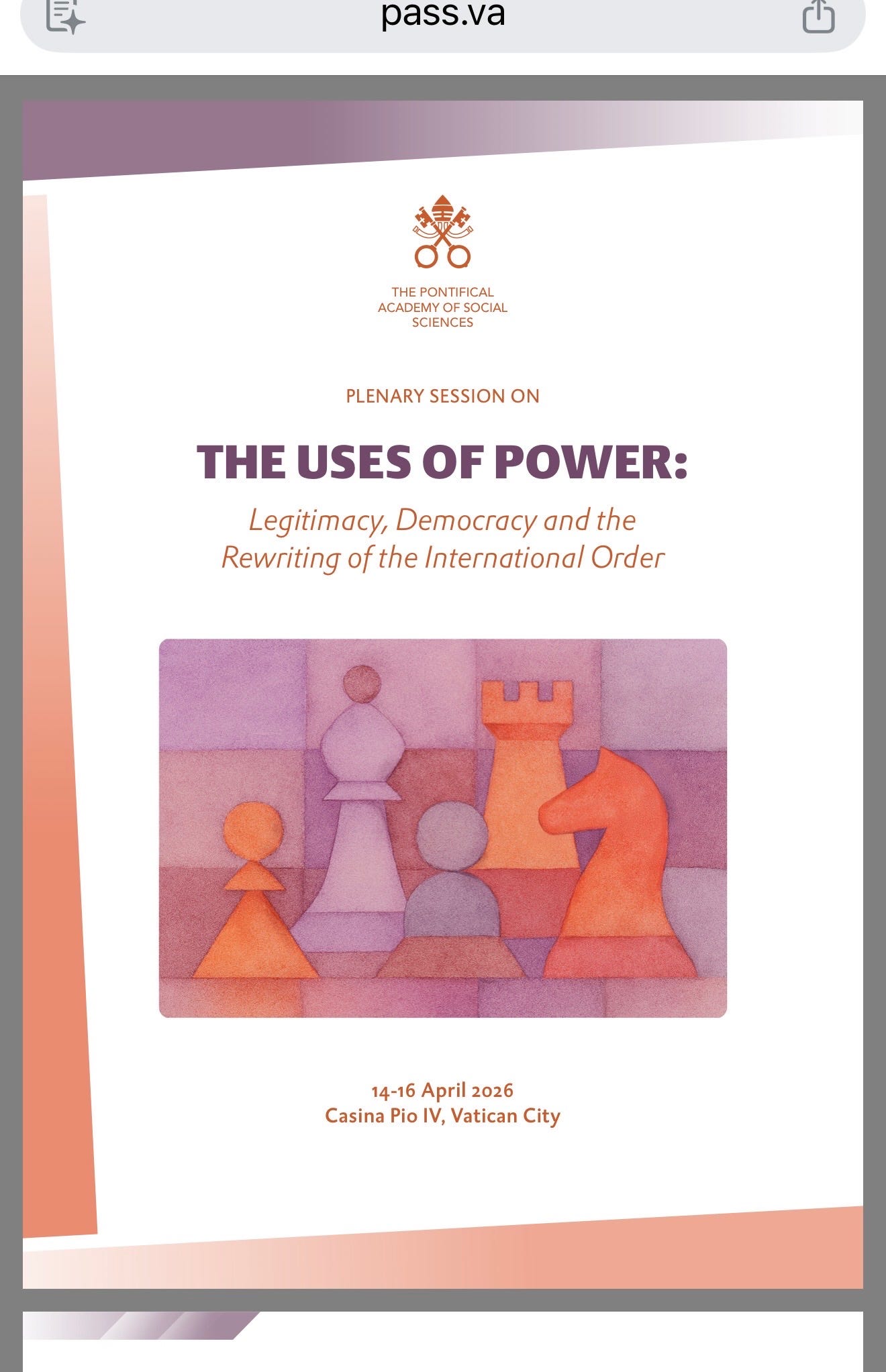
https://www.pass.va/content/dam/casinapioiv/pass/pdf-booklet/2026_booklet_plenary_pass.pdf
The Catholic tradition Leo is defending locates sovereignty not in any nation but in a universal moral law the church claims authority to interpret and apply. No government, however powerful, gets to appoint itself the executor of divine will. The bishop does not bless the sword on demand. The Reformation never settled this question. It produced two incompatible answers and Christendom spent two centuries resolving them by force before exhaustedly agreeing to set the matter aside at Westphalia in 1648.
The matter is no longer set aside.
The Fight
In January, senior U.S. defense officials summoned a top Vatican diplomat to the Pentagon in a meeting Vatican officials described as a bitter lecture warning that the United States had the military power to do whatever it wanted and that the Church had better take its side.  The demand was, in ecclesiastical terms, the oldest one in the book: sanctify our power, or get out of the way.
The Holy See is perhaps the only remaining global institution perceived to carry genuine moral authority, which is why a government with no apparent qualms about bombing foreign countries has devoted energy to courting, or demanding, the Vatican’s favor.  The White House expected the first American pope to be an asset. It is treating his independence as a betrayal.
Trump claimed on Truth Social that Leo “wasn’t on any list to be Pope, and was only put there by the Church because he was an American, and they thought that would be the best way to deal with President Donald J. Trump. If I wasn’t in the White House, Leo wouldn’t be in the Vatican.” 
Leo departed Monday for an eleven-day tour of Africa and told reporters aboard the papal plane: “I have no fear, neither of the Trump administration, nor speaking out loudly about the message of the Gospel, which is what the Church works for.” 
Neither man can consolidate the order he is proposing. A world organized around American military supremacy and Protestant divine sanction persuades no one who does not already share its premises. A moral order pressed by an institution carrying its own historical weight faces limits of its own. What is not limited is the underlying argument. The first American pope and the American president are locked in a struggle over whether political power should be restrained by universal moral law, or whether force alone determines what is permissible in history. 
One man is making that argument from somewhere over the Sahara. The other answered it Sunday night with an image of himself as Christ, light pouring from his fingers, warplanes overhead, before thinking better of it and deleting the post.
The scholars at the Casina Pio IV are debating the rewriting of the international order this week. The deepest argument driving that rewrite is one Christendom has never finished having.
