The President Who Told the Pope to Shut Up (And the King Who Tried It 500 Years Ago)
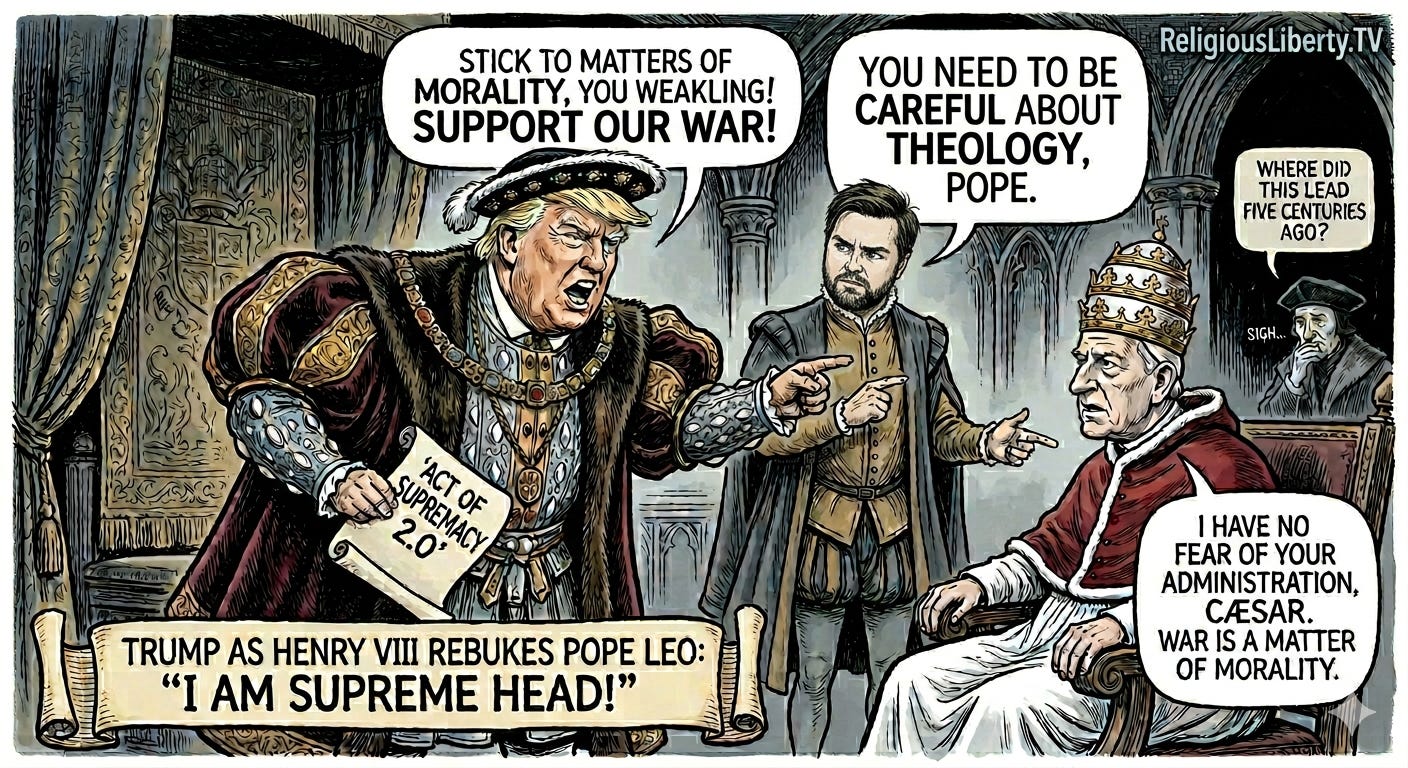
Henry VIII wanted a church that would bless his decisions. Trump appears to want the same arrangement, without the bureaucratic paperwork. Pope Leo XIV’s response was unambiguous: “I have no fear of the Trump administration.” 
Donald Trump issued a 334-word broadside on Truth Social attacking Pope Leo XIV as “WEAK on Crime, and terrible for Foreign Policy,” claimed credit for the pope’s election, and posted an AI-generated image depicting himself as Jesus Christ.  That last part he eventually deleted, but without apology.
JD Vance, a Catholic convert, was dispatched to Fox News to manage the fallout. His answer was remarkable for its candor: “In some cases it would be best for the Vatican to stick to matters of morality… and let the president of the United States stick to dictating American public policy.” 
What Vance was really doing was drawing a jurisdictional line between the spiritual and the temporal, with Washington on top. It is a very old argument, and it has a very old precedent. Henry VIII made precisely this case in 1534 when Parliament passed the Act of Supremacy, declaring the English Crown the “Supreme Head of the Church of England.” Henry had a matrimonial dispute Rome would not accommodate, and his solution was institutional: if the pope won’t cooperate, rewrite the chain of command.
The parallels are not perfect, but they are instructive. Henry did not destroy Christian faith in England; he nationalized it. He kept the liturgy, the bishops, the vestments. What he eliminated was the one thing he could not control: an external spiritual authority with the standing to say no. Trump has no Act of Supremacy, and the Catholic Church is not subject to American statute. But the impulse is identical. The pope drew Trump’s anger by speaking about the war in the Middle East and the treatment of immigrants. Vance’s argument that these fall outside the Vatican’s proper domain collapses on inspection: by any reasonable definition, they are precisely matters of morality. 
This is where Trump’s instincts reveal a fundamental misreading of what the separation of church and state was designed to do. The Founders of the United States had watched European history closely enough to know that state entanglement with religion produced persecution, coercion, and the weaponization of faith for political ends. The wall Jefferson described in his 1802 letter to the Danbury Baptists was erected precisely so that no president could tell a religious body what subjects were and were not permissible topics for moral instruction. Trump has inverted the principle entirely, treating the Vatican’s prophetic voice as an intrusion into his jurisdiction rather than recognizing that his jurisdiction ends where conscience begins.
To be precise: the United States government cannot silence the pope, and it cannot silence any other religious leader. The First Amendment remains intact, and Leo XIV is an independent sovereign head of state beyond any American legal reach. But the attempt to delegitimize religious moral authority, to draw a government-issued map of what faith may and may not address, is its own kind of pressure. Normalized over time, it shapes what religious leaders feel free to say, what congregations expect to hear, and what churches are willing to risk. The danger is not a single executive order. It is the gradual redefinition of religious liberty from a right that protects prophetic speech into a privilege that requires political permission.
Many Protestant evangelicals have cheered this confrontation from the sidelines, pleased to see a pope put in his place by a president they regard as their champion. That comfort is badly misplaced. The principle Vance articulated does not stop at the Tiber. If the state claims authority to define which religious pronouncements count as legitimate “matters of morality” and which constitute improper interference in public policy, every church is subject to that same standard. The Southern Baptist pastor who preaches on immigration, the Pentecostal bishop who speaks to criminal justice, the evangelical college that declines to comply with federal mandates on grounds of conscience: all of them are vulnerable to the same logic Vance just supplied to Washington.
Henry VIII’s Protestant heirs learned this slowly and painfully. The Church of England became a state instrument not because England abandoned Christianity, but because it handed the Crown a veto over Christian witness. Nonconformists, Baptists, and Quakers spent the next two centuries paying the price for that arrangement in fines, imprisonment, and exile.
Five centuries ago, Thomas More went to the scaffold rather than sign a loyalty oath to a king who had decided he outranked the pope. The question now is a quieter one, but not entirely different: who holds the final word on what belongs to Caesar, and what does not? Protestants who think that question only concerns Catholics have not read enough history.