
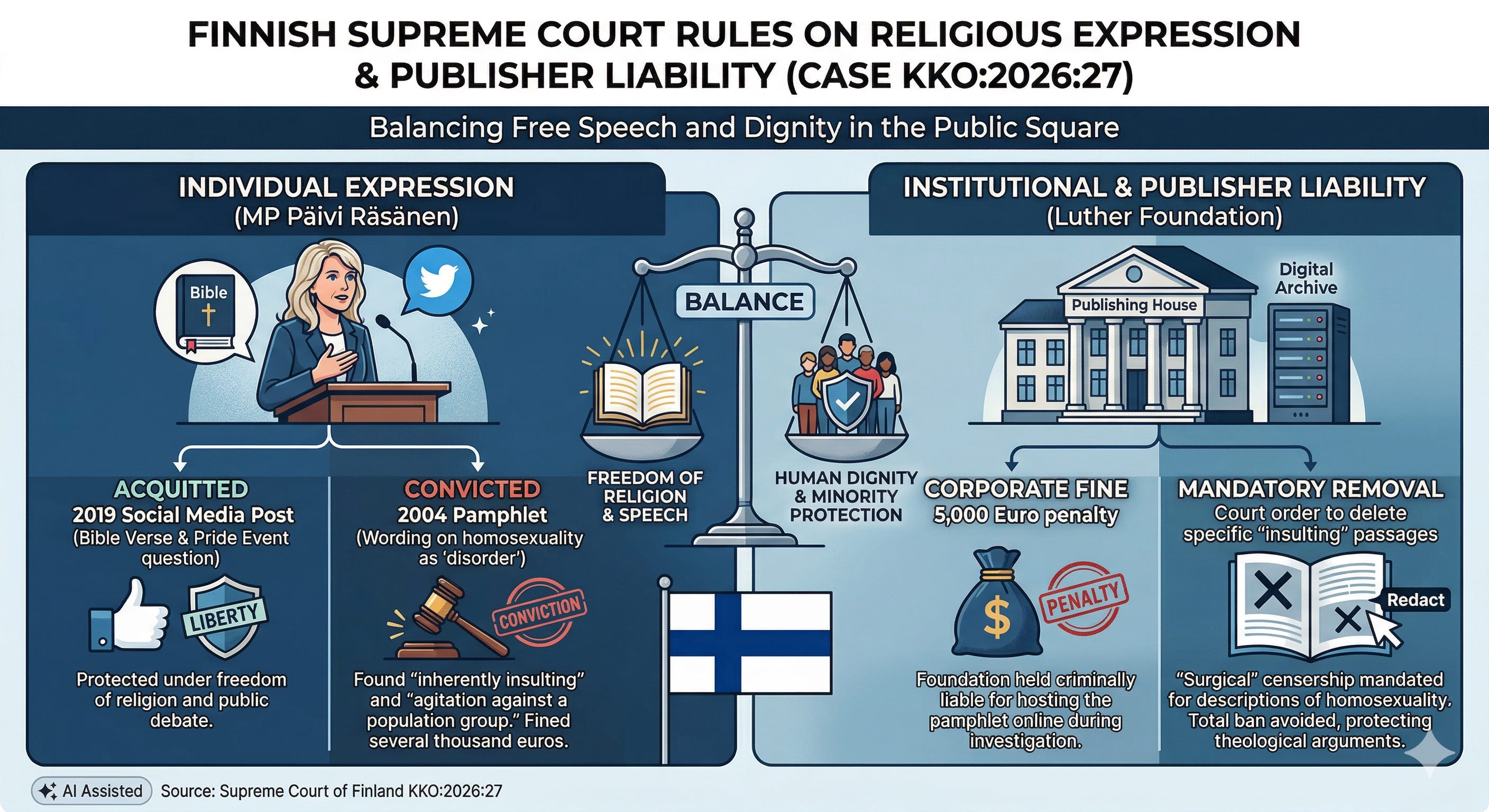
The Supreme Court of Finland has issued a final verdict in the long-running “Bible Trial,” convicting Member of Parliament Päivi Räsänen and Bishop Juhana Pohjola of “agitation against a population group.” While the Court acquitted Räsänen for a 2019 tweet featuring a Bible verse, it found that specific descriptions in a 2004 pamphlet she authored were “inherently insulting” to homosexuals. The Court levied a 5,000 euro corporate fine against the Luther Foundation Finland for hosting the document online. It also ordered the publisher to remove the offending passages immediately. This ruling establishes a precedent that publishers are legally responsible for the “insulting” content of their digital archives, even if the material was created twenty years ago. The defense maintains that this constitutes a violation of free speech and religious autonomy
Case Info: KKO:2026:27, March 26, 2026, https://korkeinoikeus.fi/fi/index/ennakkopaatokset/kko202627.html
The Supreme Court of Finland ruled that while quoting the Bible is protected, using “denigrating” clinical labels to describe protected groups is a criminal offense. The Court sentenced Päivi Räsänen and Bishop Juhana Pohjola to pay multiple day-fines for their roles in writing and publishing a 2004 pamphlet. The Luther Foundation Finland must now redact the document to comply with the Court’s order. This decision highlights the legal risks for publishers who maintain historical religious archives that conflict with modern hate speech statutes.
Why this story? This case marks a significant shift in European jurisprudence. It moves the threshold for “hate speech” from “incitement to violence” to “criminal insult.” It places a new burden on religious institutions to audit their historical publications for language that may now be considered illegal.
Why was the Luther Foundation Finland fined 5,000 euros?
The Court applied corporate criminal liability because the Foundation continued to host the 2004 pamphlet on its website during the investigation. The judges determined that the Foundation, as the legal entity in charge of the digital archive, had a duty to remove content that insulted the dignity of a minority group. By maintaining public access to the pamphlet, the Foundation was found to have participated in the ongoing “agitation.” The fine serves as a penalty for prioritizing the theological mission of the publisher over the state’s mandate for “neutral” and “respectful” public discourse.
What were the specific charges in the Räsänen case?
The prosecution brought three main charges against Räsänen. The first concerned a 2004 pamphlet she authored regarding marriage and sexuality. The second involved a 2019 tweet questioning her church’s sponsorship of a Pride event, which included a photo of Romans 1:24-27. The third related to comments made during a 2019 radio debate. The Supreme Court only ruled on the pamphlet and the tweet, as the prosecution did not appeal the lower court’s acquittal regarding the radio segment.
Why did the Court convict Räsänen for the pamphlet but not the tweet?
The Court made a distinction between citing religious texts and using derogatory clinical language. In the 2004 pamphlet, Räsänen described homosexuality as a “disorder of psychosexual development.” The majority found this phrasing crossed the line from theological opinion into “insulting” speech. Conversely, the 2019 tweet was protected because she “justified her opinion by citing a biblical text” in the context of a legitimate public debate about church policy. The Court found the tweet did not contain the same derogatory weight as the pamphlet’s specific assertions.
What are the legal penalties imposed by the Court?
The Supreme Court sentenced Räsänen to a fine of 20 day-fines, totaling approximately 1,800 euros. Bishop Juhana Pohjola, as the publisher, was fined approximately 1,100 euros. Additionally, the Luther Foundation Finland received a corporate fine of 5,000 euros. The Court ordered the removal of the derogatory portions of the pamphlet from public websites. The judges noted that the offense was not “particularly serious” because it lacked incitement to violence, but they maintained that the insult itself was a criminal act.
How did the Court rule regarding MP Päivi Räsänen?
Päivi Räsänen faced three charges, but the Court focused on her 2004 pamphlet and a 2019 social media post. The Court acquitted her of the 2019 post, ruling that quoting a Bible verse to question church policy is a protected form of religious expression. However, the Court found her guilty for the pamphlet. The judges ruled that her description of homosexuality as a “psychosexual developmental disorder” was not a theological necessity but a derogatory slur disguised as a clinical label. Despite her role as a parliamentarian, the Court found her speech exceeded the bounds of protected political debate.
What specific actions must the publisher take now?
The Luther Foundation Finland is under a court order to redact the “impugned statements” from the pamphlet titled “Male and Female He Created Them.” The Court did not ban the entire booklet but identified specific sentences that must be deleted. This “surgical” censorship requires the publisher to edit a historical document to suit modern legal standards. If the Foundation fails to remove these specific phrases, it could face further criminal charges and increased fines. This places the state in the role of an editor for religious organizations.
Does the absence of violence protect the author and publisher?
No. The Supreme Court explicitly noted that the offense was “not particularly serious” because there was no incitement to physical harm or violence. Nevertheless, the Court maintained that under Finnish law, the “insult” to human dignity is a standalone crime. This means that peaceful religious or philosophical arguments can lead to criminal convictions if the language is deemed “offensive” enough to a protected class. For publishers and politicians, this ruling removes the “non-violence” safe harbor that previously protected controversial speech.Which specific passages did the Court order the Luther Foundation to remove?
The Supreme Court targeted sections of the 2004 pamphlet that utilized medicalized and developmental language to describe homosexuality. Specifically, the Court identified passages characterizing homosexuality as a “psychosexual developmental disorder” as the basis for the conviction. The judges focused on the assertion that same-sex attraction is a “proven” deviation from healthy development. While the Court allowed the Foundation to retain general theological arguments about marriage and sin, it mandated the deletion of these specific “clinical” claims, ruling they were intended to denigrate the human dignity of homosexuals rather than merely express a religious viewpoint.
Why did the Court differentiate between Scripture and these specific descriptions?
The Court ruled that while citing the Bible is a protected exercise of religion, the supplemental “pseudo-scientific” claims made by the author were not. The majority opinion argued that by labeling a group as “disordered” or “abnormal,” the pamphlet moved beyond theological discourse into the realm of “insulting” social commentary. The Court found that these specific descriptions created a “hostile and demeaning atmosphere.” Therefore, the order to remove only these sentences was intended to separate “protected religious speech” from “unprotected criminal insult.”
How does this removal order affect the integrity of the archive?
For the Luther Foundation, the order creates a “Swiss cheese” archive where historical documents must be redacted to remain legal. The Foundation argued during the trial that removing these passages alters the historical record of the church’s internal debates. However, the Court maintained that the “continued availability” of the insult on the internet constitutes an ongoing criminal act. This means the Foundation cannot simply label the document as “historical.” They must actively edit the digital file to comply with the ruling or face further corporate penalties.
What are the implications for other publishers holding similar documents?
The ruling sets a precedent that “historical context” is not a valid defense for “insulting” content that remains publicly accessible. Any publisher or organization with archives containing similar descriptions of protected groups is now legally vulnerable. If an organization does not proactively redact language that mirrors the “disordered” phrasing found in KKO:2026:27, they could be subject to “agitation” charges. This puts the burden on the publisher to interpret current social and legal norms and apply them to documents written decades ago.
How does this ruling impact future free speech in Finland?
This decision creates a narrow but significant restriction on religious and philosophical speech. It suggests that while the Bible can be quoted, interpreting those beliefs in a way that uses “insulting” medical or developmental labels can lead to criminal conviction. The 3-2 split indicates deep judicial disagreement over where the line between “insult” and “expression” lies. Legal experts suggest this “chilling effect” may lead to increased self-censorship among religious groups and political figures when discussing sensitive social issues.
Discussion
The Supreme Court of Finland has essentially created a law against being “insulting,” which is a standard so vague it invites political prosecution. By convicting a member of parliament and her publisher for a twenty-year-old booklet, the state is sending a message that no archive is safe and no public figure is immune. This is a dramatic expansion of state power into the realm of private belief and historical record.
The 5,000 euro fine against the Luther Foundation is a heavy-handed attempt to force religious groups into self-censorship. If a foundation has to pay thousands of euros for hosting a document from two decades ago, they will likely delete everything that isn’t perfectly aligned with today’s social norms. This is how you kill the “marketplace of ideas.” You don’t burn the books; you just fine the publishers until they burn the books themselves.
Päivi Räsänen’s conviction is equally troubling. The Court is trying to distinguish between “Scripture” and “interpretation,” but for a religious believer, there is no such thing as a “pure” text without an application. By telling Räsänen she can quote the Bible but cannot apply its teachings to human development in a way the state finds “unpleasant,” the Court has effectively hollowed out the right to religious freedom.
This “surgical” removal of sentences is a form of state-mandated gaslighting. The state is forcing a church to rewrite its own history. Once the government becomes the final editor of a church’s pamphlet, the separation of church and state is over. The state has declared its own “secular theology” of dignity to be the supreme law, and any religious thought that contradicts it is now a crime.
Citations
Supreme Court of Finland. “KKO:2026:27.” Korkein Oikeus, 26 Mar. 2026, https://korkeinoikeus.fi/en/index/supremecourt/news/supremecourtpaivirasanenandherinternetpublisherconvictedofagitationagainstapopulationgroup.html.
Alliance Defending Freedom International. “Finland’s Supreme Court Convicts Parliamentarian.” ADF International, 26 Mar. 2026, https://adfinternational.org/news/breaking-finlands-supreme-court-acquits-parliamentarian-on-bible-tweet-convicts-her-for-insult-in-20-year-old-church.
Subscribe to ReligiousLiberty.TV for updates on this case and its implications for faith in the public square. Our subscribers get access to breaking news and in-depth case info.
AI Disclaimer: This article was assisted by AI. Legal Disclaimer: This does not constitute legal advice. Readers are encouraged to talk to licensed attorneys about their particular situations.