
What did Jefferson’s letter to the Danbury Baptists say about separation of church and state?
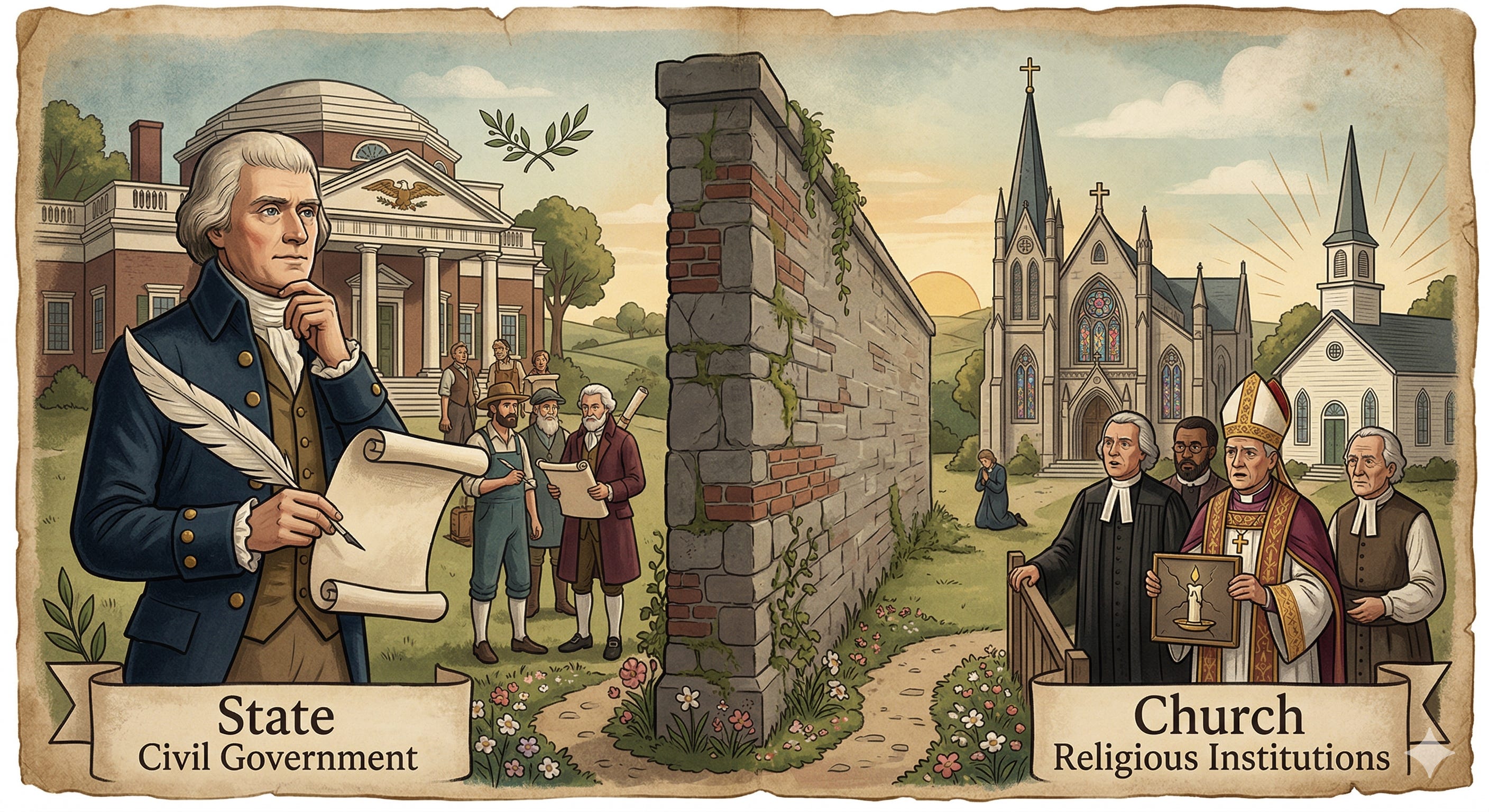
Thomas Jefferson’s Jan. 1, 1802, letter to the Danbury Baptist Association of Connecticut contains the phrase “a wall of separation between Church & State.” The letter’s key passage reads: “Believing with you that religion is a matter which lies solely between Man & his God, that he owes account to none other for his faith or his worship, that the legitimate powers of government reach actions only, & not opinions, I contemplate with sovereign reverence that act of the whole American people which declared that their legislature should ‘make no law respecting an establishment of religion, or prohibiting the free exercise thereof,’ thus building a wall of separation between Church & State.” The full letter is available at Founders Online.
Why did Jefferson write the letter to the Danbury Baptists?
Jefferson had two purposes. The first was to issue a “condemnation of the alliance between church and state.” The second was to explain publicly why he refused to issue presidential proclamations for days of fasting and thanksgiving, a practice he viewed as a Federalist instrument for vilifying him. LOC He told Attorney General Levi Lincoln his reply was meant to gratify public opinion in Republican strongholds, being “seasoned to the Southern taste only.” LOC The letter was political correspondence, carefully reviewed by two New England advisers before Jefferson signed and released it on New Year’s Day 1802.
Why did the Danbury Baptists write to Jefferson?
The Baptists’ complaint was not about a national establishment of religion. It was about the Connecticut state constitution, which did not prohibit the state from legislating on religious matters. Religious liberty in Connecticut was not a protected right but a legislative concession. Wikisource The association told Jefferson their religious freedom felt like a favor granted by the legislature rather than an inalienable right. They were a minority sect operating under a legal framework that still reflected the assumptions of the Congregationalist majority, and they wanted the new president to say, on the record, which side of that arrangement he was on.
What was Thomas Jefferson’s religion?
Jefferson’s religious beliefs defied easy categorization in his own time and still do. He was not an atheist, despite the Federalist campaign to brand him as one. He was not an orthodox Christian either, by any measure his contemporaries would have recognized. He was a product of the Enlightenment who took religion seriously enough to think about it on his own terms, which was precisely what made him dangerous to those whose authority depended on others not doing the same.
Jefferson described himself as “a real Christian, that is to say, a disciple of the doctrines of Jesus, very different from the Platonists, who call me infidel, and themselves Christians and preachers of the gospel, while they draw all their characteristic dogmas from what its Author never said nor saw.” Monticello He produced what is now called the Jefferson Bible, a personal compilation of the New Testament from which he excised the miracles, the resurrection, and the supernatural apparatus of orthodox Christianity, leaving what he considered the pure moral teaching of Jesus. He admired that teaching as, in his words, “the most sublime and benevolent code of morals which has ever been offered to man.” He simply declined to accept the institutional church’s claim to be its authorized interpreter.
Jefferson rejected the Trinity, original sin, and the divine inspiration of Scripture as later corruptions of an original and simpler message. He described himself as “a sect by myself,” and believed that human reason was the proper arbiter of religious truth. Christian History Institute He attended church services throughout his presidency, welcomed clergy to the White House, and opened federal buildings for Sunday worship. He also refused to proclaim national fast days, regarded the Federalist clergy’s political involvement as a form of spiritual corruption, and spent years dismantling the Anglican establishment in Virginia. He was, in short, a man whose relationship with religion was too complicated to fit on a campaign placard, which is why his opponents simply called him an atheist and moved on.
How was Jefferson treated because of his religion during the 1800 election?
The 1800 presidential campaign subjected Jefferson to a sustained religious attack that has few parallels in American political history. His opponents did not merely question his fitness for office. They questioned whether his election would bring divine judgment upon the nation.
Dutch Reformed clergyman William Linn published an influential pamphlet warning that a vote for Jefferson “must be construed into no less than rebellion against God,” and that elevating an infidel to high office would lead to the “destruction of all social order and happiness.” Christian History Institute Presbyterian minister John Mitchell Mason declared it would be “a crime never to be forgiven” to place the presidency in the hands of “an open enemy to their religion, their Redeemer, and their hope.” Christian History Institute
The Gazette of the United States reduced the choice to a headline: “Shall I continue allegiance to GOD — AND A RELIGIOUS PRESIDENT [John Adams] Or impiously declare for JEFFERSON — AND NO GOD!!!” Union University
Yale College President Timothy Dwight warned that a Jefferson presidency would produce a scene in which “the Bible is cast into a bonfire” and Americans would be found “chanting mockeries against God.” Splinter Alexander Hamilton wrote to New York Governor John Jay urging “a legal and constitutional step” to “prevent an Atheist in Religion and a Fanatic in politics from getting possession of the helm of the State.” Online Library of Liberty
The charges drew on a passage from Jefferson’s Notes on the State of Virginia in which he had written: “It does me no injury for my neighbor to say there are twenty gods, or no God. It neither picks my pocket nor breaks my leg.” To Enlightenment rationalists, this was a statement of principled tolerance. To the Federalist clergy, it was a confession. The New England Palladium warned that “should the infidel Jefferson be elected to the Presidency, the seal of death is that moment set on our holy religion, our churches will be prostrated.” Wikipedia
Jefferson said nothing publicly in his own defense throughout the entire campaign. He won anyway. Two months after taking office, he wrote the Danbury letter. The man who had been called an atheist by half the clergy in America used his first major statement on religion to defend a Baptist congregation’s right to worship without asking the state’s permission. The irony was not lost on anyone paying attention.
Is “separation of church and state” in the Constitution?
No. The phrase does not appear in the Constitution. It comes from Jefferson’s 1802 private letter to the Danbury Baptist Association. The First Amendment states: “Congress shall make no law respecting an establishment of religion, or prohibiting the free exercise thereof.” The Supreme Court elevated Jefferson’s phrase to constitutional significance in Reynolds v. United States (1878), declaring it could be accepted “almost as an authoritative declaration of the scope and effect of the [First] Amendment.” LOC Justice Hugo Black invoked it again in Everson v. Board of Education (1947) as an authoritative declaration of the Founders’ intent for the Establishment Clause. Bill of Rights Institute
What is Speaker Mike Johnson’s position on separation of church and state?
At the 2026 National Catholic Prayer Breakfast, House Speaker Mike Johnson said “separation of church and state” is “one of the most misunderstood issues in American society,” insisting that “Jefferson clearly did not mean that wall to keep religion from influencing our government and public life.” Johnson maintained that “the Founders wanted to protect the church and the religious practice of citizens from an encroaching state, not the other way around.” Christian Post Johnson, a lawyer and former adjunct professor of constitutional studies at Liberty University, argues the wall runs only one direction: protecting the church from government, not government from the church.
Is Mike Johnson’s reading of Jefferson’s letter accurate?
It is accurate in part and incomplete in substance. Johnson is correct that the phrase is not in the Constitution, and correct that the Founders generally believed religious and moral virtue were essential to republican self-government. Where his reading breaks down is in what the letter was actually written to address. The Danbury Baptists were not asking Jefferson to welcome religion into government. They were a religious minority in a state where the dominant sect’s assumptions were embedded in law, and their own liberty was subject to legislative discretion. Jefferson’s wall was not built to protect the majority faith from an encroaching secular state. It was built because religious minorities had learned, from experience, what happens when civil government decides which religion deserves the franchise. Jefferson himself described his purpose as issuing a “condemnation of the alliance between church and state.” LOC That condemnation ran in both directions.
It is also worth noting that Jefferson himself had just survived a presidential campaign in which organized clergy used their institutional authority to brand him an atheist and urge his defeat on theological grounds. He knew from direct personal experience what it cost a man when the church decided to influence the government’s choice of leader. The Danbury letter was written one month into his presidency. The memory was fresh.
Who else has criticized or defended the separation of church and state?
The debate runs across two centuries of American law and politics. Justice Potter Stewart argued in 1962 that jurisprudence was not “aided by the uncritical invocation of metaphors like the ‘wall of separation,’ a phrase nowhere to be found in the Constitution.” Chief Justice Rehnquist added in 1985 that “unfortunately the Establishment Clause has been expressly freighted with Jefferson’s misleading metaphor for nearly 40 years.” LOC During the 1800 campaign, Dutch Reformed clergyman William Linn warned that a vote for Jefferson “must be construed into no less than rebellion against God.” Christian History Institute Alexander Hamilton urged “a legal and constitutional step” to “prevent an Atheist in Religion and a Fanatic in politics from getting possession of the helm of the State.” Online Library of Liberty Jefferson won the election anyway, and wrote the letter two months later.
Where did the “wall of separation” metaphor come from originally?
The metaphor predates Jefferson by more than 150 years. Roger Williams, the founder of Rhode Island who was expelled from Massachusetts for his insistence on absolute liberty of conscience, wrote of “a hedge or wall of separation between the Garden of the Church and the Wilderness of the World.” His image was theological: the church needed protection from the corrupting entanglements of civil power. Jefferson borrowed the architecture, removed the theological framing, and embedded it in constitutional argument.
What has the Supreme Court said about separation of church and state recently?
The Court has moved significantly away from strict separationism in recent years. Trinity Lutheran v. Comer (2017), Espinoza v. Montana (2020), Carson v. Makin (2022), and Kennedy v. Bremerton School District (2022) collectively represent a sustained retreat toward accommodation of religion in public life. The Lemon test, the three-part framework governing Establishment Clause analysis since 1971, was effectively abandoned in Kennedy. The current Court’s direction broadly reflects the position Johnson articulates, even if the historical account supporting it remains contested.
Where can I read Jefferson’s letter to the Danbury Baptists?
The full text of both Jefferson’s letter and the Danbury Baptists’ original letter are available at Founders Online, National Archives and Teaching American History. Jefferson’s handwritten draft, including passages recovered by the FBI Laboratory, is held by the Library of Congress and viewable at loc.gov.