Most people ignore the economy because it feels boring and disconnected from real life. That usually works, until it doesn’t. I’m writing this because something unusual is happening right now that affects everyday people first. Stocks, gold, and silver are all rising at the same time, and that is not normal. It looks like good news, but it often signals stress underneath the system. This isn’t about fear or predictions. It’s about paying attention early, while there’s still time to plan calmly and make practical choices.
There is a bigger article on the American economy coming out in a couple of days, but today’s market moves really deserve some analysis. If this still doesn’t seem to be important, consider that just before Christmas, on December 22, I sent out a newsletter about silver prices that had just surpassed $65 an ounce. Today it crossed the $118 threshold and it going to likely double in a few days and go much higher. I know Jim Cramer says that it’s overblown, but he also said that Bear Stearns was a good place to keep your money in 2008. Friends, it’s time to buckle down and read the boring stuff – but like your mom said, broccoli is good for you. – Michael
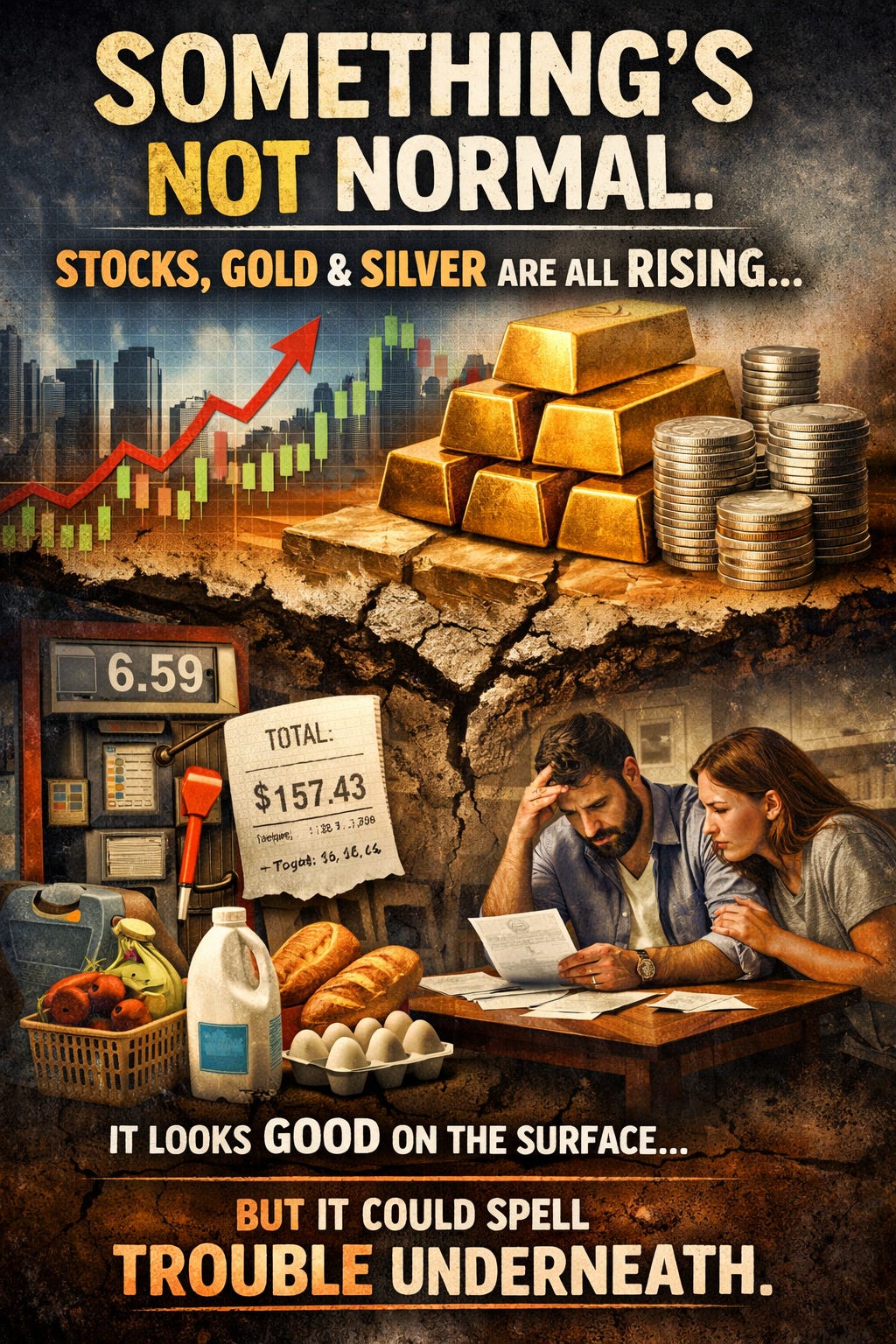
Today, January 28, 2026, the headlines look cheerful.
The S&P 500 climbed above 7,000.
Gold surged past $5,300 an ounce.
Silver continued to trade under strain.
To many people, that sounds like prosperity. Markets up. Assets up. Numbers up.
But this is one of those moments when bigger numbers can actually mean something is wrong.
To understand what is happening, you have to step back from the charts and think in everyday terms. Not as a trader. Not as an economist. As someone who buys groceries, pays rent, fills a gas tank, and tries to save for the future.
Why stocks and gold rising together is a warning
In normal times, stocks and gold move in opposite directions.
Stocks rise when people feel confident about growth, jobs, and earnings.
Gold rises when people worry about inflation or money losing value.
When both rise at the same time, it usually means people are trying to protect themselves while still chasing returns. That is not confidence. That is caution.
Gold does not get better. An ounce of gold today is the same as it was years ago. When gold jumps from $2,000 to $5,300, it is not gold changing. It is the dollar buying less.
This is the first thing many people miss. A higher gold price does not mean wealth is being created. It often means purchasing power is being destroyed.
The stock market can rise for the same reason. Stocks are priced in dollars. If dollars weaken, asset prices often inflate. That does not mean companies suddenly became more productive. It means more dollars are chasing the same things.
Silver tells a more practical story
Gold reflects fear about money.
Silver reflects stress in the real economy.
Silver is not just an investment. It is a working material. It goes into electronics, solar panels, medical equipment, batteries, power grids, and industrial machinery. Factories need it to operate.
Right now, silver is under pressure from two sides.
Investors want it as protection against currency weakness.
Manufacturers need it to keep production going.
Supply cannot easily keep up. Most silver is mined as a byproduct of other metals. You cannot just flip a switch and produce more.
China plays a major role here. It is one of the largest industrial users of silver and a major buyer of gold. When Chinese manufacturers need metal, they prioritize access over price. They are willing to pay more to secure supply.
The Shanghai price gap explained simply
This shows up in something called the Shanghai arbitrage. Ignore the jargon. The idea is simple.
Gold and silver cost more in Shanghai than they do in Western markets. In a calm system, that price gap would close quickly. Traders would move metal from the cheaper market to the more expensive one.
That is not happening smoothly right now.
Why? Because physical metal is hard to move. Imports into China are controlled. Shipping takes time. Paper contracts cannot instantly become bars. When buyers urgently want the real thing, they pay extra.
That price gap is a signal. It says physical metal is scarce where it is most needed. It also says trust in paper promises is weaker.
The hidden problem at home: access and liquidity
At the same time, parts of the physical gold and silver market in the United States are slowing down.
Small dealers depend on fast cash cycles. They buy metal from customers, send it to refiners, get paid quickly, and repeat. Recently, refiners have delayed payments due to sharp price swings. Weeks instead of days.
When cash gets stuck, dealers stop buying. That means someone trying to sell may be offered less than the quoted price or turned away entirely.
This is another important lesson. Price is not the same as liquidity. Owning something is only helpful if you can use it or sell it when needed.
Why bigger dollar numbers can be misleading
This is where everyday people get confused.
If your retirement account is higher, but groceries, insurance, rent, and utilities are rising faster, you are not getting ahead. You are treading water.
If gold is at $5,300, but it takes longer to sell or comes with bigger discounts, the headline price does not help much.
Bigger numbers do not automatically mean progress. Sometimes they mean the measuring stick is shrinking. (Think of Venezuela where the government engaged in “redenomination” of currency to try to stabilize the money by removing 14 zeros from the end of the currency in 13 years. In other words, imagine what it would mean for everyone to be “billionaires” on paper but not be able to buy a loaf of bread even with a truckload of cash.)
The Bible makes this point without economics jargon. Proverbs 11:28 says, “Whoever trusts in riches will fall.” That is not an attack on saving. It is a warning about false security.
So what should ordinary people do
This is where preparation matters, and it does not require panic or fancy strategies.
First, focus on purchasing power, not balances.
Ask what your money can actually buy. Track real costs. Pay attention to how fast essentials are rising.
Second, reduce dependence on debt.
High interest debt becomes heavier when prices rise. Paying it down is one of the safest moves you can make in uncertain times. Less debt equals more freedom.
Third, build margin into your life.
Emergency savings. Lower fixed expenses. Fewer monthly obligations. Margin gives you room to breathe when systems slow or change.
Fourth, avoid putting everything in one place.
This is not about abandoning banks or markets. It is about not assuming any one system will always work smoothly. Diversification applies to income, savings, and skills.
Fifth, prioritize what you can control.
You cannot control inflation, central banks, or global supply chains. You can control spending habits, savings discipline, and preparation.
Ecclesiastes 11:2 puts it plainly. Spread your resources. Do not assume tomorrow will look like today.
Sixth, stay informed, but do not live in fear.
Watch real world signs. Are goods harder to find. Are payments slower. Are prices moving unevenly. These details often matter more than record highs.
The bigger picture
This moment is not about one crash or one event. It looks more like a period of adjustment.
Money feels less stable.
Systems feel slower.
Prices feel disconnected from reality.
Stocks rising show hope.
Gold rising fast shows worry.
Silver tightening shows strain in production.
Taken together, they tell a story of pressure, not prosperity.
Preparation is not about guessing the future. It is about building resilience. Living below your means. Avoiding unnecessary debt. Keeping flexibility. Understanding that bigger numbers are not always good news.
Luke 12:15 offers a grounding reminder. “Life does not consist in an abundance of possessions.”
In times like these, that may be the most practical advice of all.