
Some people told me the economic article about the “Fourth Turning” was too complex. Fair enough. So now we’re walking it out piece by piece. This time: how we got here, why Bryan wasn’t crazy, and why gold and silver are back in the headlines.
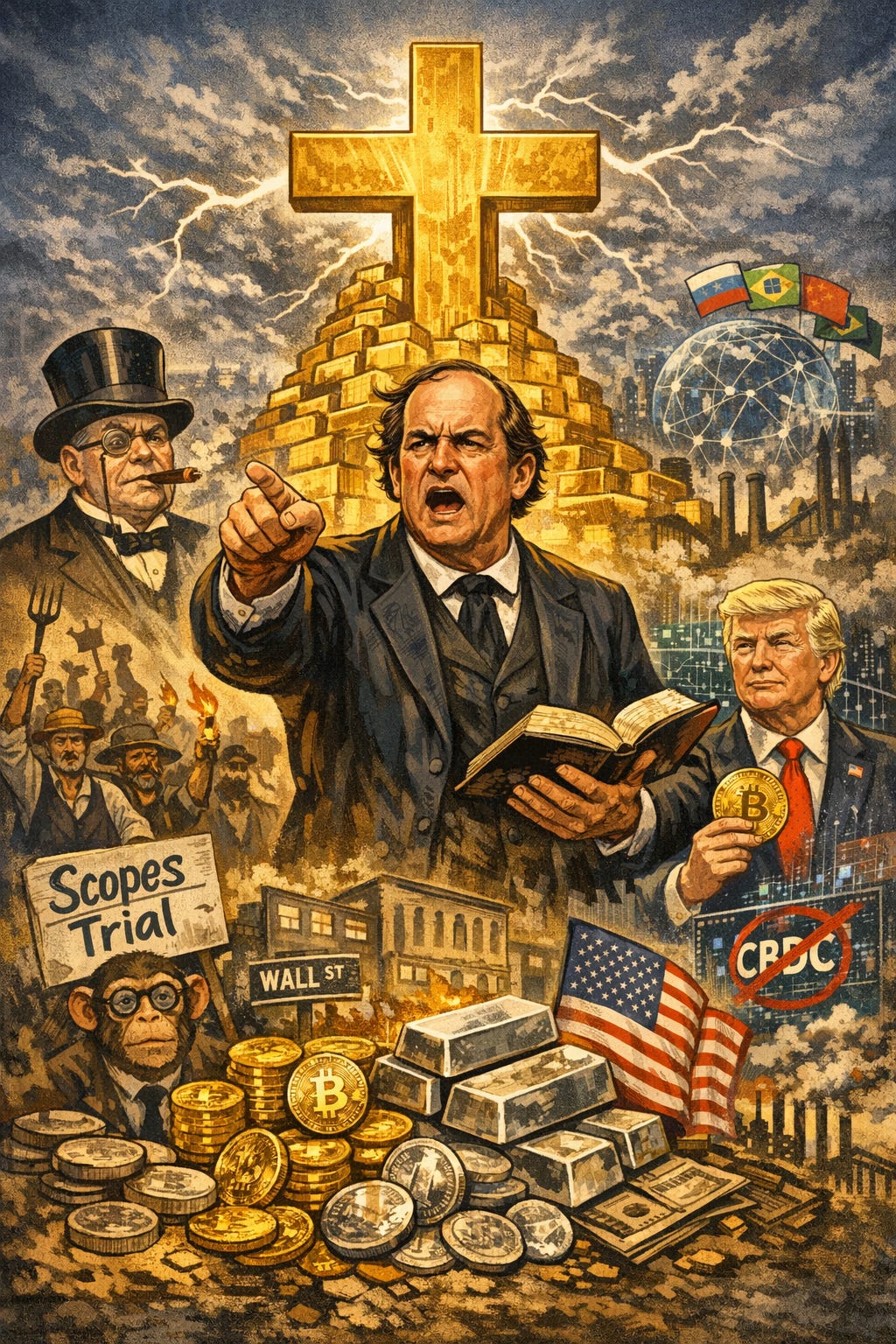
William Jennings Bryan had the look of a man with fire in his lungs and scripture in his pockets. He stepped onto the stage in Chicago in July 1896, just 36 years old, and delivered what would become one of the most famous speeches in American political history. His voice hit like a train—“You shall not crucify mankind upon a cross of gold”—and the room erupted. Men wept. Reporters dropped their pens. A thousand delegates surged to nominate him for president on the spot.
That speech was about monetary policy, yes. But not in the way some economist in a bowtie tells it. It was about control. It was about who gets to decide what your money is worth, and how hard you’ll work to earn it back after it disappears into someone else’s account. Bryan was talking about silver and gold, but what he really meant was this: If you can’t control your own money, someone else controls your life.
He lost the election. Three times. The bankers won. But the question he asked in 1896 still haunts every paycheck and price tag today. What is money? Who creates it? Who decides what it’s worth? And how do you protect yourself when the system turns against you?
Now, more than a century later, that question is wide open again.
Paper Money, Faith, and the Old American Lie
The U.S. dollar is a fiat currency. That means it’s backed by nothing. No gold. No silver. No land. Just belief. You accept a dollar because you trust that someone else will, too. That’s not economics. That’s theology with spreadsheets.
We left the gold standard in 1971. Nixon shut the door on redeeming dollars for metal, and the world adjusted. Sort of. The truth is, it never really settled. Ever since, the dollar has relied on a trust pact: The United States won’t inflate it too fast, and the rest of the world won’t run for the exits.
That pact is breaking. Slowly. Quietly. But breaking.
Inflation hit hard in the early 2020s. Grocery bills doubled. Gas soared. Rent got mean. People who played by the rules got hammered, and the ones who didn’t seemed to float. All while the Federal Reserve printed trillions of new dollars to paper over the damage. That’s when a strange thing happened.
People started stacking metal again.
The Return of Gold and the Rise of Bitcoin
So far in 2026, gold trades north of $5,000 an ounce. Silver cracked $100 and doesn’t look interested in slowing down. Coin dealers are backordered for weeks. Reddit forums light up with pictures of safes, coin rolls, and heirloom bars pulled out of sock drawers.
This isn’t nostalgia. It’s survival. When trust in the system falters, people look for anchors. Gold and silver are heavy. They don’t vanish in a market crash or glitch in the banking app. They sit there. They wait. And they don’t lie.
Then there’s bitcoin. Digital, borderless, limited. Not physical like gold, but real in a different way. It doesn’t ask you to believe in politicians or bankers. Just math. And it’s exactly the kind of money Bryan would have understood: outside the system, unforgiving, and independent.
In 2025, President Trump issued an executive order banning Central Bank Digital Currencies. No digital dollar. No programmable money. No federal account with on/off switches. He also ordered the creation of a Strategic Bitcoin Reserve, pulling together federal holdings of crypto seized through forfeiture and quietly building the first sovereign crypto stockpile.
That’s not normal policy. That’s prepping. It’s hedging the possibility that the fiat game doesn’t last forever.
You don’t make a bitcoin reserve unless you’re afraid of the paper burning.
BRICS and the International Exit Strategy
While the U.S. government argues about budget ceilings and interest rates, the BRICS countries are building an off-ramp. Brazil, Russia, India, China, and South Africa are now designing payment systems that don’t use the dollar at all. They are openly discussing a new currency basket backed in part by gold and trade flows. It’s not a rumor. It’s a live project.
This is what happens when people get tired of one country controlling the price of everything. America doesn’t just print its own money. It prints the world’s money. That comes with power—and consequences. Sanctions, restrictions, banking freezes. The dollar has been used as a weapon, and now countries want out.
It’s not about loving gold. It’s about escaping control.
And that brings us back to Bryan.
Bryan, Scopes, and the Real Meaning of Freedom
Most schoolbooks remember William Jennings Bryan for the 1925 Scopes Trial. He showed up in Dayton, Tennessee to prosecute a high school teacher for teaching evolution, a violation of state law. He squared off against Clarence Darrow and lost in the court of public opinion. The press mocked him. Intellectuals rolled their eyes. It became a shorthand for science vs. religion.
But Bryan was never a fool. He was trying to hold a line in a culture changing faster than its people. And even in that courtroom, he was still talking about trust. Who gets to define truth? Who controls what your children learn? Who decides which voices count?
The currency debate and the evolution debate weren’t the same thing, but they came from the same source: a fear that invisible systems were reshaping the world without consent from the people living in it.
Bryan was not wrong to ask the questions.
Why This Is a Religious Liberty Issue
When governments control money, they control access. When access becomes programmable, so does behavior. A Central Bank Digital Currency could track your donations. It could flag your tithe. It could block support for groups on a no-funding list. In some places, it already does.
Remember, the Mark of the Beast in Revelation 13:17 exploits monetary access rights to force a false religion on people.
Financial freedom is religious freedom. Without it, your ability to support ministries, speak publicly, and live according to conscience becomes dependent on the approval of a central authority. That is not freedom. That is compliance.
Bryan believed in a God who honored human agency. So do many today who are sounding the alarm over CBDCs, surveillance finance, and the erosion of cash.
This is not paranoia. It is pattern recognition.
What Comes Next
The dollar still rules, but it rules by inertia. As debt mounts and trust erodes, alternatives gain ground. Gold and silver are no longer fringe bets. They’re lifeboats. Bitcoin is no longer just an experiment. It’s a declaration of independence.
Trump’s strategic reserve was not a gimmick. It was a signal. Washington is preparing for a future where paper trust might not cut it.
Meanwhile, BRICS continues its work. Congress will return to the CBDC debate soon. And somewhere, deep in a federal vault, the government is quietly holding coins that can’t be printed or erased.
Bryan saw the stakes in 1896. He just didn’t have the tools we have now.
TLDR (Too Long / Didn’t Read Summary)
This is part one in a series explaining the real structure of money and why it matters for freedom. In 1896, William Jennings Bryan warned against a financial system that crushed ordinary Americans. Today, fiat currency relies entirely on belief. With inflation rising and trust fading, people are turning to gold, silver, and bitcoin. Trump’s creation of a Strategic Bitcoin Reserve and rejection of CBDCs highlights concern over state-controlled money. BRICS nations are building alternatives to the dollar. These developments affect not only economics, but religious liberty and personal autonomy.
Like this article? Share it and subscribe to the ReligiousLiberty.TV blog for breaking news, case updates, and more at religiouslibertytv.substack.com.
Legal Disclaimer: This article does not provide legal or financial advice. For legal questions about your specific situation, consult a licensed attorney.
Tags: William Jennings Bryan, Trump bitcoin reserve, BRICS currency plans, CBDC and religious liberty, gold silver bitcoin money system