
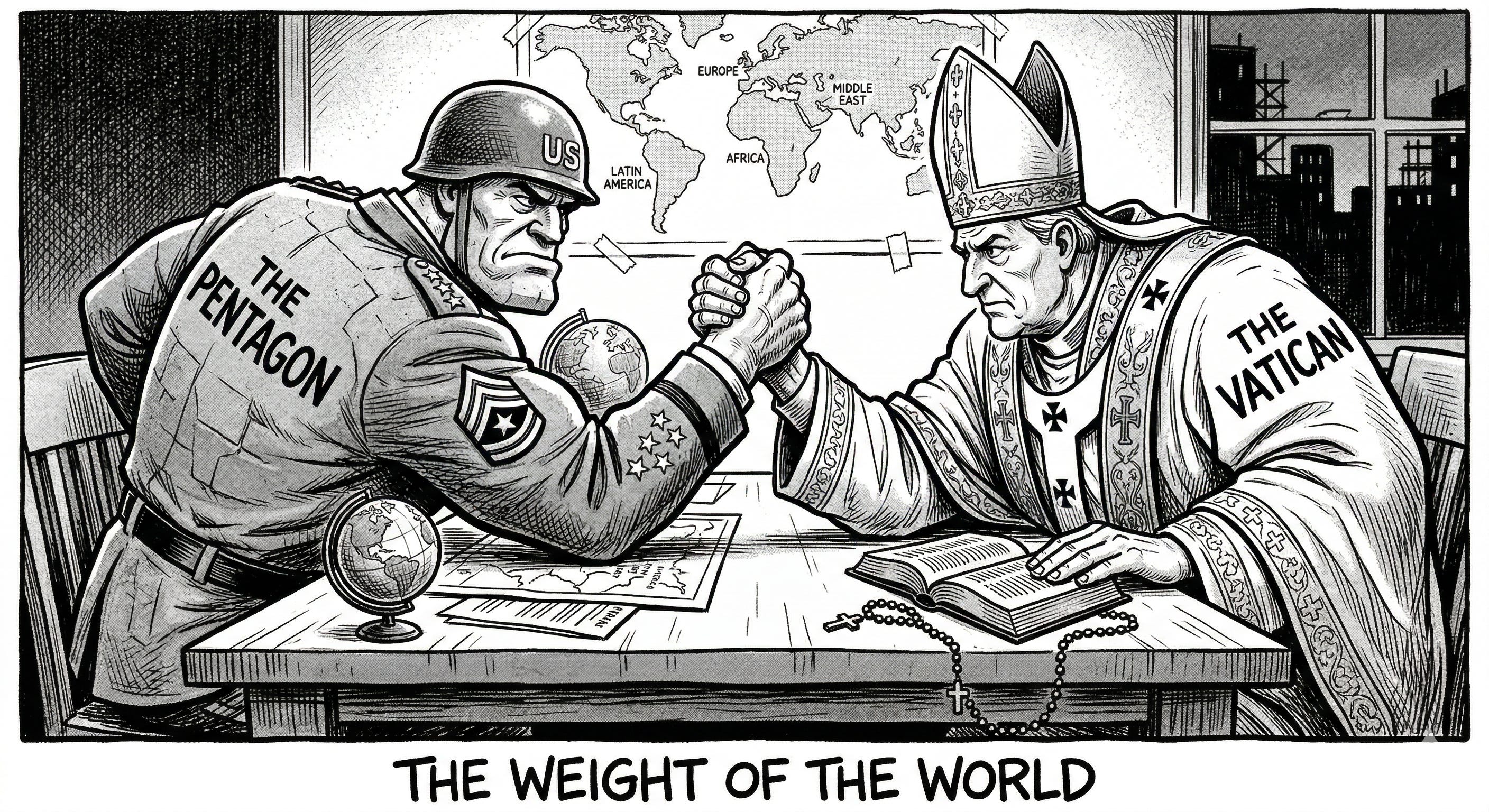
WASHINGTON — When the most powerful military in human history summons a priest and tells him to fall in line, something has shifted in the architecture of American power. That is what allegedly happened in January, and the reverberations have not stopped.
Undersecretary of Defense for Policy Elbridge Colby summoned Cardinal Christophe Pierre to the Pentagon, where he and colleagues told the cardinal that the United States has the military power to do whatever it wants in the world and that the Catholic Church had better take its side. As the meeting grew tense, an unidentified U.S. official invoked the Avignon Papacy, the 14th-century period when the French Crown used military force to bend the bishop of Rome to its will (Hale). The episode, first reported by The Free Press, is believed to be the first meeting of its kind between Pentagon leadership and a Vatican diplomat in American history.
Both sides have disputed the characterization. The Pentagon described the session as “substantive, respectful and professional,” and Vatican spokesman Matteo Bruni said the account offered by certain media “does not correspond to the truth in any way” (Iorfida). U.S. Ambassador to the Holy See Brian Burch said Pierre confirmed the reports were “fabrications” that were “just invented,” describing the session as “a frank and cordial meeting” (”Pentagon Denies”).
But something happened. Some Vatican officials were so alarmed by the Pentagon’s tactics that they shelved plans for Pope Leo XIV to visit the United States later this year. Vice President JD Vance personally extended a White House invitation in May 2025, just two weeks after Leo’s election in the conclave (Hale). The first American pope has declined to set foot on American soil under this administration.
The meeting was triggered by Leo’s January State of the World address, in which he said that “a diplomacy that promotes dialogue and seeks consensus among all parties is being replaced by a diplomacy based on force.” Pentagon officials read that line as a direct challenge to the Donroe Doctrine, Trump’s assertion of unchallenged American dominion over the Western Hemisphere (Hale; Nicholson et al.). The pope had, in effect, called out the administration by name without using it.
He has not stopped. In his Easter address, Leo declared: “Let those who have weapons lay them down! Let those who have the power to unleash wars choose peace — not a peace imposed by force, but through dialogue” (Sonne and Boorstein). When Trump threatened to destroy the “whole civilization” of Iran, Leo called it “truly unacceptable,” saying it raised “a moral question concerning the good of the people as a whole” (”Threat against Entire People”). After a two-week ceasefire was announced April 8, Leo welcomed it as “a sign of living hope” and urged its use for negotiations (Brockhaus and Cardiel).
What makes the standoff remarkable is not just the geopolitics. It is the theology. Defense Secretary Pete Hegseth has constructed a version of Christianity at the Pentagon that reads less like pastoral care and more like a state religion. He hosts monthly Christian worship services for employees, and his department’s promotional videos display Bible verses alongside military footage. At a briefing on the Iran war, he recited Psalm 144: “Blessed be the Lord, my rock, who trains my hands for war and my fingers for battle” (Lamothe et al.). At a worship service after the war’s outbreak, he led Pentagon officials in prayer for “overwhelming violence of action against those who deserve no mercy,” concluding in the “mighty and powerful name of Jesus Christ” (”Hegseth Prays”).
The White House has matched his register. When asked whether God supports the United States in the conflict, Trump said: “I do, because God is good, because God is good, and God wants to see people taken care of” (Sullivan and Liptak).
On Good Friday, April 3, the Pentagon’s in-house chapel held a Protestant-only service, the first time in recent memory that no Catholic Mass was offered on one of Christianity’s holiest days. The exclusion of Catholic employees landed against an already volatile backdrop (Laser, qtd. in “Pete Hegseth and Trump’s Labour Secretary”). Americans United for Separation of Church and State had filed a lawsuit in March, accusing Hegseth of “abusing the power of his government position and taxpayer-funded resources to impose his preferred religion on federal workers.”
The criticism has come from places the administration cannot easily dismiss. Melissa Deckman, CEO of the Public Religion Research Institute, said what distinguishes Hegseth from prior defense secretaries is “his willingness to use overt Christian language and to bring a very sectarian view of Christianity into the Pentagon and into his rhetoric” (Deckman, qtd. in “Hegseth Promoting Christian Nationalism”). More striking still, Archbishop Timothy Broglio, head of the Archdiocese for the Military Services and one of the most conservative Catholic leaders in the country, said Hegseth’s invocation of Jesus Christ to justify the Iran war is “problematic” and that under just war theory, the conflict fails the test (”Pete Hegseth Draws Scrutiny”).
A conservative archbishop, in other words, sided with the pope over the Pentagon.
The developments have landed with particular force among Seventh-day Adventists, a denomination that has spent 170 years insisting that the marriage of church and state power corrupts both. For Adventists, what is unfolding at the Pentagon is not a culture war skirmish. It is the scenario that their theology has named and dreaded for generations: a government that does not merely appreciate Christianity but wields it like a weapon.
Leo, for his part, has not flinched. On Palm Sunday he said: “Brothers and sisters, this is our God: Jesus, King of Peace, who rejects war, whom no one can use to justify war.” He added that Jesus “does not listen to the prayers of those who wage war, but rejects them” (”Threat against Entire People”).
It was a statement aimed, with some precision, at a Pentagon two thousand miles away. Whether the people inside it were listening is another matter entirely.
Works Cited
Brockhaus, Hannah, and Victoria Cardiel. “Pope Leo XIV Welcomes Ceasefire in Iran as ‘Sign of Living Hope.’” EWTN News, 8 Apr. 2026, www.ewtnnews.com/vatican/pope-leo-xiv-welcomes-ceasefire-in-iran-as-sign-of-living-hope.
Hale, Christopher. “The Pentagon Threatened Pope Leo XIV’s Ambassador With the Avignon Papacy.” Letters from Leo, 7 Apr. 2026, www.thelettersfromleo.com/p/the-pentagon-threatened-pope-leo.
“Hegseth Promoting Christian Nationalism During Wartime, Experts Say.” Foreign Policy, 8 Apr. 2026, foreignpolicy.com/2026/04/08/pete-hegseth-christian-nationalism-iran-war-religious-rhetoric-pentagon-defense.
“Hegseth Prays for ‘Overwhelming Violence’ in Iran in the ‘Name of Jesus Christ.’” Truthout, 26 Mar. 2026, truthout.org/articles/hegseth-prays-for-overwhelming-violence-in-iran-in-the-name-of-jesus-christ.
Iorfida, Chris. “Vatican, Pentagon Deny Report of Heated Meeting with Church’s U.S. Representative.” CBC News, 10 Apr. 2026, www.cbc.ca/news/world/pope-white-house-meeting-colby-pierre-9.7158714.
Lamothe, Dan, et al. “Hegseth Injects Combative Christianity into America’s Military.” The Hill, 29 Mar. 2026, thehill.com/policy/defense/5803295-hegseth-christianity-military-pentagon.
Laser, Rachel, qtd. in “Pete Hegseth and Trump’s Labour Secretary Sued over Prayer Services, Religious Discrimination.” CBC News, 26 Mar. 2026, www.cbc.ca/news/world/hegseth-religious-services-prayer-lawsuit-9.7142921.
“NAD Public Affairs and Religious Liberty: Liberty Magazine.” North American Division of Seventh-day Adventists, www.religiousliberty.info/liberty-magazine. Accessed 11 Apr. 2026.
Nicholson, Tom, et al. “Trump Goon Gives Vatican ‘Bitter Lecture’ Amid Growing Rift.” The Daily Beast, 7 Apr. 2026, www.thedailybeast.com/trump-official-gives-vatican-bitter-lecture-amid-growing-rift.
“Pentagon Denies Threatening Vatican During January Meeting with Holy See’s Diplomat.” The Hill, 10 Apr. 2026, thehill.com/policy/defense/5824857-pentagon-denies-threats-vatican.
“Pete Hegseth Draws Scrutiny After Claims He Was ‘Triggered’ by Pope Leo’s Anti-War Message Amid Curtailed Pentagon Catholic Services.” IBTimes, 5 Apr. 2026, www.ibtimes.com/hegseth-draws-scrutiny-after-claims-he-was-triggered-pope-leos-anti-war-message-amid-curtailed-3800895.
“Pete Hegseth and Trump’s Labour Secretary Sued over Prayer Services, Religious Discrimination.” CBC News, 26 Mar. 2026, www.cbc.ca/news/world/hegseth-religious-services-prayer-lawsuit-9.7142921.
“Pete Hegseth’s Christian Rhetoric Reignites Scrutiny After the U.S. Goes to War with Iran.” PBS NewsHour, 20 Mar. 2026, www.pbs.org/newshour/politics/pete-hegseths-christian-rhetoric-reignites-scrutiny-after-the-u-s-goes-to-war-with-iran.
Sonne, Paul, and Michelle Boorstein. “Pope Leo’s First Easter Speech Is Message of Peace to World at War.” The Washington Post, 5 Apr. 2026, www.washingtonpost.com/world/2026/04/05/pope-leo-easter-trump-war-peace.
Sullivan, Kate, and Kevin Liptak. “Analysis: Trump and Hegseth on Iran War: ‘God Is Good.’” CNN Politics, 6 Apr. 2026, www.cnn.com/2026/04/06/politics/hegseth-trump-iran-war-easter-christianity-analysis.
“Threat against Entire People of Iran ‘Is Not Acceptable,’ Pope Leo XIV Says.” EWTN News, 7 Apr. 2026, www.ewtnnews.com/vatican/pope-appeals-for-peace-iran-war-april7-2026.