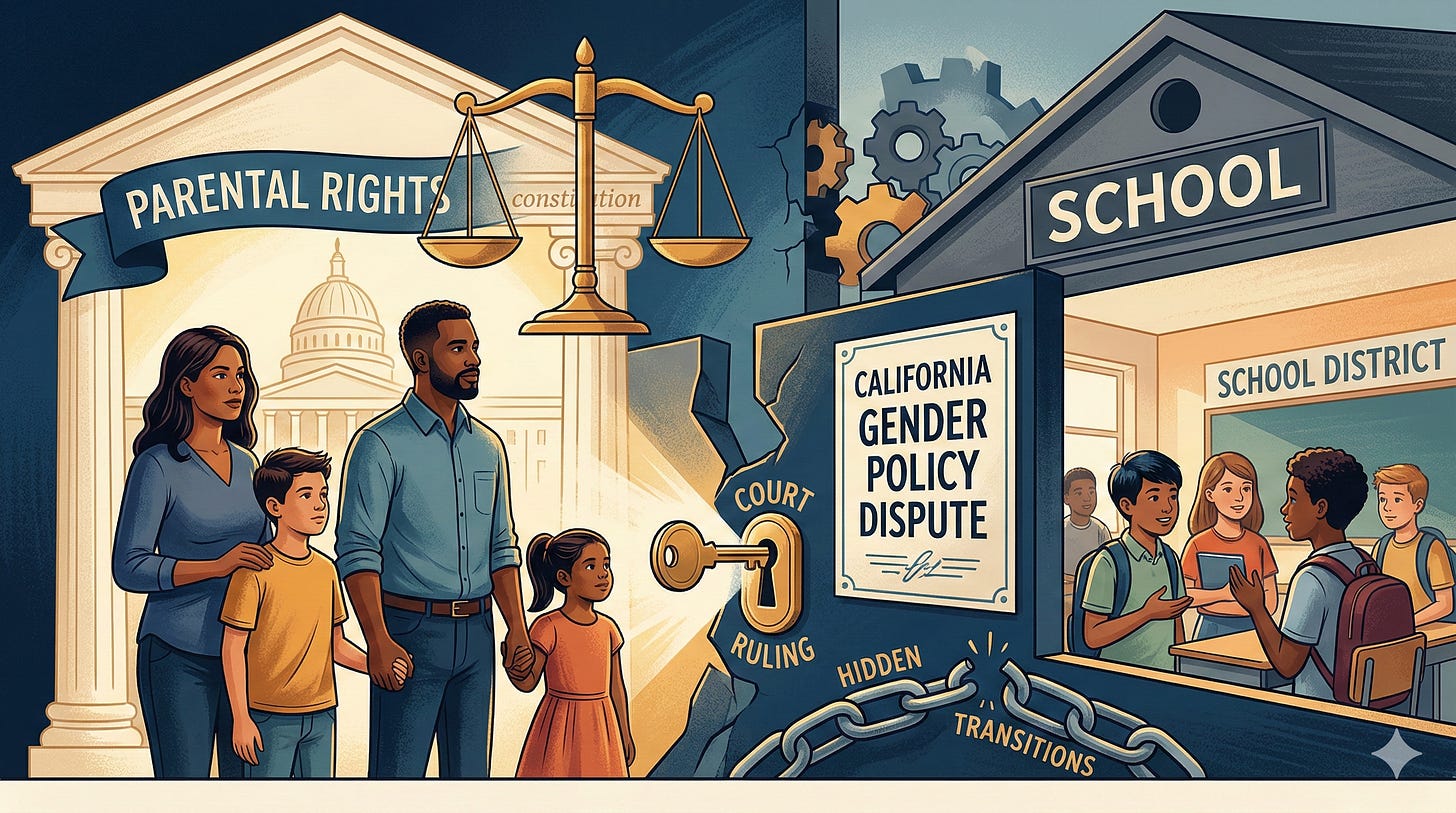
On March 2, 2026, the U.S. Supreme Court ruled in Mirabelli v. Bonta, No. 25A810, that California’s policies preventing public schools from disclosing a student’s gender transition to parents without the student’s consent likely violate both the Free Exercise Clause of the First Amendment and the Due Process Clause of the Fourteenth Amendment. The Court vacated a Ninth Circuit stay and reinstated a permanent injunction protecting parents, finding that California’s policies cut parents out of consequential mental health decisions about their own children. The Court applied strict scrutiny under Mahmoud v. Taylor (2025) and relied on longstanding parental-rights precedents including Pierce v. Society of Sisters (1925), Meyer v. Nebraska (1923), and Parham v. J. R. (1979). The ruling applies to parents only; the stay remains in effect for teacher plaintiffs. Justice Barrett wrote a concurrence joined by the Chief Justice and Justice Kavanaugh. Justice Kagan dissented, joined by Justice Jackson.
Case Caption: Elizabeth Mirabelli, et al. v. Rob Bonta, Attorney General of California, et al. Case Number: No. 25A810 Date: March 2, 2026 Citation: 607 U.S. ____ (2026)
The Supreme Court of the United States has told California that its public schools cannot keep parents in the dark about their children’s gender transitions. In a per curiam opinion issued today, the Court vacated a Ninth Circuit stay and restored a district court injunction blocking the state’s nondisclosure policies. The ruling holds that parents with religious objections are likely to succeed on their Free Exercise Clause claims and that all objecting parents are likely to succeed on their substantive due process claims. California’s policies, which required schools to conceal a student’s gender identity from parents unless the student consented, are now blocked statewide for objecting parents while the case continues on appeal.
This case sits at the intersection of parental rights, religious liberty, and the state’s role in children’s education. It is the first time the Supreme Court has directly addressed whether a state may prohibit schools from informing parents about their child’s gender transition at school. The ruling arrives less than a year after Mahmoud v. Taylor (2025), in which the Court held that exposing children to LGBTQ curricular materials over parental religious objections triggers strict scrutiny under the Free Exercise Clause. With roughly 40 similar cases currently working through the federal courts, Mirabelli v. Bonta sets the terms for how those disputes will be resolved.
What are the facts of Mirabelli v. Bonta?
The case began in 2023 in the U.S. District Court for the Southern District of California. Two teachers initially sued their school district for a religious exemption from policies governing students’ gender identity. During litigation, the school district argued that California state law, as interpreted by the attorney general and Department of Education, required the adoption of these policies. State officials were added as defendants, and parents joined as plaintiffs.
Two families illustrate how the policies operated in practice.
- The Poe family: John and Jane Poe hold religious objections to gender transitioning. Their daughter began presenting as a boy during seventh grade, using a male name and male pronouns at school. No one informed the Poes. At parent-teacher meetings, school staff did not mention the transition or use the male name and pronouns that were in use at school. At the start of eighth grade, the Poes’ daughter attempted suicide and was hospitalized. Only then did her parents learn from a doctor that she had gender dysphoria and had been living as a boy at school. Months after discharge, she was rehospitalized involuntarily due to risk of self-harm. When she began ninth grade at a new school and once again identified as a boy, teachers and administrators continued using male name and pronouns, citing obligations under California state law, even against her parents’ express instructions.
- The Doe family: John and Jane Doe also object to gender transitioning. Their daughter had sometimes identified as a boy since fifth grade. In seventh grade, the Does confronted the school principal about their daughter’s transition. The principal told them that state law prohibited the school from sharing information about a child’s transitioning with the child’s parents without the child’s consent. The Does felt the risk of leaving their daughter in that school was too great. They transferred her to a new public school because private school was financially and logistically out of reach. They also placed their daughter in therapy.
What did the lower courts decide?
The District Court certified a class with separate subclasses for parents and teachers. One parent subclass includes all parents who object to the challenged policies; a separate subclass is limited to parents who seek a religious exemption. Two similar teacher subclasses were also certified.
After discovery, the District Court granted summary judgment for all plaintiffs and entered a permanent injunction that:
- Prevents schools from “misleading” parents about their children’s gender presentation and social transitioning at school.
- Requires schools to follow parents’ directions regarding their children’s names and pronouns.
- Compels defendants to include in state-created or approved instructional materials a notice of the rights protected by the injunction.
The Ninth Circuit then stayed the injunction pending appeal. In doing so, the Ninth Circuit raised two objections. It claimed the District Court certified the class without the rigorous analysis required by Federal Rule of Civil Procedure 23. It also stated the injunction appeared overly broad because it “covers every parent of California’s millions of public school students and every public school employee in the state.”
On the merits, the Ninth Circuit brushed aside Mahmoud v. Taylor as “a narrow decision focused on uniquely coercive ‘curricular requirements’” and relied on a not-precedential Sixth Circuit decision. The Ninth Circuit also expressed skepticism about the parents’ Fourteenth Amendment claims.
How did the Supreme Court rule?
The Court granted the parents’ application and vacated the Ninth Circuit’s stay as to the parent plaintiffs. It denied the application as to the teacher plaintiffs.
The Court applied the four-factor test from Nken v. Holder (2009), examining likelihood of success on the merits, irreparable harm, the balance of equities, and the public interest.
On Free Exercise (First Amendment):
The Court found that parents with religious objections are likely to succeed on the merits. California’s policies trigger strict scrutiny because they “substantially interfere” with the “right of parents to guide the religious development of their children,” as recognized in Mahmoud v. Taylor and Wisconsin v. Yoder (1972). The parent plaintiffs hold sincere religious beliefs about sex and gender and feel a religious obligation to raise their children in accordance with those beliefs.
The Court stated that California’s policies impose a burden on religious exercise that Yoder found unacceptable. It went further, finding that the intrusion on parents’ free exercise rights here, which the Court described as “unconsented facilitation of a child’s gender transition,” is greater than the introduction of LGBTQ storybooks the Court found sufficient to trigger strict scrutiny in Mahmoud.
California argued its policies advance a compelling interest in student safety and privacy. The Court rejected this argument, stating that the policies “cut out the primary protectors of children’s best interests: their parents,” citing Troxel v. Granville (2000). The Court also found the policies likely fail narrow tailoring because the State’s interest in safety “could be served by a policy that allows religious exemptions while precluding gender-identity disclosure to parents who would engage in abuse.”
On Substantive Due Process (Fourteenth Amendment):
The Court found that all objecting parents, not only those with religious claims, are likely to succeed. The Court cited Pierce v. Society of Sisters (1925), Meyer v. Nebraska (1923), and Parham v. J. R. (1979) for the proposition that parents, not the state, hold primary authority over “the upbringing and education of children.” That right includes the right not to be excluded from decisions regarding their children’s mental health.
The Court stated that gender dysphoria is a condition with an important bearing on a child’s mental health, but that California’s policies conceal that information from parents and facilitate a degree of gender transitioning during school hours. These policies, the Court concluded, likely violate parents’ rights to direct the upbringing and education of their children.
On Irreparable Harm and the Balance of Equities:
The Court held that the denial of constitutional rights during the appeals process constitutes irreparable harm, citing Roman Catholic Diocese of Brooklyn v. Cuomo (2020). On the equities, the Court stated that children’s safety is the overriding concern and that the injunction promotes child safety by guaranteeing fit parents a role in consequential decisions in their children’s lives. The injunction also permits the State to enforce child-abuse laws and remove children from parental custody in appropriate cases.
What did Justice Barrett say in her concurrence?
Justice Barrett, joined by Chief Justice Roberts and Justice Kavanaugh, wrote separately to address the substantive due process issue. She acknowledged that substantive due process is a controversial doctrine but stated that the parent-applicants are likely to succeed under a “straightforward application” of existing precedent.
Barrett pointed to the factual record: California prohibits schools from informing parents of their child’s gender transition unless the child consents. The record shows this applies even when parents expressly request the information. She highlighted that one set of parents learned of their child’s transition only after the child attempted suicide, and that even after that event, school administrators continued to withhold information.
Barrett addressed the relationship between this case and Dobbs v. Jackson Women’s Health Organization (2022), responding to the dissent’s invocation of that decision. She stated that Dobbs “calls into question neither the doctrine of substantive due process nor the other unexpressed rights that the doctrine protects.” Dobbs held that Roe v. Wade and Planned Parenthood v. Casey were incorrectly decided because the right to abortion was not deeply rooted in the Nation’s history and tradition. It does not follow, Barrett wrote, that all substantive due process precedents conflict with the standard from Washington v. Glucksberg (1997).
Barrett also defended the Court’s decision to issue a per curiam opinion rather than an unexplained order. She stated that the Ninth Circuit “misunderstood” Mahmoud v. Taylor, and that course correction would allow the case to progress efficiently. She also stated it would have been “unwise to issue an unreasoned order” on the substantive due process claim given the questions raised about the Dobbs relationship.
What did Justice Kagan say in dissent?
Justice Kagan, joined by Justice Jackson, dissented. Her objections focused on process, not on the underlying merits of parental rights.
Kagan argued the Court’s emergency docket “malfunctioned” by resolving novel legal questions through truncated procedures. She noted the case had received only scant briefing, no oral argument, and no conference deliberation. She described the per curiam opinion as “terse” and “tonally dismissive” and stated it was “designed to conclusively resolve the dispute.”
Kagan raised three specific procedural concerns:
- The Ninth Circuit was already acting. The plaintiffs had filed parallel motions: one at the Supreme Court and one asking the Ninth Circuit for en banc review of the panel’s stay. The Ninth Circuit had already called for a response from the State and was preparing to vote on reconsideration. Kagan argued the Court should have let the Ninth Circuit finish first.
- A merits case was already available. Since November 2025, a certiorari petition has been pending in Foote v. Ludlow School Comm., 128 F. 4th 336 (CA1 2025), which Kagan described as “a carbon copy” of this case. She noted that roughly 40 similar cases are currently in the judicial system, and the Court could grant certiorari in any of them for full merits treatment.
- Substantive due process tensions remain unresolved. Kagan argued the Court’s willingness to invoke substantive due process here sits uneasily with recent skepticism of the doctrine expressed by members of today’s majority. She pointed to statements from Justice Thomas, Justice Gorsuch, and Justice Kavanaugh questioning the legitimacy of finding unexpressed rights in the Due Process Clause. She contrasted the ruling with Dobbs, which repudiated a woman’s right grounded in substantive due process, and with United States v. Skrmetti (2025), in which the Court declined even to hear parents’ substantive due process claims about gender-affirming care decisions for their children.
Kagan stated she has “no doubt that parents have rights, even though unenumerated, concerning their children and the life choices they make.” She acknowledged that California’s policy “could have crossed the constitutional line.” Her objection was to the process, not the outcome.
How does this ruling affect parental rights nationwide?
The ruling applies directly to California, but its reasoning will influence dozens of pending cases. By finding that parents are likely to succeed on both free exercise and due process grounds, the Court has given lower courts a template for evaluating similar school policies across the country.
The free exercise holding extends Mahmoud v. Taylor beyond curricular materials to school-level policies about student gender identity. Any state policy that conceals a student’s gender transition from parents with sincere religious objections will now face strict scrutiny.
The due process holding is broader. It protects all objecting parents, regardless of religious motivation. Under the reasoning of Mirabelli, a school policy that systematically excludes parents from information about their children’s mental health is likely unconstitutional, subject to the state’s ability to enforce child-abuse protections in individual cases.
The Court’s statement that “children’s safety is the overriding equity” and that the injunction itself “promotes child safety” by keeping parents involved flips the framing that many school districts have used to justify nondisclosure policies. The Court treats parental involvement as a child-safety measure, not a threat to it.
What happens next?
The case now returns to the Ninth Circuit, where California’s appeal of the District Court’s permanent injunction will proceed. The injunction remains in effect for all objecting parent plaintiffs while the appeal continues. The stay remains in place for teacher plaintiffs.
The Ninth Circuit must still rule on the merits of the appeal. The Supreme Court’s per curiam opinion, Barrett’s concurrence, and the Court’s characterization of the Ninth Circuit’s errors all constrain the appellate court’s options. The Ninth Circuit’s earlier dismissal of Mahmoud v. Taylor as a narrow curricular decision has been directly rejected.
The certiorari petition in Foote v. Ludlow School Comm., No. 25-77, remains pending. If the Court grants certiorari, it could produce a full merits opinion on parental rights and school gender-identity policies as early as the October 2026 Term. With nearly 40 similar cases in the pipeline, further Supreme Court action on this issue is a matter of when, not whether.
Commentary
This decision is a sharp message from the Court, and the message is straightforward: you cannot use the machinery of public education to keep parents out of their own children’s lives. California built a policy architecture that treated parents as adversaries to be managed rather than partners in their children’s wellbeing. The Court has now told every state considering a similar approach that it will not survive constitutional review.
The legal logic is tight. The free exercise holding flows directly from Mahmoud, which already established that forcing religious parents to accept school-level decisions about gender and sexuality triggers the highest form of judicial review. If LGBTQ storybooks in a curriculum are enough to trigger strict scrutiny, then concealing a child’s gender transition from religious parents is an even greater intrusion. The Court did not have to stretch existing doctrine to reach this result. It applied the law as written last Term.
The due process holding is where the real action is. Barrett’s concurrence does the heavy lifting by confronting the Dobbs tension head-on. Her answer is precise: Dobbs overruled Roe and Casey because abortion rights failed the Glucksberg “deeply rooted” test, but parental rights have been recognized since 1923 and 1925. These are among the oldest unenumerated rights in American constitutional law. You do not get to use Dobbs as a wrecking ball against every substantive due process precedent. That is a line the concurrence draws clearly, and it binds the lower courts.
Kagan’s dissent is procedurally serious but substantively empty. She does not disagree that parents have unenumerated rights over their children’s upbringing. She does not say California’s policy is constitutional. She says the Court moved too fast and should have taken a merits case instead. That is a fair criticism of process, but that’s as far as it goes. The Court decided that those parents could not wait, and the four-factor test supported that conclusion.
Citations
Mirabelli v. Bonta, No. 25A810, 607 U.S. ____ (2026) (per curiam).
Mahmoud v. Taylor, 606 U.S. 522 (2025).
Wisconsin v. Yoder, 406 U.S. 205 (1972).
Pierce v. Society of Sisters, 268 U.S. 510 (1925).
Meyer v. Nebraska, 262 U.S. 390 (1923).
Parham v. J. R., 442 U.S. 584 (1979).
Troxel v. Granville, 530 U.S. 57 (2000).
Dobbs v. Jackson Women’s Health Organization, 597 U.S. 215 (2022).
United States v. Skrmetti, 605 U.S. 495 (2025).
Roman Catholic Diocese of Brooklyn v. Cuomo, 592 U.S. 14 (2020).
Nken v. Holder, 556 U.S. 418 (2009).
Alabama Assn. of Realtors v. Department of Health and Human Servs., 594 U.S. 758 (2021).
Washington v. Glucksberg, 521 U.S. 702 (1997).
Foote v. Ludlow School Comm., 128 F.4th 336 (CA1 2025), cert. pending, No. 25-77.
Diamond Alternative Energy, LLC v. EPA, 606 U.S. 100 (2025).
Like, share, and subscribe to ReligiousLiberty.TV for breaking news and in-depth case analysis. Subscribers get access to breaking news updates and case information as it develops.
AI Disclaimer: In order to expedite distribution, this article was assisted by AI. Please double-check all sources.
Legal Disclaimer: This does not constitute legal advice. Readers are encouraged to talk to licensed attorneys about their particular situations.
Holding: The President cannot use emergency statutes to bypass Congress for actions of vast economic or political significance without clear congressional permission under the Major Questions Doctrine.
Holding: Parents have a fundamental right to direct the upbringing and medical care of their children without state interference.
Holding: States cannot require all children to attend public schools; families and private institutions retain authority over education and religious upbringing.