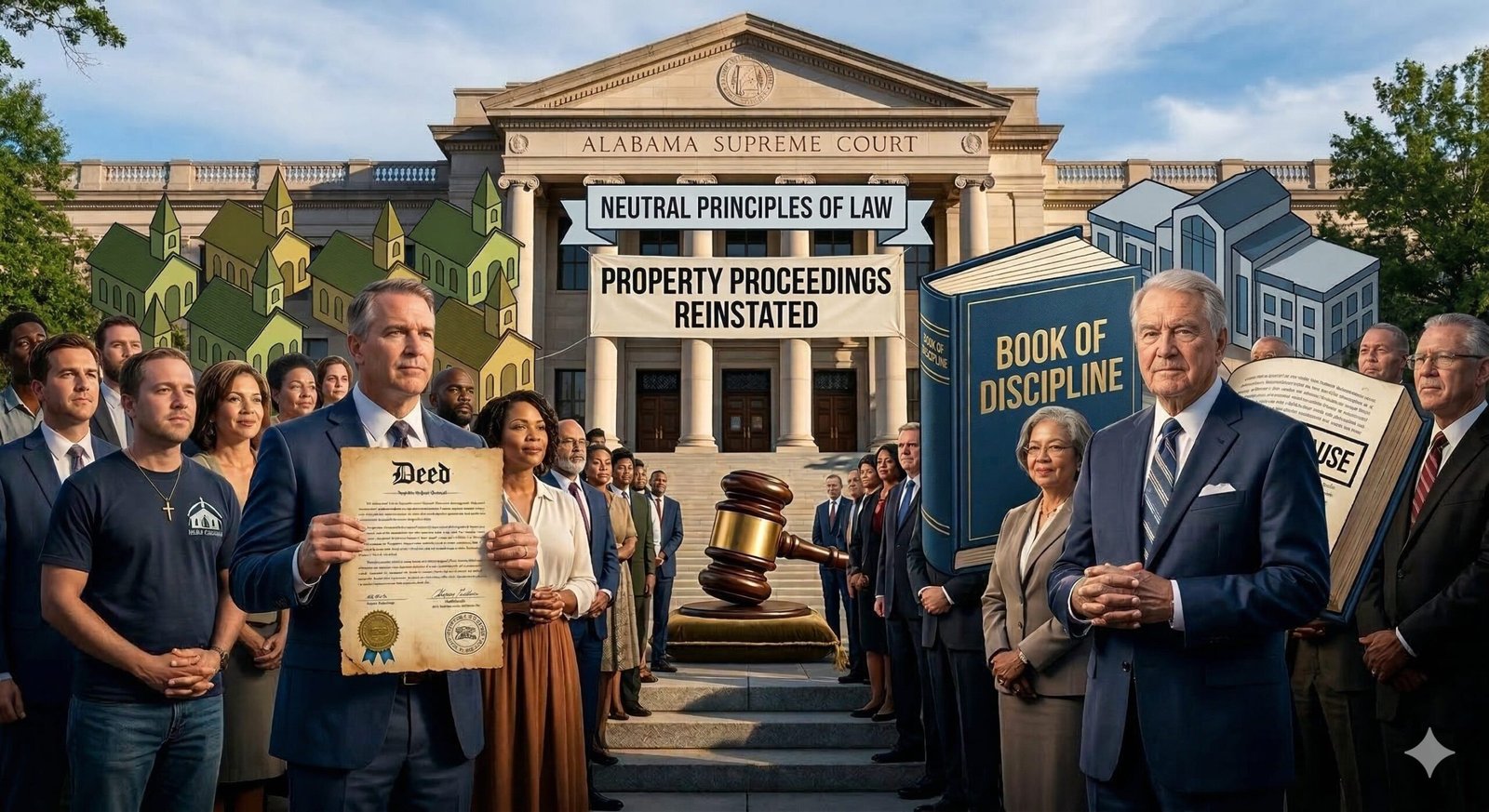
The Alabama Supreme Court decided that judges can use regular property laws to settle a massive disagreement between 15 local churches and the United Methodist Conference.
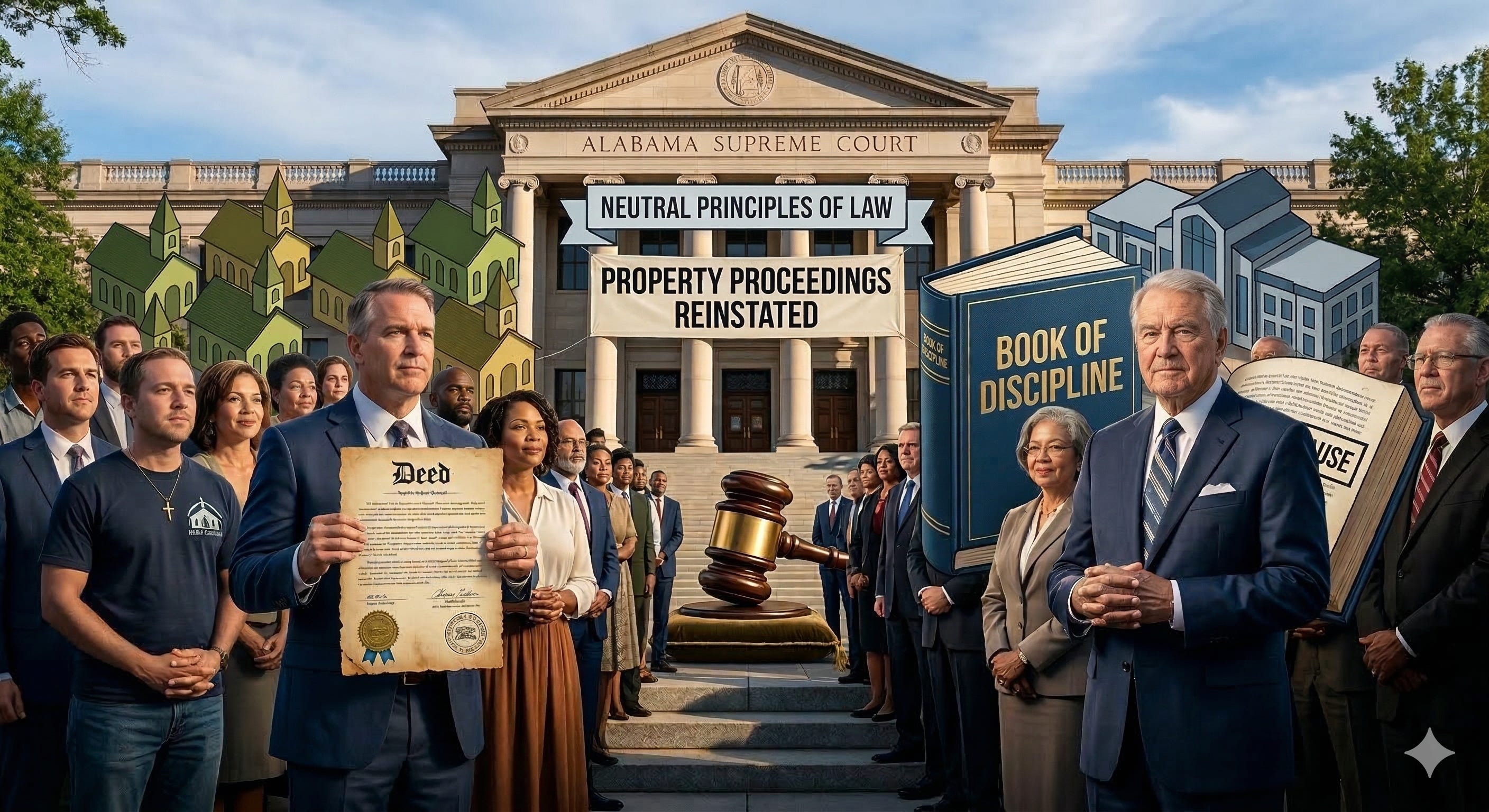
TLDR (Too Long / Didn’t Read Summary)
On March 6, 2026, the Alabama Supreme Court ruled that trial courts must look at property claims filed by the Alabama-West Florida Conference of the United Methodist Church. Fifteen local churches sued the Conference because they wanted to own the land and buildings where they worship. Lower court judges originally threw out the Conference’s claims, saying that secular courts should stay out of church business. However, the Supreme Court said these judges were wrong. The court decided that the dispute can be settled by looking at deeds and trust papers like any other land case. This means both sides now get to show their evidence in court to see who really owns the property.
Why Every Denomination Should Watch the Alabama Methodist Property Fight
Religious organizations like Seventh-day Adventists, Presbyterians, and Episcopalians need to pay close attention to this ruling because it changes the rules for church property splits. For a long time, if a local church wanted to leave its national group, it usually lost its building because of internal church rules. This new decision from the Alabama Supreme Court says that judges do not have to just follow church rulebooks; they can look at regular land deeds and state laws instead. If your denomination uses a “trust clause” to keep control of local buildings, this case shows that those clauses can now be challenged in a regular court of law.
This case is a big deal for any group with a “top-down” structure where a central office has a say over local assets. For example, the Seventh-day Adventist Church often holds property in a way that links local congregations to a larger “Conference,” which is very similar to how the Methodists are organized. If Alabama courts continue to decide these fights based on secular land records rather than church manuals, it could make it much easier for local congregations to break away and keep their property. This ruling moves power away from big church organizations and gives it to the local level, making it a must-watch for religious leaders everywhere.
Case Information
Case Caption: Ex parte Alabama-West Florida Conference of the United Methodist Church, Inc., et al. Date: March 6, 2026 Case Numbers: SC-2025-0347 (Consolidated with others)
The Alabama Supreme Court has ruled that local judges have the power to settle property fights between the United Methodist Church and local congregations. The court said that judges must use “neutral” laws to look at deeds and trust papers instead of ignoring the cases. This decision means that the regional Conference can now argue for its rights to the land in court.
This story is important because it explains when regular courts can get involved in church splits. It shows that if a case is about land records and not religious beliefs, judges are allowed to make a decision.
What led to the Alabama Supreme Court’s decision?
Fifteen local Methodist churches sued to “quiet title,” which is a legal way to ask a judge to name them the official owners of their land. The Alabama-West Florida Conference filed their own claims. They argued that the church’s rulebook, called the Book of Discipline, says the property belongs to the larger Conference.
At first, local judges threw out the Conference’s arguments. Those judges believed the “ecclesiastical abstention doctrine” stopped them from helping. This rule says courts cannot decide on religious topics or how a church is run. The Conference then asked the Supreme Court to step in and fix the situation.
How do regular property laws apply to churches?
The Supreme Court used an approach called “neutral principles of law”. This means judges can look at regular papers to solve the problem:
-
They can read the specific words used in property deeds.
-
They can look at the local church’s official charter or setup papers.
-
They can follow Alabama state laws about how groups own land.
-
They can look at parts of the Book of Discipline that talk about trusts in a non-religious way.
The court said that as long as a judge does not have to vote on religious beliefs, they can settle the land fight.
Why did some judges disagree with this ruling?
Not every judge on the court agreed with the decision. Justice Mendheim wrote that the Methodist Book of Discipline is a religious book that is hard to separate from church beliefs. He worried that by looking at these papers, courts would be getting too involved in church business.
He also mentioned that in a different case, the court refused to help because that fight was about “reasons of conscience,” which is a religious topic. Another judge, Acting Chief Justice Bryan, disagreed because he thought the Conference should have used a different legal path to appeal the case.
What happens next for these 15 churches?
The Supreme Court told the local judges to bring the Conference’s claims back to court. This means:
-
The Conference can now present its side of the story in all 15 cases.
-
Judges will now look at the deeds and church documents for each individual church.
-
Every case will be decided based on what the legal papers say about who owns the land.
This ruling makes sure the legal battle is fair. Now, both the local churches and the larger Conference have the chance to show their evidence to a judge.
Commentary
The court is trying to be very careful not to touch religious beliefs while still following property laws. By allowing these claims, the court is saying that a church’s rules can be treated like a regular legal contract. If a deed says land is held in a “trust,” the court will look at it just like they would for a business. This helps make sure that property rights are clear, even for religious groups.
However, the judges who disagreed have a good point. The Book of Discipline was written for church members, not for lawyers. It might be very difficult for a judge to read those rules without accidentally getting involved in religious ideas. When a judge decides what a church rule means, the government is getting very close to church business.
There is also a question of fairness. The local churches were the ones who started the lawsuits. It wouldn’t be fair to let the local churches use the court to win the land but then tell the Conference they aren’t allowed to defend themselves. The Supreme Court realized that if the doors of the courthouse are open for one side, they must be open for the other side too.
In the future, this means that if a church fight is about a deed or a trust, a judge will probably look at it. To stay out of court, religious groups will have to show that their land fights are strictly about their religious beliefs. For now, in Alabama, what is written on a property deed is more important to a judge than what is preached in a sermon.
Citations
-
Alabama Supreme Court. Ex parte Alabama-West Florida Conference of the United Methodist Church, Inc., et al. SC-2025-0347. March 6, 2026.
Subscribers to ReligiousLiberty.TV receive access to breaking news and full case information.
AI Disclaimer: This article was assisted by AI.
Legal Disclaimer: This does not constitute legal advice. Readers are encouraged to talk to licensed attorneys about their particular situations.
Holding: Trial courts must hear property claims filed by the Alabama-West Florida Conference of the United Methodist Church and may use regular property laws and deeds to settle disputes rather than deferring entirely to internal church governance.
