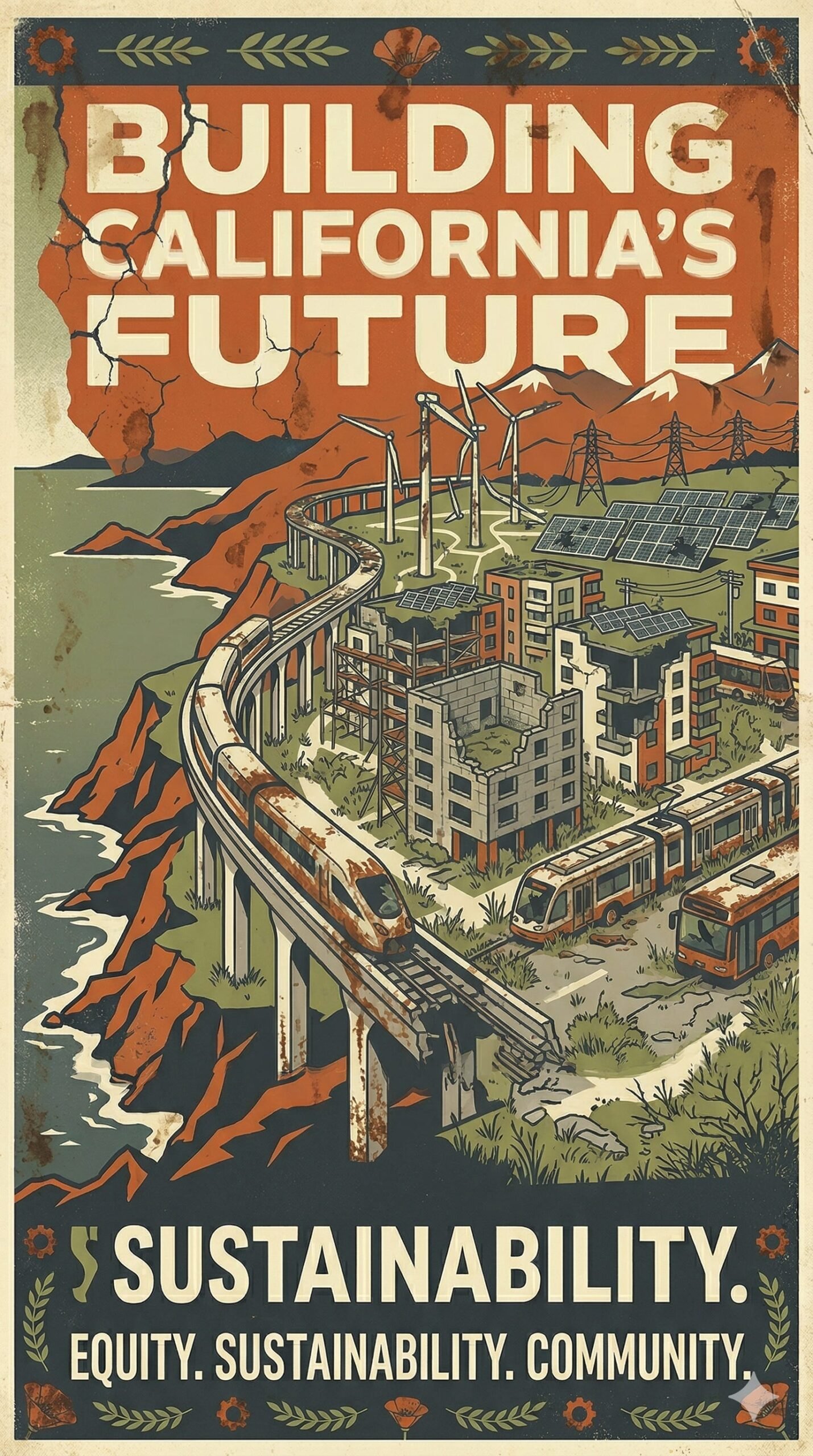
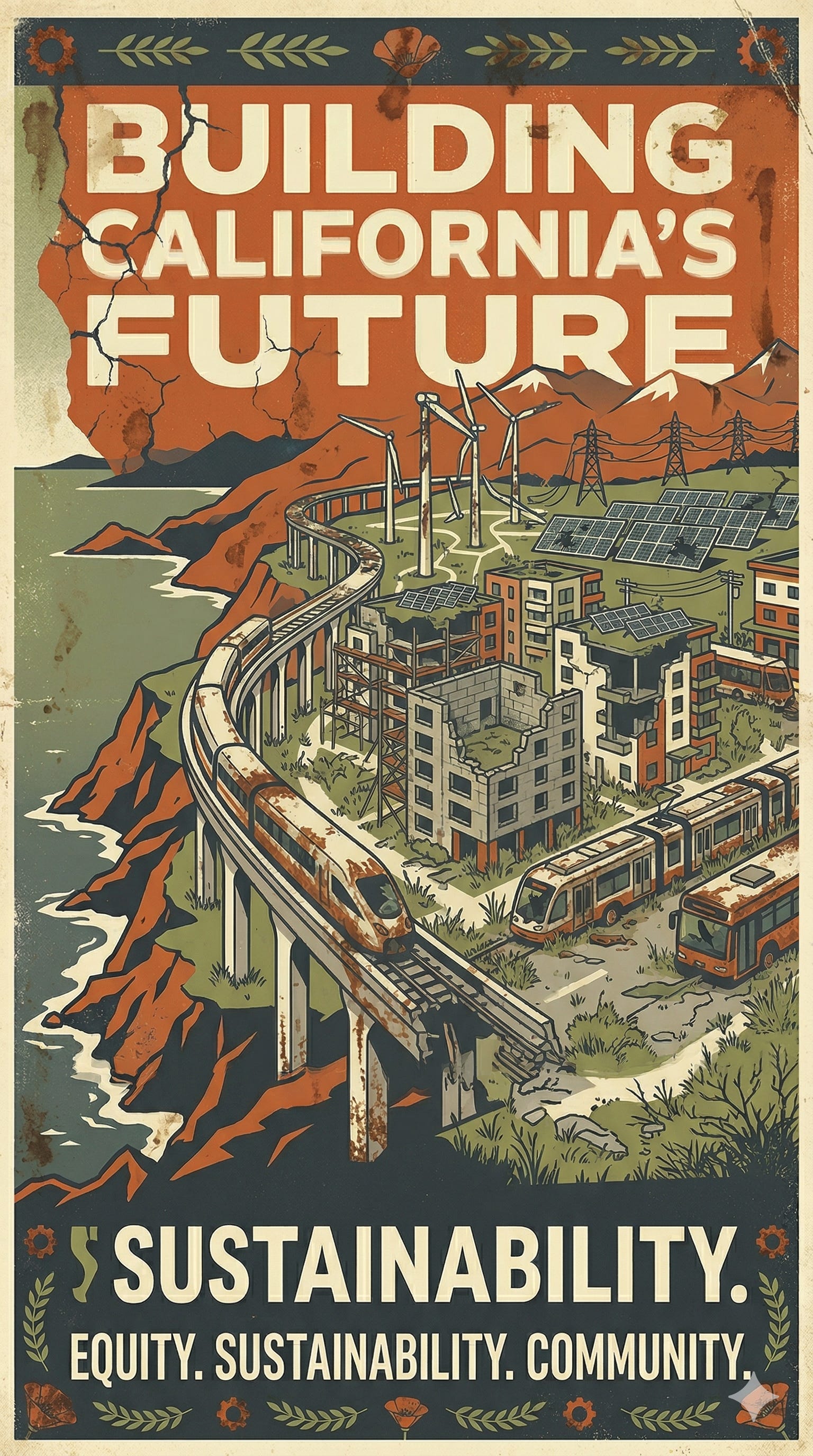
Somewhere in Havana, a building constructed in 1927 is still standing. Nobody built anything like it after the revolution, because the revolution had more important things to do than build. The same pattern plays out in slow motion across California, where a high-speed rail project approved in 2008 has consumed over $100 billion and produced a stretch of track connecting two cities nobody asked to connect, where a single unit of supportive housing in San Francisco costs more per square foot than a Manhattan penthouse, and where the regulatory apparatus that makes construction nearly impossible remains remarkably efficient at one task: restricting what churches can build, where they can serve, and on what ideological terms they may operate. The capacity to obstruct, it turns out, does not require the capacity to build.
There is a building in Havana, on the corner of a street whose name the revolution changed and whose pavement the revolution never repaired, that was constructed in 1927. It still stands, more or less, though its balcony leans at an angle that would make a structural engineer reach for sedatives. The plaster is the color of old teeth. The ironwork is magnificent, and magnificently rusted. Nobody built anything like it after 1959, because nobody built much of anything after 1959. The revolution came, and the cranes went quiet.
This is not a coincidence. It is a pattern. And it is a pattern that repeats itself with such regularity, across such varied geographies and ideological inflections, that it deserves to be examined as something more than bad luck or external pressure. The evidence increasingly suggests that the centralized, bureaucratically managed state is simply bad at building things. Not occasionally. Structurally.
The Promise and the Pavement
Western socialism, in its contemporary form, rarely announces itself with red flags and five-year plans. It arrives instead through the vocabulary of equity, sustainability, and community investment. It wins elections promising to direct state resources toward the common good, particularly toward infrastructure: rail lines, affordable housing, transit systems, green energy grids. These are, on their face, reasonable aspirations. The question is not whether government should build things. The question is whether governments organized along these principles can.
California provides the most instructive case study available to any student of this question, because California has the money, the stated ambition, and the political will, and still cannot seem to finish anything. The state’s high-speed rail project, first approved by voters in 2008, was projected to cost $33 billion and connect Los Angeles to San Francisco by 2020. The current estimate exceeds $100 billion. The completion date has drifted into the next decade like a ship that has lost its engines. A single stretch of track in the Central Valley, connecting communities that most Californians cannot locate on a map, remains the project’s most visible accomplishment after sixteen years.
This is not a funding failure. California’s GDP surpasses that of most nations. It is a structural failure, and the structure in question is the apparatus of government itself when it attempts to function as builder, regulator, litigant, employer, environmental steward, equity auditor, and community stakeholder all at once.
Too Many Hands, Not Enough Mortar
The mechanics of modern government infrastructure failure are well-documented, even if rarely stated plainly. A project begins with a political announcement, which triggers a legislative appropriation, which triggers an environmental review, which triggers a public comment period, which triggers a legal challenge from any of several dozen interest groups whose concerns are not so much with the project itself as with the leverage the project provides. By the time a shovel enters actual ground, a decade may have passed and a third of the budget has been absorbed by the process of obtaining permission to spend the rest of it.
California’s affordable housing crisis illustrates the same dynamic in a different material. The state has declared housing emergencies, passed housing legislation, allocated housing funds, and created housing agencies with impressive frequency over the past two decades. San Francisco, a city of roughly 870,000 people sitting atop some of the most expensive real estate on earth, spent approximately $50,000 per square foot to build certain units of supportive housing. A figure that, when encountered by someone who has actually purchased construction materials, tends to produce a long silence.
The explanation is not graft, or not graft alone. It is the compounding cost of compliance: prevailing wage requirements, union labor mandates, accessibility standards, seismic retrofitting codes, environmental certifications, and the administrative overhead of a development process that requires the sign-off of agencies whose interests are sometimes complementary and sometimes flatly opposed. Each requirement, viewed individually, is defensible. Stacked together, they produce a system where building a modest residential unit costs more than it would to purchase an existing home in most of the country.
New York’s experience with transit infrastructure follows the same logic. The Second Avenue Subway, a project that New York City began planning in earnest in the 1920s, opened its first phase in 2017 at a cost of roughly $4.5 billion per mile. By comparison, similar subway construction in Madrid and Copenhagen costs a fraction of that figure. The difference is not labor costs or geology or ambition. It is the administrative and political machinery through which every decision must pass before it can be executed.
Cuba and the Frozen Clock
The Cuban example is useful precisely because it is unambiguous. The island’s built environment is, in large measure, a museum of the Batista era. Havana’s architectural stock, the neoclassical facades, the art deco apartment buildings, the grand hotels with their crumbling cornices, dates overwhelmingly from the pre-revolutionary period. Visitors who arrive expecting a living city and find instead something more like an architectural hold are sometimes moved to romanticize the decay as picturesque. The Cubans who live inside it tend not to share this aesthetic perspective.
The explanation offered by the Cuban government, and by sympathetic observers in Western capitals, has always centered on the American embargo. The embargo is real and its effects are real. But it does not account for the fact that the Soviet Union pumped billions of dollars in subsidies into Cuba for thirty years without producing a built environment that matched the ambition of pre-revolutionary Havana. It does not account for the fact that countries with comparable isolation, or comparable poverty, have managed to construct functional housing, roads, and public buildings. And it does not account for what every Cuban architect and construction worker who has been willing to speak plainly has said: that the state is a catastrophic client.
Materials go missing. Approvals are delayed by bureaucracies that lack the authority to approve anything. Political considerations override engineering ones. Corruption, in systems where prices are suppressed and resources are allocated by administrative fiat rather than market signals, is not an aberration but a rational adaptation. The man who can get cement becomes a very important man. The building that needs cement waits.
The Ideological Architecture
It is worth being careful here about causation. The failure of socialist states to build is not simply a matter of competence, as though a better class of central planner would produce a better class of highway. The problem is more fundamental. Socialism, in its operational forms, tends to subordinate the productive question (how do we build this?) to the distributional question (who benefits, who decides, who gets credit?). These are not illegitimate questions. But when they precede and dominate the productive question, they tend to strangle it.
California’s progressive political culture has produced an infrastructure procurement process that is, in some respects, more deliberative than any in American history. Community input is solicited. Environmental impact is assessed. Equity considerations are incorporated. The interests of affected populations are weighed. All of this is, in isolation, admirable. The result, in combination, is a process so weighted with consultative requirements that it produces outcomes that serve none of the communities it purports to protect. The homeless remain homeless. The train does not run. The building does not open. The meetings continue.
The rise of socialism as an aspirational framework among younger Western voters is driven, at least in part, by genuine frustration with the failures of market systems to deliver affordable housing, accessible healthcare, and functional public transit. The frustration is legitimate. The proposed remedy is less clearly so. The governments that have most conspicuously failed to build are not markets that haven’t been tried. They are states that have been expanding their role in procurement, regulation, and oversight for decades. More government has produced more process, and more process has produced less output.
What Gets Built and What Does Not
The contrast with the mid-twentieth century American state is instructive. The Interstate Highway System, whatever its suburban pathologies and its displacement of communities, was built. The Hoover Dam was built. The Tennessee Valley Authority built. The Apollo program built. These were government projects, initiated and funded by the federal government, and they succeeded. The difference is not that the government was smaller, because in some respects it was not. The difference is that the government of that period had not yet constructed the consultative and litigative architecture that now encases every major project in a carapace of procedure.
The question for Western nations that aspire to social democratic governance is whether they can recover the capacity to execute. Several European countries manage it: Germany builds transit, the Netherlands builds flood control, the Scandinavian countries build social housing at costs that bear some reasonable relationship to actual construction expenses. These are not socialist states in the Cuban or Venezuelan sense. They are mixed economies with functional regulatory systems and administrative cultures that are capable of deciding something and then doing it.
California is not Hamburg. Its political culture has evolved toward a form of progressive governance that is long on stated intention and short on completed projects. The state’s homelessness crisis, its housing shortage, its transit failures, and its high-speed rail debacle are not unrelated phenomena. They are products of the same administrative culture: one that has elevated the politics of distribution and the process of consultation to such a degree that the underlying act of construction has become nearly incidental.
The Church They Could Not Build, and the One They Could Not Close
There is a second architectural fact about Cuba that receives less attention than the crumbling facades: the churches built before 1959 are still standing, and still in use, and the state spent decades trying to change that. The Cathedral of Havana, completed in 1777, has outlasted every government that has threatened it. The same is true of the Protestant congregations that survived the revolution’s early hostility, the Seventh-day Adventist churches that continued holding services when the state classified religion as ideological contamination, and the network of house churches that expanded precisely because the government could not build enough surveillance apparatus to monitor all of them. Religious communities, it turns out, are very good at operating in the absence of state support. They have had considerable practice.
The connection between state overreach in construction and state overreach in conscience is not incidental. Governments that cannot resist the temptation to manage the built environment tend to find the inner life equally inviting as a subject of administration. In California, the same regulatory impulse that inflates the cost of a housing unit has been applied, with increasing confidence, to the operations of religious organizations: land use restrictions that make it difficult for congregations to expand their facilities, zoning classifications that treat a church’s feeding program as a commercial operation, and social service licensing requirements that condition the delivery of charity on compliance with state ideological frameworks. The Religious Land Use and Institutionalized Persons Act exists because these pressures became systematic enough to require a federal statutory answer. The pressures have not abated. In a state that cannot build a train on time or house its own citizens at any reasonable cost, the regulatory apparatus remains remarkably energetic when the target is a congregation that declines to conform. The capacity to obstruct, it turns out, does not require the capacity to build.
The Building as Verdict
Architecture does not lie in the way that politicians do. A building either stands or it does not. A train either runs or it does not. A city’s skyline either changes or it does not. Havana’s skyline, largely unchanged since the revolution that promised to transform it, is not primarily a testament to American pressure. It is a record of what sixty-five years of state-directed development actually produced.
The Western left would do well to study this record, not because it validates every criticism made by the right, but because it contains a genuine lesson about the relationship between ideological ambition and material execution. You cannot redistribute what you have not built. You cannot house people in equity statements. You cannot move workers on a train that exists only in an environmental impact report.
The buildings in Havana from 1927 were built by people who had no particular ideology about construction. They had contracts, materials, workers, and a client who wanted a building. The building went up. The revolution arrived, and the ideology went up instead. The ideology, unlike the building, requires constant maintenance to remain standing. The building, for all its rust and peeling plaster, is still there.
Michael Peabody, Esq. is the founder and publisher of ReligiousLiberty.TV.
