A First Amendment for Britain: The Bill, the Ballot, and the Crackdown
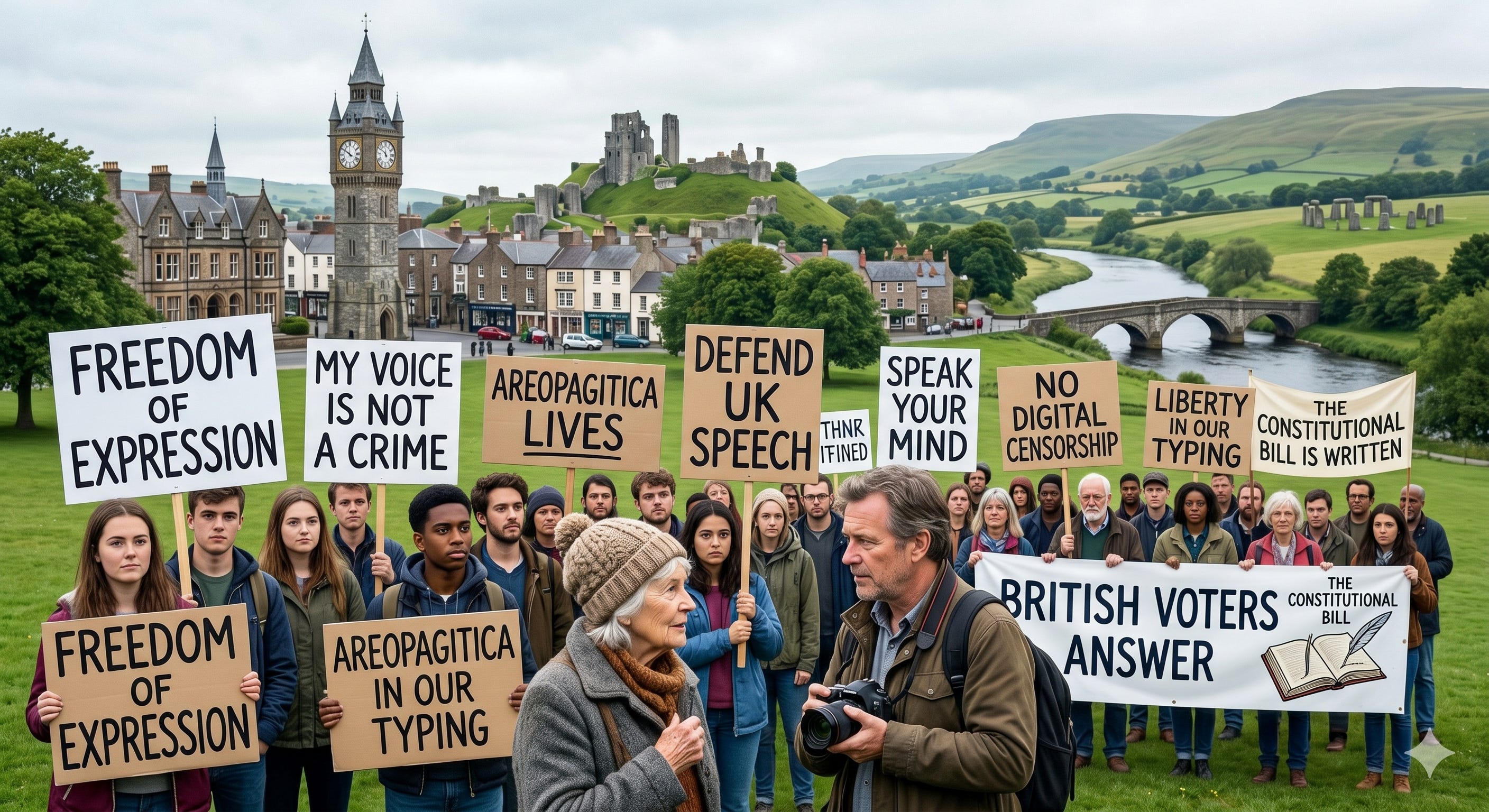
By Michael Peabody, Esq. / ReligiousLiberty.TV
There is a particular kind of national embarrassment reserved for a country that produced Magna Carta, Areopagitica, and On Liberty, and now arrests its grandmothers for tweets. Britain has achieved it. The country that once exported the doctrine of the freeborn Englishman to the rest of the Anglosphere now imports its citizens into police cells at a rate of more than thirty a day, roughly twelve thousand a year, for the crime of typing the wrong thing onto a screen. The figure comes from custody data, not from a Reform UK press release, and it ought to make anyone with a passing acquaintance with the history of English liberty want to lie down in a darkened room.
Some examples:
Lucy Connolly, a forty-two-year-old childminder and the wife of a Conservative councillor, was sentenced to thirty-one months in prison for a tweet she posted in the hours after the Southport murders and deleted three and a half hours later. She served roughly forty percent of the sentence before being released on licence. The same sentencing tables, applied in the same week to defendants who had thrown actual bricks at actual police officers, produced shorter terms. Even the leader of the Conservative Party, a woman whose interest in the rights of childminders is not famously acute, noticed that something was off.
Julian Foulkes, a seventy-one-year-old retired special constable, was handcuffed in his own home by six officers from the Kent force he had served for over a decade. His offence was a tweet warning about rising anti-Semitism. He was locked in a cell for eight hours and cautioned for malicious communications. Eighteen months later, the same force quietly admitted that the caution had been a mistake and removed it from his record. The six officers, the seized devices, and the cell were not returnable.
Isabel Vaughan-Spruce, a Catholic pro-life campaigner, has been investigated three times by police for the offence of silently praying inside a buffer zone near an abortion clinic in Birmingham. Not protesting. Not chanting. Not even speaking. Standing on a public street with her head bowed. Rose Docherty, a seventy-five-year-old grandmother in Glasgow, became the first person charged under Scotland’s new buffer zone law for holding a sign that read “Coercion is a crime, here to talk, only if you want.” She was eventually cleared, after months of proceedings, on the apparently controversial proposition that offering to listen to another human being is not yet a criminal offence in the British Isles.
Maxie Allen and Rosalind Levine, a couple from Borehamwood, were arrested in January by six Hertfordshire Police officers in front of their three-year-old daughter and held in cells for eight hours. Their offence was complaining about their elder daughter’s primary school in a private parents’ WhatsApp group. The school called the police. After a five-week investigation, the force concluded that no further action was warranted. The three-year-old, presumably, had her own conclusions.
Allison Pearson, a Telegraph columnist, was questioned at her home on Remembrance Sunday morning by two Essex Police officers over a year-old deleted tweet about pro-Palestinian protests. The Crown Prosecution Service closed the case four days later on the unimpeachable ground that there was no realistic prospect of conviction. The two officers had already arrived. The Remembrance Sunday had already been ruined. Rob Davies, a Wrexham shop owner, was visited by North Wales Police after putting up a handwritten sign reading “Due to scumbags shoplifting, please ask for assistance to open cabinets.” Officers told him to take the sign down because it might cause offence. The actual shoplifters were not similarly inconvenienced.
This is the Britain that the Online Safety Act of 2023 produced and that the political establishment, for nearly three years, asked the public to accept as the price of doing business. The Act expanded the powers of Ofcom and the Crown Prosecution Service over online content. It was passed by a Conservative government under Rishi Sunak and preserved by a Labour government under Keir Starmer. The two parties that have dominated British politics for a century reached a quiet bipartisan consensus that the state should police what its citizens said and prosecute them when they said the wrong thing. The voters were not consulted. The Telegraph kept publishing the case files. The arrests continued.
On Thursday, May 7, the consensus shattered.
The largest set of subnational elections since Starmer became prime minister produced what can only be described as a political extinction event for the two main parties. Nigel Farage’s Reform UK gained more than a thousand council seats. Labour lost over nine hundred and surrendered control of nearly thirty councils, including Westminster itself. The Conservatives, who passed the Online Safety Act in the first place, lost more than four hundred seats and six councils. In Wales, Plaid Cymru displaced Labour as the dominant force for the first time in a century. In Scotland, the SNP held the centre but Reform now sits as the second-largest party. Projected onto a general election, the Reform vote share would put Farage in Downing Street with two hundred and eighty-four seats, forty-two short of a majority but close enough to govern in coalition.
The British press has been determined to read this as a story about immigration and nothing else, and immigration certainly polled at the top of voter concerns. But the determination to ignore the speech crackdown as a contributing cause has become, at this point, comic. Reform UK has campaigned for nearly a year on a pledge to repeal the Online Safety Act outright. The party’s digital policy spokesperson has called the Act “borderline dystopian.” Farage testified before the United States House Judiciary Committee in September, in terms that made his hosts sound restrained, on the British state’s war against its own citizens’ speech. The position was treated by establishment commentators as imported American culture-war noise, the kind of thing one expects from a man who has spent too much time in Washington studios. The position turned out to have a constituency. The constituency turned out to be enormous. It turned out to include, in particular, the kind of voter who has watched a neighbour, a relative, or a colleague get arrested for a Facebook post and has drawn the obvious conclusion.
It would be pleasant to report that the new political arithmetic guarantees a return to the principles of Areopagitica. It does not. Repealing the Online Safety Act would be an excellent start, and a Reform government has pledged to do it. But the deeper problem is structural and predates the Act by decades. Britain has no enforceable constitutional bar against speech regulation. Parliament is sovereign. What one Parliament repeals, another can re-enact under a different name with a different sympathetic victim attached to the press release. The Online Safety Act was preceded by the Malicious Communications Act, the Public Order Act, the Communications Act 2003, and the labyrinth of non-crime hate incident guidance that allows police to visit homes without charging anyone with anything. Cut off one head, two more grow back, each with a sympathetic charity behind it.
That structural problem is the gap that a draft Freedom of Speech Bill, published in April by the Adam Smith Institute, attempts to close. The bill was drafted by Preston Byrne, a digital rights lawyer and Adam Smith Institute senior fellow, with co-authors Michael Reiners and Elijah Granet. It runs to thirty-two sections, repeals seven existing Acts of Parliament outright, includes six schedules, and creates four new public order offences and two new communications offences to replace the sprawling regime it dismantles. Byrne, who is American by background and apparently undeterred by the spectacle of carrying coals to Newcastle, has described it openly as “a First Amendment for the UK,” designed to “put locks on the doors” currently stopping the government from censoring Britons.
The bill is, by its drafters’ admission, a proof of concept. Byrne has said as much. It is intended to demonstrate that American-style free speech protections can be replicated within the British constitutional system without rewriting the constitution from scratch. The Adam Smith Institute board, in a joint statement accompanying the launch, situated the rot as nearly half a century in the making. A Lord Ashcroft survey cited in the launch found that forty-two percent of Britons have stopped themselves from expressing their true opinions on controversial matters. Self-censorship at that scale is what twelve thousand arrests a year is supposed to produce. The arrests are the demonstration effect. The chill is the policy.
There is also pressure from the western side of the Atlantic that the British political class would prefer not to dwell upon. The United States State Department, under Under-Secretary for Public Diplomacy Sarah Rogers, is reportedly building a website to allow Britons overseas to access content banned by their own government. Rogers has said publicly that “nothing is off the table” in opening up what she has characterised as authoritarian closed societies that censor the internet. The phrasing was not a slip. The United States government has begun applying to the United Kingdom the same diplomatic vocabulary it has historically reserved for China, Iran, and Russia, and the British Foreign Office has not yet figured out how to object without conceding the underlying point.
The American observer should resist the temptation to feel smug. The British did not lose their speech protections in a single legislative ambush. They lost them slowly, statute by statute, prosecution by prosecution, with each step justified by a sympathetic case and a designated villain. Hate speech laws to protect minorities. Communications offences to protect women from harassment. The Online Safety Act to protect children from predators. Buffer zones to protect women approaching clinics. Each component was eminently reasonable when held up by itself in a well-lit room. The aggregate is a country where police visit your home for a tweet, raid your house at dawn for a Facebook post, and arrest you in front of your toddler for a WhatsApp message. Each individual brick was laid by people who were quite certain they were building something other than a wall.
The First Amendment to the United States Constitution is not a feature of the natural world. It is a contingent legal arrangement that depends on courts, on Congress, and on a public that still recognises it as worth defending. The British, who had no First Amendment, had something arguably more impressive: a thousand years of accumulated common law, parliamentary practice, and inherited assumption about the freeborn Englishman, all of which proved to be no defence whatsoever once a sufficiently energetic generation of legislators decided that offence was a public health emergency. The tradition turned out to be insufficient. The retrofit, which is what the Byrne bill represents, is now being attempted in real time by people who understand that repeal without constitutional protection is a temporary reprieve, not a settlement.
What Thursday’s election demonstrates is that publics can revolt against speech regimes when the prosecutions become visible enough and absurd enough. Lucy Connolly doing longer time than rioters. A retired police officer in handcuffs over a tweet. A Catholic woman investigated three times for praying in silence. A couple held in cells in front of their three-year-old over a WhatsApp group. A shop owner ordered to remove a sign calling thieves what they are. These are the kinds of facts that eventually move voters, even British voters, even after years of polite accommodation. The encouraging news is that the cycle is not entirely one-way. The sobering news is that it required prison sentences, dawn raids, and a seventy-five-year-old grandmother in the dock before the correction arrived.
The deeper question is whether the answer holds when the next crisis arrives, and the next state of emergency, and the next plausible justification for jailing someone over a tweet. Britain has blinked. The historical record on speech rollbacks suggests that governments which have acquired the power to punish expression rarely surrender it voluntarily. They surrender it when voters force them to, and then they come back for it later, repackaged, renamed, and accompanied by a fresh designated villain. The Byrne bill exists precisely because its authors understand this. Repeal is the easy part. Building something that prevents the next Online Safety Act, the one that will be drafted in five years under whatever name happens to be fashionable then, is the work that matters.
For now, the British public has spoken with a clarity that the British political class will spend the next several months pretending not to have heard. The ballot has been cast. The bill is on the shelf. The crackdown has produced its own opposition, slowly at first, and then all at once. Whether the new Parliament does the harder work of building structural protection, or whether it merely repeals the most embarrassing statutes and waits for the next moral panic to bring them back, is the question that will define the next decade of free expression in the English-speaking world.
The Britain that produced Milton, Mill, and Magna Carta is still in there somewhere. The voters appear to have remembered. The lawyers have done the drafting. The only remaining question is whether the politicians, having received the loudest possible instruction from the electorate, are capable of taking it.
Michael Peabody, Esq. writes on religious liberty, First Amendment law, and the legal stakes of current events at ReligiousLiberty.TV.