The Law Is Not Optional: Why Congress Should Defund Jury Nullification Campaigns
By Michael Peabody, Esq.
TL;DR: Representative Julia Letlow’s legislation HR 8485 introduced in April, to defund jury nullification training programs is constitutionally sound and practically justified. Juries have always retained the raw power to acquit for any reason, but that power was never meant to be advertised as a civic duty. Organized pre-trial campaigns instructing citizens to treat the law as optional introduce an unaccountable and unpredictable variable into criminal proceedings, one that history shows cuts toward injustice as readily as toward mercy. The Jim Crow acquittals were jury nullification too. Courts have correctly refused to formalize this power as an instruction, and Congress has no obligation to fund organizations whose purpose is to do what courts have declined to do.
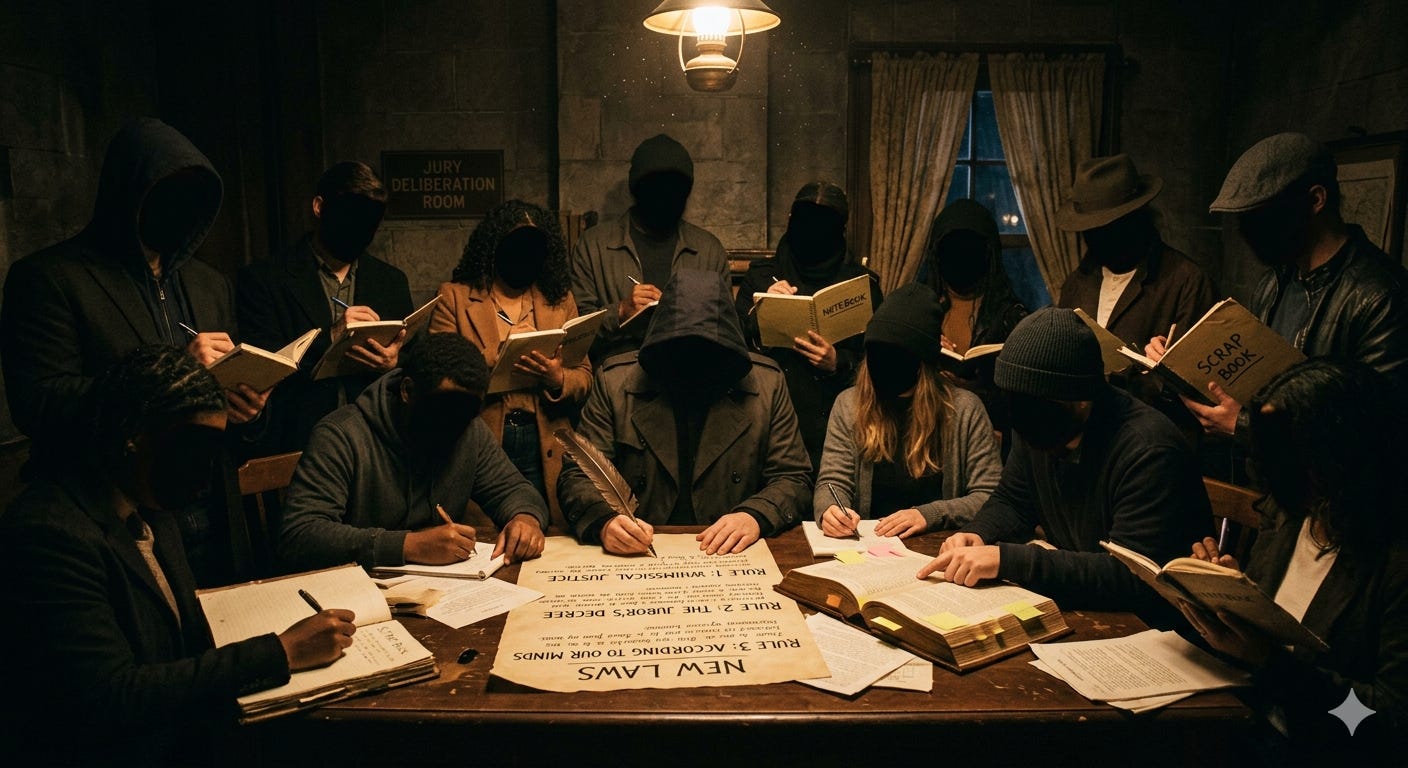
Representative Julia Letlow of Louisiana has introduced legislation (H.R. 8485, introduced 4/23/2026) would condition federal funding on prohibiting organizations from conducting jury nullification training, and the reaction from civil libertarians has been swift, confident, and largely beside the point. Her critics have wrapped themselves in the Zenger acquittal and the Fugitive Slave Act and declared her bill an assault on American liberty. What they have not done is answer the question her legislation actually raises: why should anyone be instructing jurors to ignore the law in the first place?
That question deserves a direct answer, and the nullification movement has not provided one.
A juror is not a legislator. A juror is not an appellate judge. A juror is not a constitutional convention. A juror is a citizen called to perform a specific civic function under oath, and that function is to determine whether the facts of a case satisfy the legal elements of the charged offense as the court has explained them. That is a demanding task. It requires careful attention to evidence, credibility assessments, and the application of legal standards that took centuries of common law development to refine. It does not require, and is not improved by, the addition of each juror’s personal moral philosophy as a variable in the equation.
The nullification movement frames jury education as a form of empowerment. What it actually does is introduce a parallel and unacknowledged decision-making process into a proceeding that the defendant, the prosecution, the court, and the public have all been told is governed by law. When a juror is instructed by a pre-trial advocacy organization that the law is optional, that juror does not disclose this view during voir dire, cannot be questioned about it on appeal, and will not explain it in a verdict. The defendant who is acquitted by nullification receives no explanation. The defendant who is convicted by a juror applying the same logic in reverse, deciding that this particular person deserves punishment regardless of what the evidence shows, receives no remedy. The asymmetry is structural, and it is permanent.
Courts have addressed this directly. In United States v. Dougherty, the D.C. Circuit acknowledged that juries possess the raw power to acquit for any reason, but refused to require that jurors be told about it. The reasoning was precise: the existence of a power is not an argument for its advertisement. Judges do not instruct juries on the power to ignore eyewitness testimony they find credible, or to convict on charges the prosecution did not prove, simply because juries have occasionally done those things without consequence. The unreviewable nature of a general verdict is a structural feature designed to protect jurors from retaliation. It was never designed to be a curriculum.
The Letlow bill’s critics treat the absence of a formal nullification instruction as a form of deception, as if jurors are being denied something they are owed. But the legal system does not owe jurors a comprehensive briefing on every way they could theoretically deviate from their oath. The oath itself is the instruction. The law as explained by the judge is the standard. The job of a juror is to apply that standard to the facts. Organizations that exist specifically to tell jurors that the standard is negotiable are not filling a gap in civic education. They are campaigning for a specific outcome in cases they have not seen, involving defendants they do not know, under circumstances they cannot predict.
HR 8485 addresses this through the funding mechanism rather than criminal prohibition, which is both constitutionally sounder and practically more targeted. The government is under no obligation to subsidize organizations whose stated purpose includes instructing citizens to disregard the legal standards courts are required to apply. This is not a suppression of truthful speech. It is a decision about which activities federal dollars will support, a decision the government makes constantly and in every policy domain. No serious reading of the First Amendment requires Congress to fund its own subversion.
The historical cases the nullification movement cites as justification actually undermine the case for organized pre-trial instruction. The Zenger jury acted on the specific facts and atmosphere of that case, in response to a specific argument made by defense counsel within the courtroom, in a proceeding where everyone present understood what was happening. The Fugitive Slave Act juries operated in communities where the moral weight of the law’s injustice was obvious, immediate, and shared. These were not juries that had been pre-conditioned by outside organizations to treat law as advisory before they ever heard a word of testimony. They were juries that responded to the facts before them with a moral judgment that history has largely vindicated.
The nullification training industry is doing something categorically different. It is not responding to specific injustice. It is cultivating a general disposition toward legal non-compliance in advance of any particular case, in any particular courtroom, involving any particular defendant. The historical cases involved conscience applied to known facts. The training industry involves conscience applied to nothing, a standing instruction to override law whenever a juror personally disagrees with it, which is an instruction whose results depend entirely on what that juror happens to believe.
History has recorded what those beliefs have sometimes produced. The Jim Crow jury that acquitted Emmett Till’s murderers was following its conscience with exactly the certainty that nullification advocates ask jurors to cultivate. That jury was not operating in a legal vacuum. It was operating in a community that had been thoroughly educated, through culture, law, custom, and organized social pressure, about which lives the legal system was expected to protect. The nullification training of that era was not conducted in seminars. It was conducted everywhere else. The result was verdicts that foreclosed any legal remedy, permanently, because a general acquittal cannot be appealed and a confession published afterward cannot undo double jeopardy.
This is not an argument against jury conscience as a human reality. Jurors will always bring their moral sensibilities into the jury room, and no instruction will fully prevent that. It is an argument against the organized, deliberate cultivation of legal non-compliance as a civic virtue, particularly when that cultivation is funded by entities with specific political and legal agendas that have nothing to do with the case the juror has been sworn to decide.
Letlow’s critics have argued that her bill is a response to the Trump administration’s courtroom losses, an attempt to shore up prosecutorial power by keeping jurors ignorant. That charge should be evaluated seriously, and the legislative record should be scrutinized for evidence of selective application. If the bill would target organizations that educate jurors about civil liberties and prosecutorial overreach while leaving untouched organizations that encourage harsh verdicts against unpopular defendants, that asymmetry would be a legitimate constitutional concern.
But the principle underlying the legislation is sound regardless of the political circumstances that produced it. There is no affirmative case for instructing juries to ignore the law. There is no coherent theory of justice that improves by making legal standards optional for whoever happens to be in the box on a given Tuesday.
The existing equilibrium, in which juries retain the unreviewable power to acquit while courts decline to formalize that power as an instruction, is not a deception. It is a calibration, arrived at through centuries of common law development, that preserves the jury’s protective function while maintaining the integrity of legal standards as the governing framework of criminal adjudication.
Michael Peabody, Esq. / ReligiousLiberty.TV