Dismissed and Divided: Judges Clash Over Religious “Nexus” in COVID-19 Testing Case
Ninth Circuit Rejection of Religious Bias Claim Sparks Heated Judicial Debate
A divided federal appeals court refused to rehear a case involving a healthcare worker fired for refusing COVID-19 testing on religious grounds.
TLDR
The Ninth Circuit Court of Appeals declined to rehear a case involving Sherry Detwiler, a data privacy executive fired for refusing nasal COVID-19 tests. Detwiler argued that her Christian faith required her to treat her body as a “temple of the Holy Spirit,” making it a religious duty to avoid “defiling” substances. She claimed the swabs contained harmful carcinogens, but a panel majority dismissed her lawsuit, labeling her concerns as “purely secular” medical judgments rather than bona fide religious beliefs. Several dissenting judges criticized this “nexus” test, arguing that courts lack the competence to act as theological arbiters. The case highlights a significant legal split regarding how strictly courts should scrutinize an employee’s religious convictions under Title VII.
Case Info
Caption: Detwiler v. Mid-Columbia Medical Center
Date: April 15, 2026
Court: United States Court of Appeals for the Ninth Circuit
The Ninth Circuit has let stand a ruling that allows employers to dismiss religious accommodation claims if the employee’s objection appears to be based on secular or scientific information. By denying a rehearing en banc, the court affirmed that simply invoking prayer or general religious tenets is insufficient to convert a medical concern into a protected religious conviction. This decision effectively raises the pleading bar for plaintiffs seeking religious exemptions in the workplace.
This story is a focal point for labor law and religious liberty because it tests the limits of Title VII of the Civil Rights Act of 1964. While the law requires employers to accommodate “all aspects of religious observance,” this court has now utilized a “nexus” test to separate spiritual motivations from secular ones. The sharp dissents from within the court suggest this issue is headed for a potential Supreme Court challenge as other circuits have adopted more permissive standards.
What are the facts of the Detwiler v. Mid-Columbia Medical Center case?
• Sherry Detwiler was a data privacy executive at Mid-Columbia Medical Center (MCMC) whose role was remote-capable and did not involve patient contact.
• MCMC granted her a religious exemption from the COVID-19 vaccine but required weekly nasal swab testing as a condition.
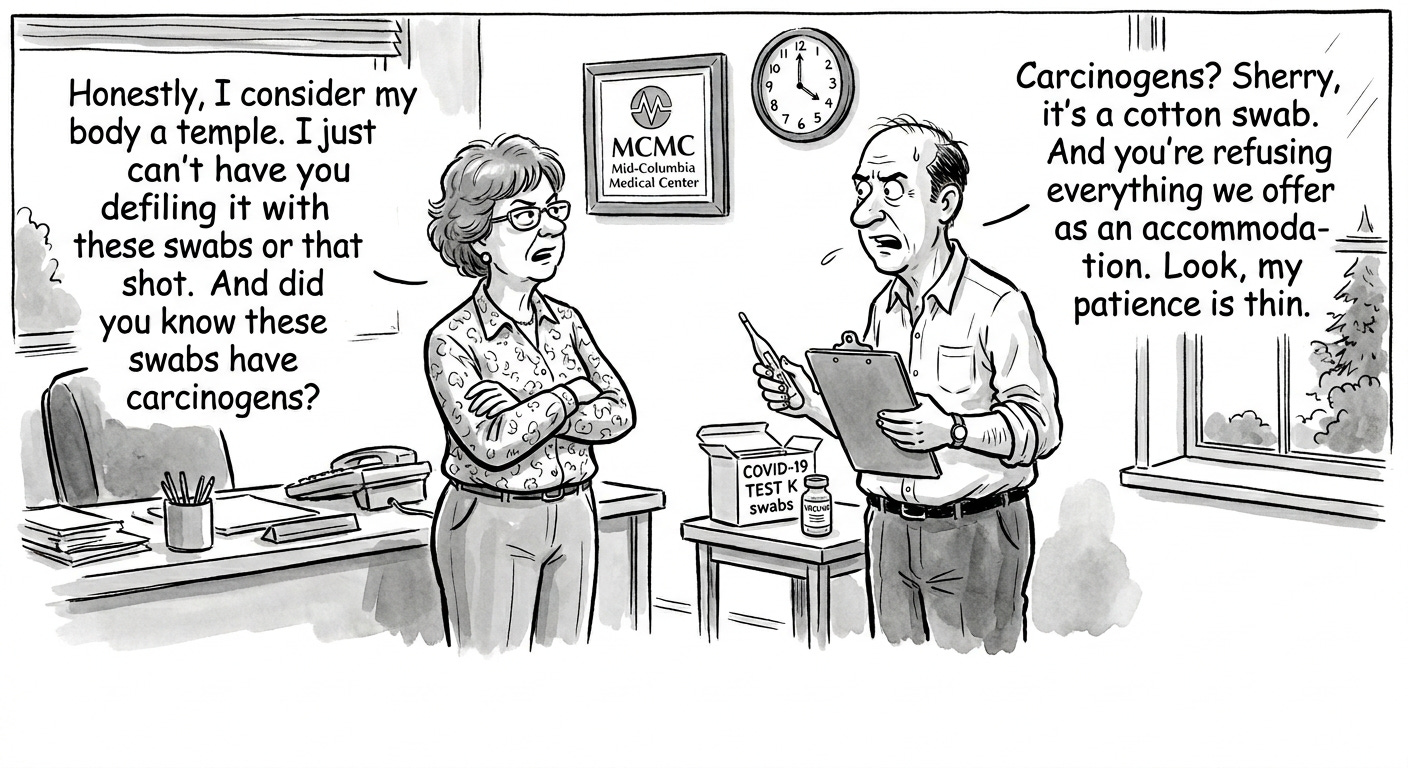
• Detwiler refused the nasal tests, stating that after “much prayer and consideration,” she felt the Holy Spirit moved her conscience to avoid the swabs because she believed they contained carcinogens.
• She argued that submitting to the test would violate her “Christian duty to protect [her] body as the temple of the Holy Spirit.”
• As an alternative, she offered to submit to weekly saliva testing or to work fully remote, but MCMC rejected these proposals and terminated her.
Why did the court dismiss the religious discrimination claim?
• The panel majority held that Detwiler failed to plausibly allege a “bona fide religious belief” that conflicted with her employment duties.
• The court reasoned her objection was “purely secular” because it relied on her research into the harmful effects of ethylene oxide rather than biblical tenets.
• Judges Owens and Seeborg concluded that her religious principles were “too broad” and her medical judgments “too tenuous” from her faith to warrant protection.
• The ruling stated that “prayer, without more,” is insufficient to elevate a personal medical judgment to a level of religious significance.
How does the dissent view the ruling on religious freedom?
• Judge Forrest argued that judges lack the competence to evaluate the veracity, reasonableness, or orthodoxy of a religious belief.
• The dissenters noted that many faiths believe God provides individualized guidance for daily living, including health choices, through prayer and revelation.
• Judge Tung stated the majority recharacterized a religious objection as secular just because it turned in part on a scientific consideration.
• Dissenting judges warned that this qualitative screening risks reducing the freedom of belief to only “accepted belief.”
What are the implications for employee rights?
• Workers in the Ninth Circuit must now show a “clear nexus” between their faith and their actions that does not rely primarily on “secular” knowledge.
• This standard directly conflicts with rulings in the Sixth, Seventh, and Eighth Circuits, which have upheld “body is a temple” claims as adequately pleaded.
• Employers may find it easier to deny religious exemptions at the motion-to-dismiss stage if they can frame an employee’s objection as medical rather than spiritual.
• The case establishes that plaintiffs may not rely solely on the invocation of prayer to satisfy the legal requirements for a religious discrimination claim.
The Ninth Circuit has stepped onto a slippery slope by trying to bifurcate the human mind into “secular” and “religious” compartments. Under Title VII, the definition of religion is intentionally broad to prevent exactly this type of judicial overreach. When a court decides that a woman’s prayerful conviction is “too tenuous” to her faith, that court has stopped practicing law and started practicing theology.
The legal error here is fundamental. If a person believes their body is a temple, any substance they perceive as a defilement becomes a religious matter. It does not matter if that perception is based on a medical journal or a spiritual vision; the motive for the refusal remains the religious duty to God. By requiring a nexus that excludes secular knowledge, the court is effectively telling believers they can only be protected if they remain ignorant of the world around them.
Furthermore, this ruling creates a split among the circuits that the Supreme Court will likely have to resolve. Other circuits have recognized that a religious belief can turn on secular considerations without losing its protected status. In those jurisdictions, the sincerity of the believer is the primary question for the court. The Ninth Circuit’s “qualitative” approach instead asks if the belief is “logical” or “correct,” which is a direct violation of long-standing constitutional principles.
It is a valid concern that some might use religion as a “blanket privilege” to avoid unwanted rules. However, the law already provides tools to catch insincere claims, such as checking for evidence of dishonesty or proving that an accommodation creates an “undue hardship” for the business. This case shows that religious freedom is at risk when judges begin to police the boundaries of what counts as a “true” belief.
Citations:
Detwiler v. Mid-Columbia Medical Center, No. 23-3710 (9th Cir. Apr. 15, 2026).
Subscription Call:
Like, share, and subscribe to ReligiousLiberty.TV for breaking news and updates on this case. Our subscribers get access to breaking news and case information.
Disclaimers:
AI Disclaimer: This article was assisted by AI.
Legal Disclaimer: This does not constitute legal advice. Readers are encouraged to talk to licensed attorneys about their particular situations.
Holding: An employee's refusal to undergo nose swab testing based on fear of ethylene oxide exposure, though religiously motivated, is not entirely religious when premised on medical research interpretation.