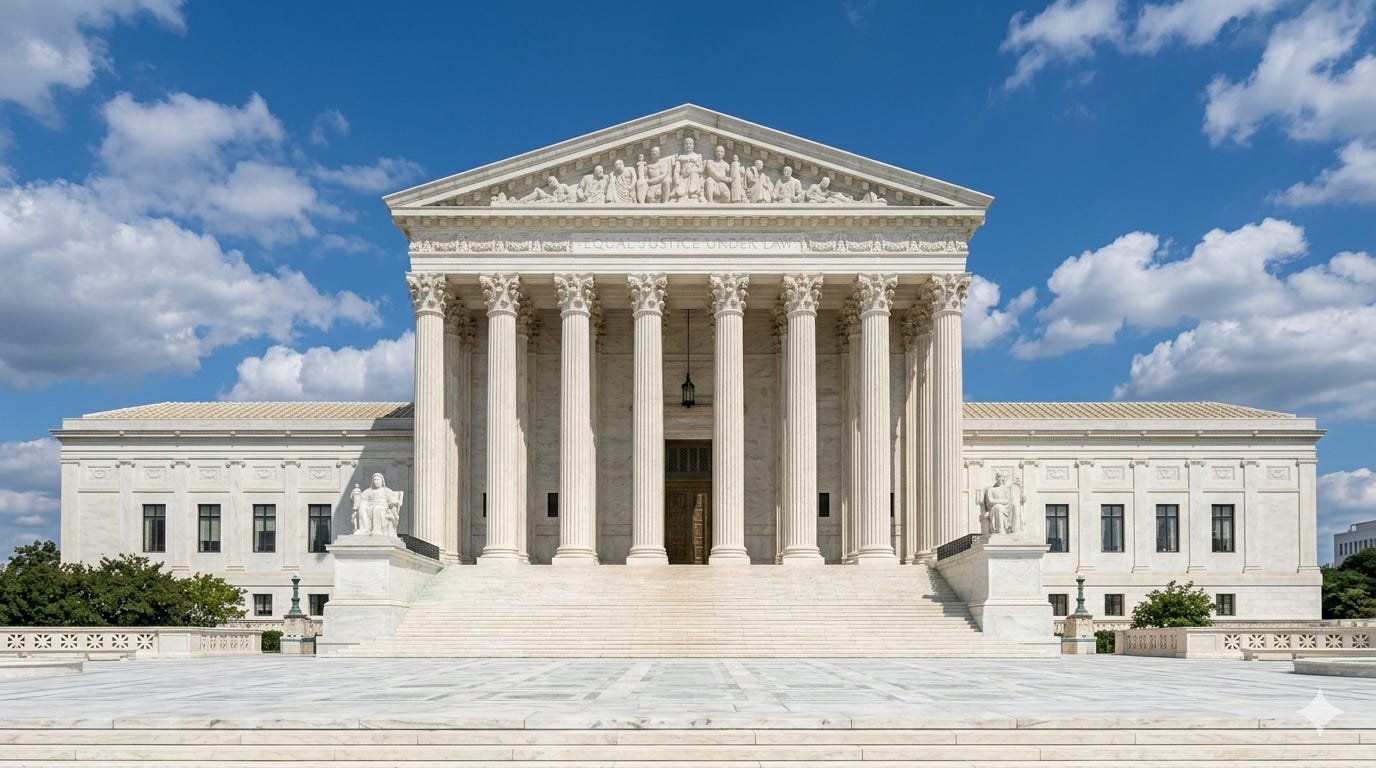
The Court held that Louisiana’s creation of a second majority-black district was an unconstitutional racial gerrymander, setting new standards for Voting Rights Act compliance.
TLDR
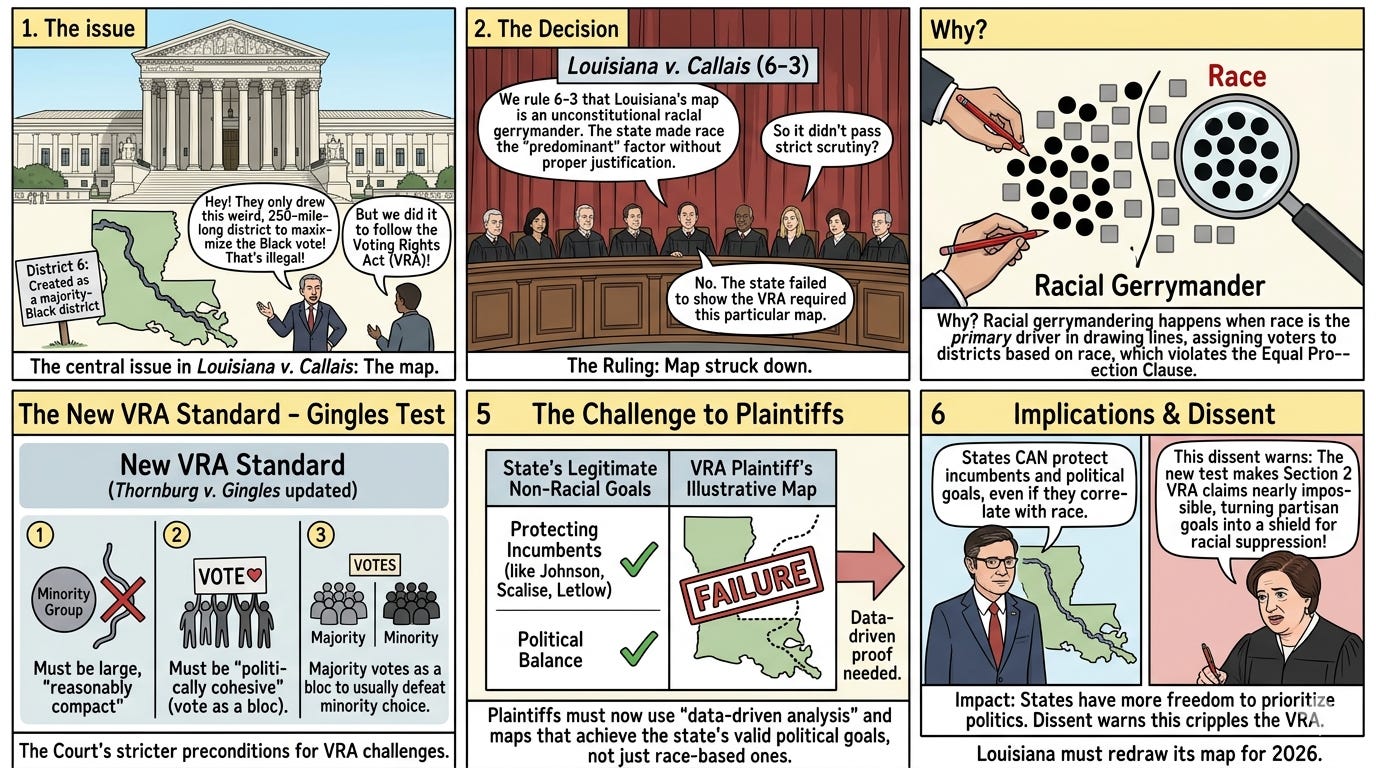
The Supreme Court, in Louisiana v. Callais, ruled 6-3 that Louisiana’s 2026 congressional map, SB8, is an unconstitutional racial gerrymander. The central issue was District 6, which connected distant black populations to create a majority-black district. The Court found race predominated the process and was not justified by the Voting Rights Act (VRA). The ruling establishes a strict new standard for Section 2 VRA claims, requiring plaintiffs’ illustrative maps to meet all of a state’s legitimate non-racial goals, such as protecting incumbents, and requiring evidence that controls for political affiliation. This landmark decision curtails the ability to use race in redistricting, demanding states focus on non-racial factors and prohibiting the use of historical discrimination data as a primary justification.
Case Info
Case Caption: Louisiana v. Callais (Consolidated with Robinson v. Callais)
Date: April 29, 2026
Link: https://www.supremecourt.gov/opinions/25pdf/24-109_21o3.pdf
Supreme Court Strikes Down Louisiana’s SB8 Map
The Supreme Court ruled that Louisiana’s SB8 congressional map is unconstitutional. The decision clarifies that a state may not use race as the “predominant” factor in drawing a district unless it can meet the strict demands of constitutional review. The Court determined that the creation of the second majority-black District 6 was an unconstitutional racial gerrymander and that the Voting Rights Act did not require its creation.
This ruling resolves a long-standing conflict over the intersection of the Equal Protection Clause and the Voting Rights Act (VRA). This case also set new standards for proof in VRA cases, particularly regarding evidence and the role of partisan goals in districting.
What is a racial gerrymander, and why did the Court find one in Louisiana?
A racial gerrymander occurs when a state makes race the primary consideration in drawing district lines, assigning voters to districts based on their race. The Court applied “strict scrutiny,” requiring the state to show a “compelling interest” and “narrowly tailored” means for its action. Louisiana officials stated that their goal was to draw a second majority-black district. Because the state’s map was drawn with race as the main driver, it was deemed a racial gerrymander. The Court found the state failed to show the VRA compelled this action.
How did the Court update the standard for Voting Rights Act claims?
The Court updated the Thornburg v. Gingles test used for Section 2 VRA claims. The new standard requires plaintiffs to prove three preconditions:
• First, the minority group must be large enough to form a majority in a “reasonably compact” area. A state may not create “narrowly-tailored, z-shaped” districts that connect disparate communities.
• Second, the group must be “politically cohesive,” meaning it votes as a bloc.
• Third, plaintiffs must show that the majority group also votes as a bloc to usually defeat the minority’s preferred candidate.
Critically, the Court held that plaintiffs must now submit illustrative maps that show a compliant district could be drawn. These maps cannot use race as a criterion and must achieve all of the state’s legitimate, non-racial goals, such as maintaining political balance or protecting specific incumbents. Plaintiffs must also provide analysis that “controls for party affiliation” to show racial polarization, not just partisan alignment.
What role did political goals play in this case?
The Court ruled that when race and party affiliation closely overlap, plaintiffs must prove it was race, and not party, that motivated the state legislature. In Louisiana, the state had legitimate non-racial goals, including preserving a specific political balance and protecting certain Republican incumbents like Speaker Mike Johnson and representatives Steve Scalise and Julia Letlow. The illustrative maps provided by the VRA plaintiffs failed to meet these non-racial goals. The Court concluded the VRA did not require the state to ignore its valid political considerations in order to draw a race-based district.
How did the dissent view this decision?
Justice Kagan, writing for the dissent, argued that this decision “overturns decades of established precedent” and effectively makes Section 2 of the VRA “impossible to win” in many states. The dissent contended that the new test places an impossible burden on plaintiffs, allowing states to use “partisan gerrymandering as an automatic defense against racial discrimination claims.” Justice Kagan noted that this creates a shield for states that want to suppress the voting power of minority communities, provided they can link the action to a political goal.
What’s Next?
This decision means that Louisiana must redraw its congressional map for the 2026 election cycle. The case returns to the lower court to oversee that process. The decision will have a broad impact, setting a high bar for any future challenges to a state’s redistricting plan.
Citations
• Louisiana v. Callais, 608 U. S. ___ (2026).
• Thornburg v. Gingles, 478 U. S. 30 (1986).
• Alexander v. South Carolina State Conference of the NAACP, 602 U. S. 1 (2024).
• Shelby County v. Holder, 570 U. S. 529 (2013).
Subscription Call
To stay informed on legal battles over voting rights and other constitutional liberties, subscribe to ReligiousLiberty.TV. Like and share this article to help spread the word. Our subscribers receive breaking news and detailed case analysis on the legal issues that shape our nation.
Disclaimers
AI Disclaimer: This article was assisted by AI.
Legal Disclaimer: This does not constitute legal advice. Readers are encouraged to talk to licensed attorneys about their particular situations.
