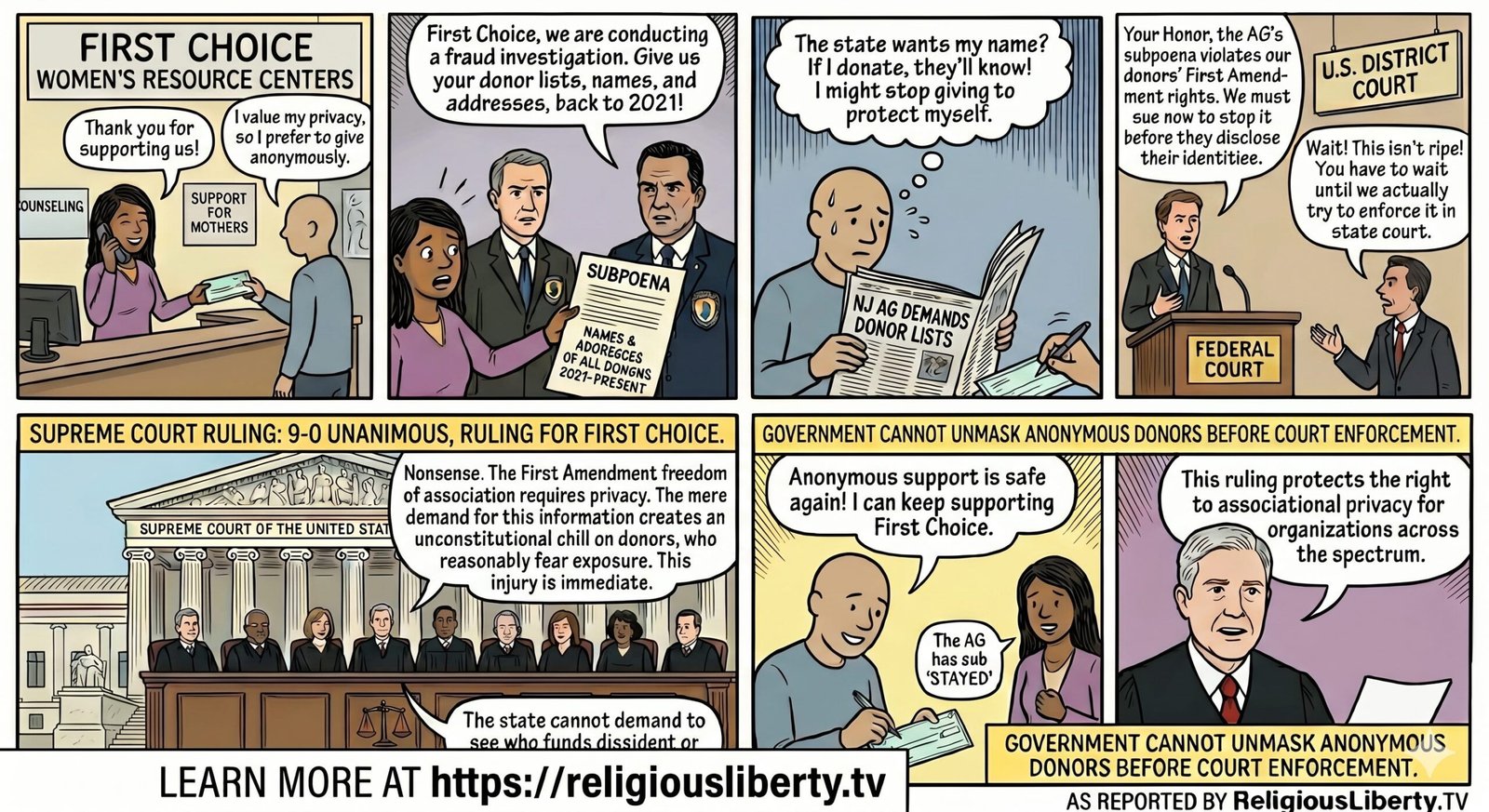
In a unanimous 9-0 decision on April 29, 2026, the U.S. Supreme Court ruled that First Choice Women’s Resource Centers has standing to challenge a New Jersey subpoena in federal court. The state’s Attorney General sought 28 categories of documents, including the names and addresses of private donors, as part of a consumer fraud investigation. Justice Neil Gorsuch wrote that such demands for private information inevitably discourage individuals from associating with groups that hold dissident or controversial views. The Court rejected New Jersey’s argument that the group had to wait for a state court to enforce the subpoena before filing a federal civil rights claim. This ruling reinforces the First Amendment right to “associational privacy” for nonprofits across the political and religious spectrum.
Case Info
Case Caption: First Choice Women’s Resource Centers, Inc. v. Jennifer Davenport, Attorney General of New Jersey
Date: April 29, 2026
Link to Decision: https://www.supremecourt.gov/opinions/25pdf/24-781_pok0.pdf
The Supreme Court has confirmed that a nonprofit organization can sue in federal court to block a state subpoena that demands the identities of its financial supporters. The ruling clarifies that the mere issuance of such a demand causes an immediate “injury in fact” by deterring donors who value their anonymity. You do not have to wait for the government to hold you in contempt before you can seek protection for your constitutional rights.
This decision is a major win for privacy in an era of intense political polarization. While New Jersey claimed it was investigating potential consumer fraud, the Court found that the threat to the First Amendment was too great to ignore. This case establishes a clear roadmap for how advocacy groups can protect their internal records from government overreach.
What are the facts of the First Choice v. Davenport case?
-
First Choice is a religious nonprofit in New Jersey that provides counseling to pregnant women but does not offer or refer for abortions.
-
In 2022, New Jersey’s Attorney General formed a “Reproductive Rights Strike Force” and issued a consumer alert against groups that provide “misleading” abortion information.
-
The state served a broad subpoena on First Choice, demanding names, addresses, and employment info for almost all donors since 2021.
-
The Attorney General admitted his office had received zero public complaints about First Choice before launching the investigation.
-
First Choice sued under 42 U.S.C. §1983, arguing the demand violated their donors’ First Amendment right to associate privately.
How did the Court define the injury to the First Amendment?
The Court relied on a long history of precedents, including cases involving the NAACP during the Civil Rights Movement. Justice Gorsuch explained that when the government demands to see who is funding a “dissident” group, it creates a “constant and heavy” pressure on those people to withdraw their support.
-
Privacy is Vital: The Court noted that without privacy, the freedom to associate would be “no freedom at all”.
-
Immediate Chill: An injury occurs the moment the demand is made because donors “reasonably fear disclosure” and “hesitate to associate”.
-
Targeting Advocacy: Government demands for donor info encourage groups to “cease or modify” their message to avoid being in the government’s crosshairs.
Why did the Court reject New Jersey’s defense?
The Attorney General argued that First Choice suffered no harm because the subpoena was “non-self-executing,” meaning the state had to go to a judge to make the group comply. The Court found this reasoning faulty. Gorsuch used the “Sword of Damocles” metaphor to explain that the threat of the subpoena hanging over the group is what causes the damage.
The Court also dismissed the state’s claim that a “protective order” to keep the names secret would solve the problem. Even if the names were never made public, the fact that government officials have the list is enough to scare off supporters.
What are the broader implications of this ruling?
This decision prevents states from using “channeling” tactics to force groups into state-preferred forms of association. It ensures that federal courts remain open to citizens who believe state actors have violated their rights, without requiring them to “exhaust” every possible state court remedy first.
First Choice will now return to the lower courts where they can argue the merits of their case. The Attorney General will have to meet “heightened scrutiny” to prove that there is a compelling reason to seize these donor lists that cannot be achieved through less intrusive means.
The Supreme Court has essentially told state prosecutors that they cannot use the discovery process as a tool for political intimidation. By allowing this suit to move forward, the Court recognizes that the “process is the punishment.” If a religious or political group has to spend years in litigation just to keep its donors’ names private, the government has already won by draining the group’s resources and scaring away its base.
The Attorney General’s argument that the subpoena was “purportedly non-self-executing” is a clever bit of legal phrasing that ignores the reality of the situation. When a state official with the power to prosecute serves you with a “command” to hand over documents, no reasonable person views that as an optional request. The Court was right to see through this and focus on the “objectively reasonable chill” felt by the donors themselves.
Furthermore, the rejection of the “protective order” defense is a win for transparency. In a digital age where government databases are frequently breached or leaked, a promise of confidentiality from a “hostile” official is cold comfort to a donor. This ruling acknowledges that the First Amendment protects the right to stay anonymous from the government, not just from the public.
Finally, the Court’s insistence on a federal forum for §1983 claims protects the “promise” of the Civil Rights Act. If plaintiffs were forced to litigate their constitutional rights in the very state courts that might be aligned with the state officials they are suing, the federal protection would be “hollowed out.” This 9-0 decision provides a unified front against government overreach into the private associations of the American people.
Citations
First Choice Women’s Resource Centers, Inc. v. Davenport, 608 U.S. ___ (2026).
Subscription Call
If you value reporting on religious liberty and the protection of your constitutional rights, please like, share, and subscribe to ReligiousLiberty.TV. Our subscribers get exclusive access to breaking news alerts and in-depth analysis of landmark Supreme Court cases.
Disclaimers
Legal Disclaimer: This does not constitute legal advice. Readers are encouraged to talk to licensed attorneys about their particular situations. This article was assisted by AI.
