As the United States enters its Semiquincentennial, the founding ideal of religious freedom remains central to our identity.
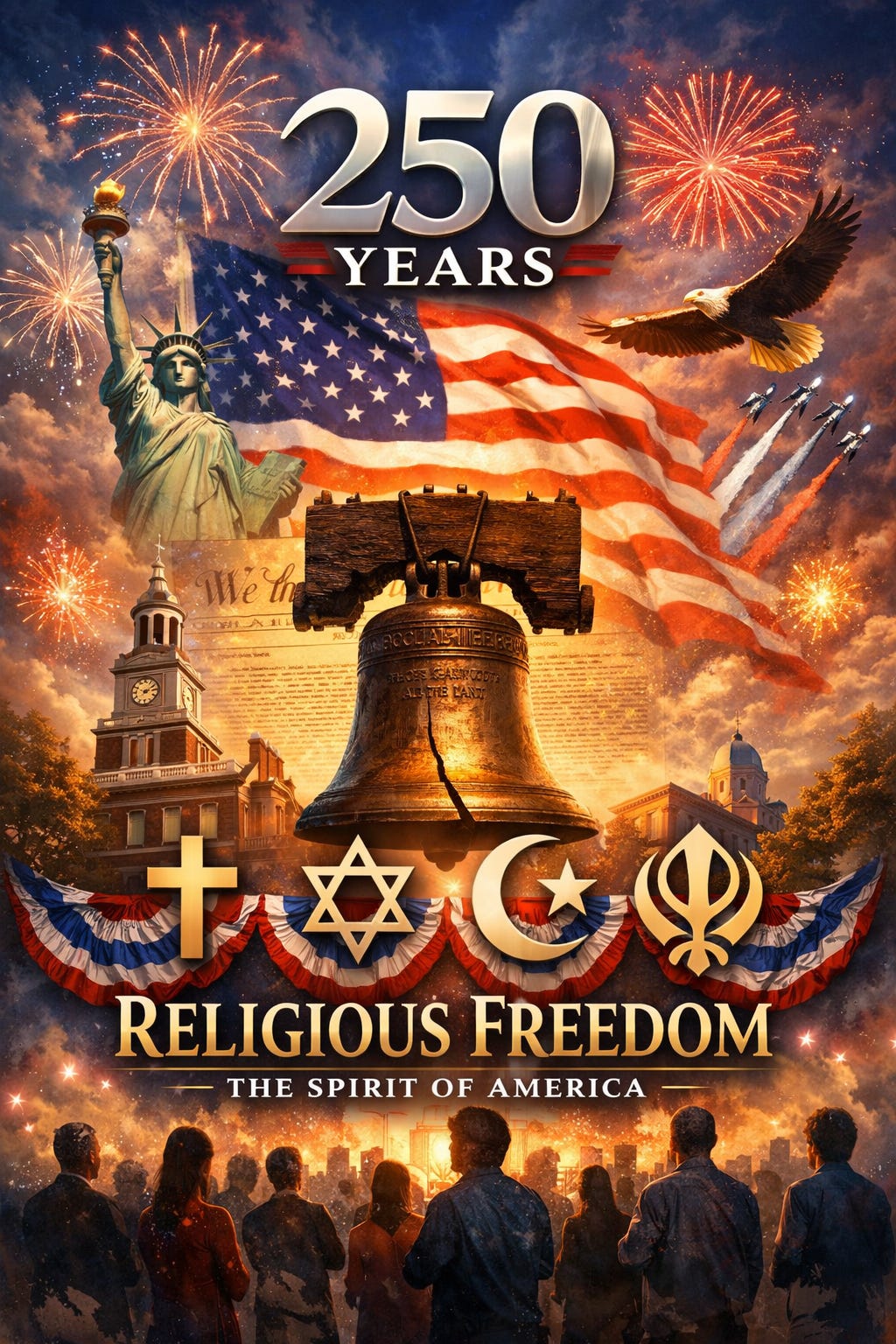
As the United States enters its 250th year in 2026, religious freedom remains central to our identity. The First Amendment protects both the free exercise of religion and bars government from establishing religion. The year ahead will be filled with reflection and renewed legal challenges. From landmark decisions to public discussions, the meaning of liberty of conscience will remain a focus throughout the Semiquincentennial.
On this New Year’s Day in 2026, the United States marks the first hours of its 250th year. Church bells ring over old town greens. Fireworks light the skies above every city. Flags wave in front of homes, schools, and courthouses. It is a moment to remember not just what was declared in 1776, but what was dared.
When the founders signed their names to the Declaration of Independence, they did more than split from an empire. They opened a space where liberty could grow. That liberty was not only political. It was deeply personal. In a world ruled by kings and state churches, America promised something rare: a land where every person could worship—or not—according to their own conscience.
This promise was not just rhetoric. The very first right protected in the First Amendment to the Constitution is this: “Congress shall make no law respecting an establishment of religion, or prohibiting the free exercise thereof.” These were not throwaway words. They formed a wall between church and state, not to keep faith out of public life, but to keep government from taking control of the soul.
From its earliest days, the United States became a refuge for the persecuted. Quakers, Baptists, Catholics, Jews, and later Muslims, Hindus, Buddhists, Sikhs, and atheists all found room to build their communities here. From the prayerbooks of Puritan settlers to the Torah scrolls carried by immigrants at Ellis Island, from the gospel choirs of the South to the incense of urban temples, the sound of religious freedom has always been part of our identity.
This freedom has not always been perfectly lived. At times, Americans have failed to honor their own ideals. Religious minorities have faced suspicion, violence, and discrimination. Courts have sometimes narrowed rights that the Constitution was meant to protect. Yet even in those moments, the principle has endured, and people have continued to demand its full protection.
Religious freedom in the United States is not only a philosophical value. It is a constitutional guarantee. The First Amendment’s religion clauses operate in two parts: the Establishment Clause bars the government from creating or favoring a religion; the Free Exercise Clause protects individuals’ rights to live out their beliefs.
This structure creates ongoing legal questions. For example, when public schools allow students to pray, officials must ensure it is truly voluntary and student-led. If a business owner raises a religious objection to a government regulation, courts must weigh that claim against the rights of others. These conflicts can be difficult, but the framework is designed to protect conscience while preventing government enforcement of belief.
Religious liberty belongs to all of us. It protects Christians, Jews, Muslims, Hindus, Sikhs, Buddhists, atheists, and others equally. Courts have ruled that even those without religion are entitled to the same First Amendment rights. The law does not ask what someone believes; it only ensures they are free to hold that belief without government interference.
This legal protection defines a central part of our identity as Americans. It assumes that religious truth is not defined by law, and that freedom of belief is a basic right, not a reward granted by majority vote. Each time the courts defend a Sabbath observer’s right to accommodation, or a person’s ability to wear a cross, turban, or hijab, we reaffirm our commitment.
As we begin our 250th year, these questions continue to matter. Debates over religious accommodation in schools, workplaces, and public spaces will remain active. Courts will refine the boundaries, but the core idea remains intact: government must not stand between a person and their conscience.
The Semiquincentennial invites us to reflect on what holds this country together. It is not shared religion. It is shared freedom. That includes the right to believe, the right to question, and the right to live according to conscience without fear.
In a world where religious repression and sectarian violence remain common, the United States stands apart. Our foundation in liberty, not uniformity, makes this a place where people of every background can live side by side under one flag. The work of protecting that freedom is not finished. But it remains central to who we are.
This milestone year will bring renewed attention to the meaning of the American experiment. Throughout 2026, we’ll be returning to this theme often: examining new cases, reviewing old ones, and asking what liberty of conscience looks like today. From courtrooms to classrooms, this national conversation will continue, and we’ll be covering it here in depth.
Like this article?
Help keep thoughtful reporting on faith and freedom going.
Share this story, and subscribe to the ReligiousLiberty.TV blog at religiouslibertytv.substack.com for access to breaking news, legal analysis, and ongoing case updates from the front lines of religious liberty.
Disclaimer:
This article is for informational purposes only and does not constitute legal advice. Please consult a licensed attorney regarding your own legal situation.
SEO Tags:
United States 250th anniversary, religious freedom in America, First Amendment rights, 2026 Semiquincentennial, American constitutional liberty
