On December 21, 2025, Puerto Rico Governor Jenniffer González-Colón signed Senate Bill 504 (Law 183-2025), officially recognizing the unborn child (nasciturus) as a “natural person” from the moment of conception. The law explicitly aims to align the Civil Code with the biological reality of unique genetic identity at fertilization. While it does not immediately amend the Penal Code on abortion, it grants fetuses civil rights like inheritance and legal standing. This creates a “conflict of laws” similar to the Scott Peterson trial, where a fetus was a person for homicide charges but not for abortion. This article examines the new law, its basis in scientific observation, and the inevitable legal collisions.
Bill Info: Puerto Rico Senate Bill 504 (Law 183-2025) | Signed: Dec. 21, 2025 | Jurisdiction: Commonwealth of Puerto Rico
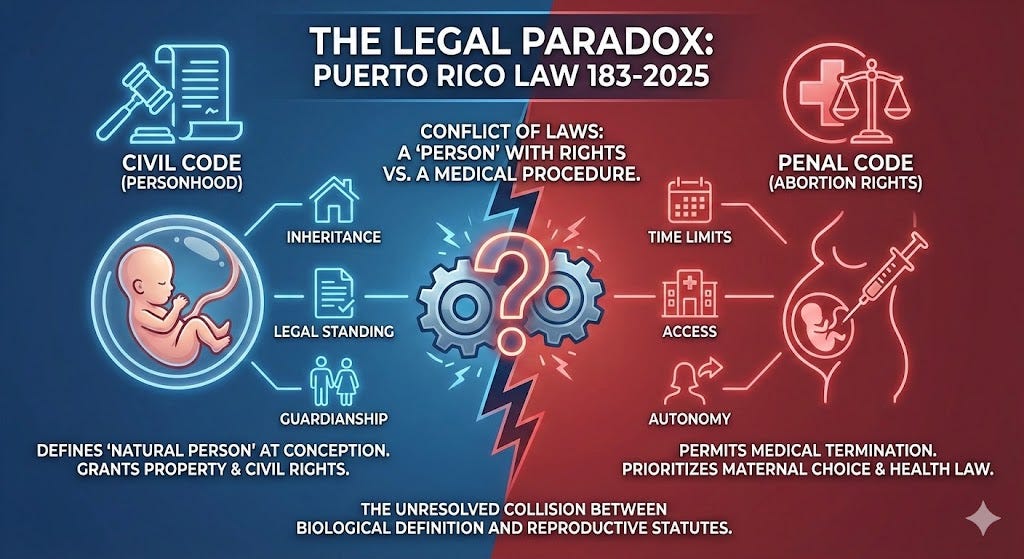
Puerto Rico Senate Bill 504 fundamentally shifts the legal definition of human life by codifying that a “natural person” exists from the moment of conception. This law grants the unborn distinct civil rights, including inheritance and the capacity to be represented in court, based on the premise that a unique human life begins at fertilization.
Why this story? Why now?
This legislation represents a critical escalation in the post-Dobbs era. By establishing “personhood” in the Civil Code without explicitly amending the Penal Code’s abortion regulations, Puerto Rico has created a deliberate legal friction. This move forces the courts to reconcile how a distinct “person” with inheritance rights can legally be terminated, effectively setting the stage for a judicial showdown that could reshape rights across U.S. territories.
What does Puerto Rico Bill SB 504 change in the Civil Code?
Senate Bill 504 amends the Civil Code of Puerto Rico to recognize the nasciturus (the conceived but unborn child) as a legal person. Previously, rights were conditional upon a live birth. The new law mandates that the unborn child is a “natural person” (persona natural) for all purposes favorable to them. This includes:
-
Inheritance Rights: An unborn child can now legally inherit property, homes, or assets.
-
Legal Standing: The fetus can be represented by a guardian in legal disputes or trusts.
-
Civil Protection: The law equates the child in the womb with a born child for civil liability purposes.
Opponents, including legal experts cited by the Centro de Periodismo Investigativo, argue this creates a backdoor ban on abortion. If a fetus is a person with rights, ending that life becomes a violation of civil rights. Proponents argue it merely aligns the law with biological reality, ensuring that if a father dies before his child is born, the child is not disinherited.
How does the law correlate with scientific reality?
SB 504 grounds its legal definition in the biological event of fertilization. Proponents argue that the law is merely catching up to scientific consensus regarding the start of a distinct biological life.
The Scientific Argument:
-
Unique Genetic Identity: At the moment of fertilization (conception), a zygote is formed with a unique DNA profile distinct from both the mother and the father.
-
Self-Directed Development: This new organism is not merely a part of the mother’s body (like a kidney or skin cell) but a self-directing entity that will develop into a mature human if not interrupted.
-
Biological Continuity: There is no point after fertilization where the entity undergoes a change of kind, only a change of degree (growth and development).
The Legal Translation: The law translates these biological facts into legal status. If science confirms the entity is a distinct human life, SB 504 argues the law must treat it as a distinct legal person. This challenges the arbitrary lines drawn by previous courts (such as “viability” or “birth”) which rely on location or dependence rather than biological essence.
How does the Scott Peterson trial illustrate the ‘Two-Tiered’ legal status?
The Scott Peterson trial in California remains the most potent example of the judicial system’s “schizophrenic” approach to fetal life. Peterson was convicted of double murder for killing his wife, Laci, and their unborn son, Conner.
This conviction relied on fetal homicide laws, which define the fetus as a victim when killed by a third party. The legal conflict arises here:
-
Context A (Homicide): The fetus is a “person” worthy of protection, and killing it is murder.
-
Context B (Abortion): The fetus is “tissue” or “potential life,” and ending its existence is a protected medical right.
This double standard relies entirely on the intent of the mother. If the mother wants the child, it is a person in the eyes of the law (as seen with Peterson). If she does not, it acts as non-person biological matter. SB 504 attempts to close this gap by declaring the fetus a person regardless of parental intent.
How did Roe v. Wade necessitate the dehumanization of the fetus?
To establish a constitutional right to abortion, Roe v. Wade had to legally dehumanize the fetus. The 1973 Court explicitly stated that the word “person,” as used in the Fourteenth Amendment, does not include the unborn.
This dehumanization was a functional necessity for the ruling. If the fetus were recognized as a person, the Fourteenth Amendment’s guarantee that no person shall be deprived of “life, liberty, or property” would prohibit abortion. Consequently, federal law spent 50 years treating the fetus as a distinct class of “non-person” to ensure the legality of abortion.
The overturning of Roe in Dobbs removed this federal restriction. States and territories like Puerto Rico are now free to re-humanize the fetus in their legal codes. SB 504 is the direct result of this shift, reclaiming the “personhood” status that Roe explicitly denied.
What is the current ‘Conflict of Laws’ regarding fetal status?
The “conflict of laws” refers to the incoherence that arises when different statutes define the same entity in contradictory ways. Dehumanization of the fetus in one area of law (reproductive rights) creates friction when other areas (property, torts, criminal law) attempt to humanize it.
SB 504 creates a scenario where:
-
Civil Law: The fetus is a person with the right to inherit a home.
-
Criminal/Health Law: That same “person” can be legally terminated.
This leads to uncomfortable legal questions. Can a “person” with a court-appointed guardian be aborted? If a doctor performs an abortion, are they destroying a “natural person” who holds title to property? The dehumanization required for abortion rights is incompatible with the personhood granted by SB 504. The law cannot indefinitely sustain the fiction that a being is a person for the purpose of a bank account but not for the purpose of the right to life.
Analysis: The Law Abhors a Paradox
The American legal system is currently attempting to maintain a logical impossibility. We are witnessing a collision between biological reality and political convenience. The Scott Peterson case proved that society intuitively recognizes the unborn as a victim when violence is committed against them by a stranger. We do not charge a person with “destruction of medical tissue” when they kill a pregnant woman’s unborn child; we charge them with homicide. That is an admission of personhood.
Yet, we maintain a parallel legal track where that same status is revocable based solely on the desires of the mother. This is unique in jurisprudence. Generally, personhood is an objective state—you either are a person or you are not. You do not become a person only when someone else wants you to be one. SB 504 exposes this hypocrisy. It forces the state to admit that if a fetus can own property (a right that requires legal existence), it must exist as a distinct legal entity.
The dehumanization of the fetus was a necessary legal fiction to sustain Roe. It required us to pretend that there was no “there” there. Now that Dobbs has returned this power to the people, laws like SB 504 are peeling back that fiction. The conflict of laws is not just a technicality; it is the system screaming that it cannot serve two masters. You cannot have a law that punishes Scott Peterson for murder while simultaneously claiming the victim did not exist.
Ultimately, this conflict will force a decision. Either the fetus is a person with all attendant rights, or it is property. It cannot be a person for the sake of inheritance and a non-person for the sake of abortion. The law abhors a paradox, and Puerto Rico has just forced the issue.
Sources & Citations
-
Caro González, Leysa. “Jenniffer González signs law recognizing the unborn as a natural person.” El Nuevo Día, 21 Dec. 2025, https://www.elnuevodia.com/english/news/story/jenniffer-gonzalez-signs-law-recognizing-the-unborn-as-a-natural-person/.
-
del Mar Quiles, Cristina. “The Known Consequences of Fetal Personhood Laws.” Centro de Periodismo Investigativo, 11 Dec. 2025, https://periodismoinvestigativo.com/2025/12/fetal-personhood-laws-risks-puerto-rico/.
-
“Murder of Laci Peterson.” Wikipedia, https://en.wikipedia.org/wiki/Murder_of_Laci_Peterson.
-
“PS 504 – Puerto Rico Senate (2025-2028).” Open States, 2025, https://open.pluralpolicy.com/pr/bills/2025-2028/PS504/.
Subscribe to ReligiousLiberty.TV: Stay ahead of the curve. Subscribers receive immediate alerts on breaking case law and analysis that the mainstream media often overlooks.
Disclaimers:
-
This article was assisted by AI.
-
This does not constitute legal advice. Readers are encouraged to talk to licensed attorneys about their particular situations.
Tags: Puerto Rico SB 504, Fetal Personhood, Conflict of Laws, Scott Peterson Trial, Roe v Wade
