
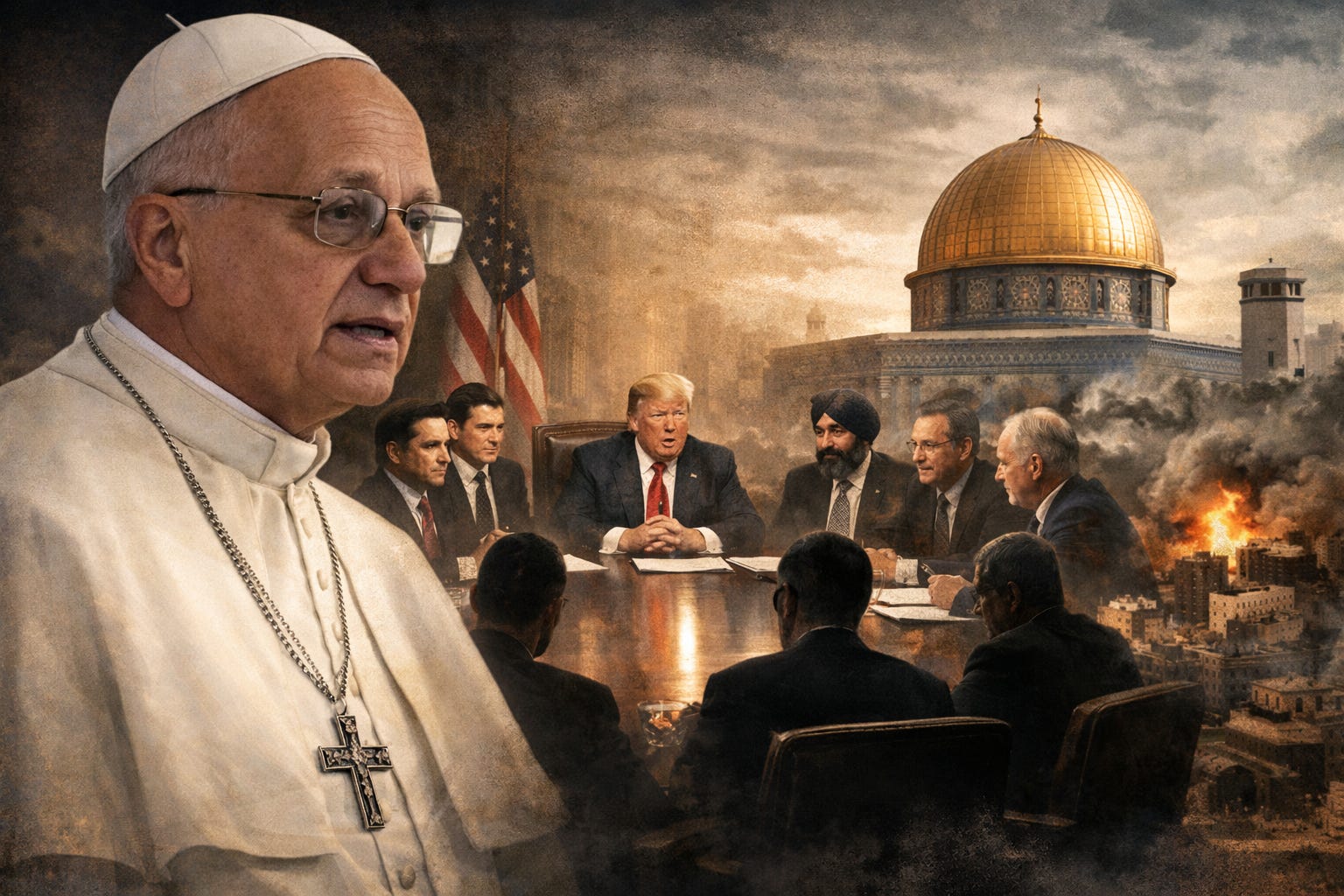
A new Board of Peace is taking shape under President Donald Trump, charged with managing Gaza after the war and staffed by political insiders, financiers, and foreign power brokers. One question has captured outsized attention. The Vatican has confirmed that Pope Leo XIV has been invited to join. No answer has been given. That silence is driving speculation.
The key questions are who sits on the board, what authority it actually has, how religion shapes the Gaza conflict (and beyond) and why the Vatican is weighing the risks of participation. This article explains what the board is designed to accomplish, what it cannot control, and why the Pope’s decision could define how this project is remembered.
The Vatican’s Choice and Trump’s Board of Peace
As religion shapes the Gaza conflict, the Pope’s invitation to join a U.S. led Board of Peace exposes the limits of power, the risks of moral authority, and what this project is realistically built to do.
The most revealing question surrounding President Donald Trump’s Board of Peace is not how many governments have endorsed it or how much reconstruction money it hopes to marshal. The question is whether the Vatican will participate, and what that decision would say about the board itself.
The Board of Peace was formally announced by the White House in January 2026 as part of Trump’s Comprehensive Plan to End the Gaza Conflict. Trump chairs the board personally. Its mandate is to oversee postwar security arrangements, transitional governance, reconstruction, and investment in Gaza. It is an executive body by design, centralized, hierarchical, and impatient with prolonged diplomacy.
Its membership reflects that structure. The Executive Board includes U.S. Secretary of State Marco Rubio, Middle East envoy Steve Witkoff, and Jared Kushner, who reprises his earlier role as a presidential negotiator. Former British Prime Minister Tony Blair brings experience from prior international intervention efforts. Ajay Banga, president of the World Bank, represents the financial architecture behind reconstruction. Business figures are included to channel private capital.
A separate Gaza Executive Board handles operational matters. It includes representatives from Egypt, Qatar, Turkey, the United Arab Emirates, Israel, and the United Nations. These actors already shape Gaza’s reality through mediation, aid, intelligence, and military leverage. The board does not pretend neutrality. It is a managed coalition assembled under U.S. leadership.
Religion is not peripheral to the conflict this board seeks to manage. Gaza is governed by Hamas, an Islamist movement. Israel defines itself as a Jewish state. Jerusalem, inseparable from the wider conflict, holds sacred meaning for Jews, Christians, and Muslims. Religious language has justified claims, hardened identities, and fueled violence. Any peace effort that treats faith as background noise misunderstands the terrain.
That is why the Vatican’s role matters. The Holy See has confirmed that Pope Leo XIV has received a formal invitation to join the Board of Peace. The invitation is under review. No decision has been announced.
For the Vatican, this is not a symbolic dilemma. It is an institutional one. The Church’s diplomatic influence rests on moral witness rather than executive authority. It mediates, urges restraint, and speaks in universal terms of human dignity. It does not administer security forces or oversee reconstruction budgets.
Joining the Board of Peace would change that posture. It would place the Vatican inside a structure that makes decisions about enforcement, political legitimacy, and economic leverage. It would associate the Pope with outcomes shaped primarily by state power and military realities. Influence would increase. Distance would vanish.
Supporters of papal participation argue that the board needs a moral anchor. They believe the Vatican could temper excess, emphasize civilian protection, and remind participants that Gaza is not simply a territory to be stabilized but a population with memory and grievance. They point to the Church’s past role in mediation as proof that moral authority can shape political behavior.
That argument misunderstands how moral authority works. It is persuasive precisely because it is not operational. Once the Vatican shares responsibility for outcomes it cannot control, its voice loses clarity. If reconstruction stalls or violence resumes, the Pope’s presence would not prevent failure. It would only bind the Church to it.
There is also a perception risk the Vatican understands well. A Christian institution joining a board that oversees a Muslim majority territory under Israeli military dominance would be read through history, not intent. Even neutral involvement can look partisan in a conflict saturated with religious memory.
The Board of Peace, for its part, is not built to resolve theology or history. It is built to manage consequences. Its goal is to reduce violence, impose order, and create conditions where daily life can resume. That may be a necessary task. It is not the same as reconciliation, and it does not claim to be.
Peace, in this model, is provisional and enforced. It lasts as long as funding flows and security holds. When either weakens, legitimacy becomes decisive. The Vatican has little incentive to stake its credibility on a structure whose endurance depends on forces beyond moral persuasion.
For now, the board proceeds without papal participation. It negotiates funding, coordinates regional actors, and prepares implementation phases. Its authority remains limited to what states consent to enforce. Its ambitions may grow. Its results remain uncertain.
The Vatican’s decision will come later, if at all. Acceptance would signal a willingness to trade distance for influence. Refusal would preserve moral independence at the cost of proximity to power. Either choice carries consequence.
What the hesitation already reveals is this. The Board of Peace is a mechanism of management, not redemption. It may succeed in stabilizing Gaza for a time. It will not end the deeper conflict that religion, history, and identity have sustained. The Vatican understands that distinction. It is why its answer matters more than its seat.
Like this article, share it, and subscribe to the ReligiousLiberty.TV blog for ongoing coverage of religion, law, and international affairs. Subscribers receive access to breaking developments and in depth case analysis. Visit

.
This article does not constitute legal advice. Readers are encouraged to consult licensed attorneys regarding their particular circumstances..
Potential SEO Tags: Board of Peace, Vatican Gaza conflict, Trump foreign policy, Pope Leo XIV, religion and Middle East conflict

