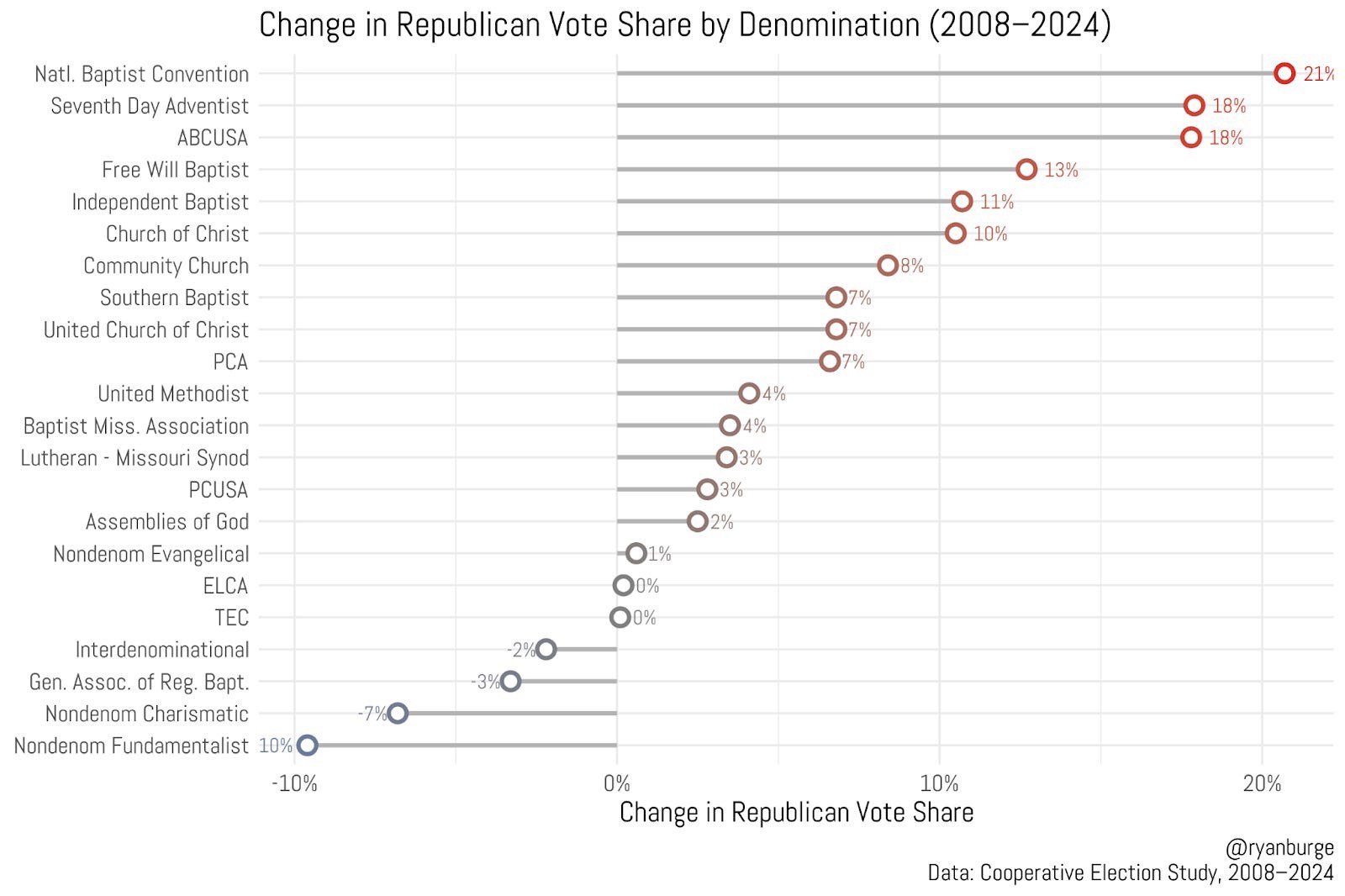
If you’re wondering why traditionally apolitical religious groups are suddenly voting like they’ve got a Sean Hannity subscription, Ryan Burge’s chart based on data from the Cooperative Election Study (Harvard) might offer a clue. Burge, a political scientist who tracks religion and politics like a hawk, looked at how different denominations voted between 2008 and 2024. His data shows that Seventh-day Adventists have increased their Republican vote share by 18 points. The National Baptist Convention is up 21. The American Baptist Churches USA? Also up 18. These aren’t evangelical megachurches in Dallas. These are historically cautious, sometimes skeptical, and often socially quiet religious groups.
So what’s going on? Is the choir voting red now? Did a bunch of people who never wanted a sermon to become a stump speech suddenly get political?
Probably not. They’re not flocking to the Republican Party. They’re aligning with candidates who sound like they care about the same issues that have always mattered to them. In other words, it’s not that they’re becoming more conservative. It’s that the ground under them has shifted so far left that staying put now looks like a move to the right.
It’s not that they’re becoming more conservative. It’s that the ground under them has shifted so far left that staying put now looks like a move to the right.
Let’s talk about the Adventists for a second. This is a denomination with a deep commitment to religious liberty and a long history of political neutrality. You won’t find them running campaign ads from the pulpit. But now their Republican vote share is up by almost 20 points. Not because they’ve suddenly become Fox News superfans. Because a whole range of policies—from school mandates to conscience exemptions in healthcare—have started pressing hard against their core beliefs.
That’s a pattern across the chart. Free Will Baptists are up 13. Independent Baptists, 11. Church of Christ, 10. Meanwhile, Nondenominational Fundamentalists and Charismatics are going in the opposite direction. Down 10 and 7, respectively. These numbers suggest the shift isn’t about church type or theological category. It’s about whether you think the current cultural moment respects your convictions.
It also depends on the kinds of candidates that show up. Some voters like strong positions on school curriculum, religious hiring, or the right to say “no” based on conscience. Others are turned off by the tone and rhetoric, even if they agree on the issue. Which explains the disconnect. These voters are reacting to policy and personality. Party loyalty? Not so much.
Now, if you’re sitting in a pew at a mainline Protestant church (the ELCA, the Episcopal Church, the PCUSA) you might not notice any change. These groups stayed steady in their Republican vote share. That’s because they’ve generally kept pace with social progressivism. Their values and the broader cultural narrative are still pretty close together. They didn’t have to move. The others did.
But the shift isn’t just cultural. It’s legal. As more voters feel out of step with the policies being handed down from the courts, schools, or HR departments, they’re showing up in another courtroom. The one with a judge. More lawsuits are being filed over religious exemptions, speech restrictions, parental rights, and medical ethics. These aren’t new beliefs. They’re old ones suddenly clashing with new expectations.
These aren’t new beliefs. They’re old ones suddenly clashing with new expectations.
And courts pay attention to that. Judges tend to give more weight to beliefs that are long-standing and sincerely held. If someone says, “I’ve always believed this,” they’ll have a stronger First Amendment case than someone who adopted a view last week after reading a blog post. Which means this political shift might have real legal weight.
Religious institutions now face a choice. Stay neutral and watch members get more politically engaged on their own, or step in and start helping shape that engagement. Denominations like the Seventh-day Adventist Church have always valued their distance from politics. But when members start showing up at the ballot box with religious liberty on their minds, the leadership may find that silence feels like abdication.
Politicians should also take a cue. These aren’t voters looking for red versus blue. They’re looking for someone who won’t steamroll their values. The person matters more than the party. And the policies matter most of all. If a Democrat starts defending parental rights, conscience protections, and religious speech, they might get these votes back. Until then, the trend continues.
These aren’t voters looking for red versus blue. They’re looking for someone who won’t steamroll their values.
This isn’t a right-wing takeover of the pews. It’s a reaction to a cultural shift that left some religious communities feeling like the rules changed without a vote. The more those communities feel pushed to the margins, the more they’ll respond at the ballot box.
So yes, Seventh-day Adventists just jumped 18 points toward Republican candidates. But don’t expect them to start waving party flags. They’ll vote for whoever respects their right to live their beliefs. If that means crossing the political aisle every few years, so be it.
TLDR (Too Long / Didn’t Read Summary)
According to Ryan Burge’s latest data, several religious groups, including Seventh-day Adventists and the National Baptist Convention, have sharply increased their support for Republican candidates since 2008. But this doesn’t reflect a surge in party loyalty. Instead, it suggests that many religious voters are reacting to policy shifts and cultural changes they feel threaten their beliefs. Issues like conscience protections, education, and religious freedom are driving these shifts more than party platforms. Expect continued movement based on issues, not labels.
Like this article? Share it and subscribe to the ReligiousLiberty.TV blog for breaking news, legal updates, and expert analysis of religious freedom cases. Stay informed at religiouslibertytv.substack.com.
Legal Disclaimer: This article does not constitute legal advice. For legal questions about your rights or obligations, consult a licensed attorney.