
TLDR
President Donald Trump has officially announced a national prayer event titled “America Prays,” scheduled for May 17, 2026. Speaking at the National Prayer Breakfast on February 5, 2026, Trump described the gathering as a “sacred ceremony” to rededicate the United States as “one nation under God.” This event is a central piece of the “Freedom 250” initiative, celebrating the semiquincentennial of American independence. The announcement follows a series of executive actions, including the 2025 establishment of the Religious Liberty Commission and a new Task Force to Eradicate Anti-Christian Bias. While supporters embrace the move as a restoration of the country’s religious roots, critics have voiced concerns regarding the separation of church and state and the potential for government-sanctioned religious coercion.
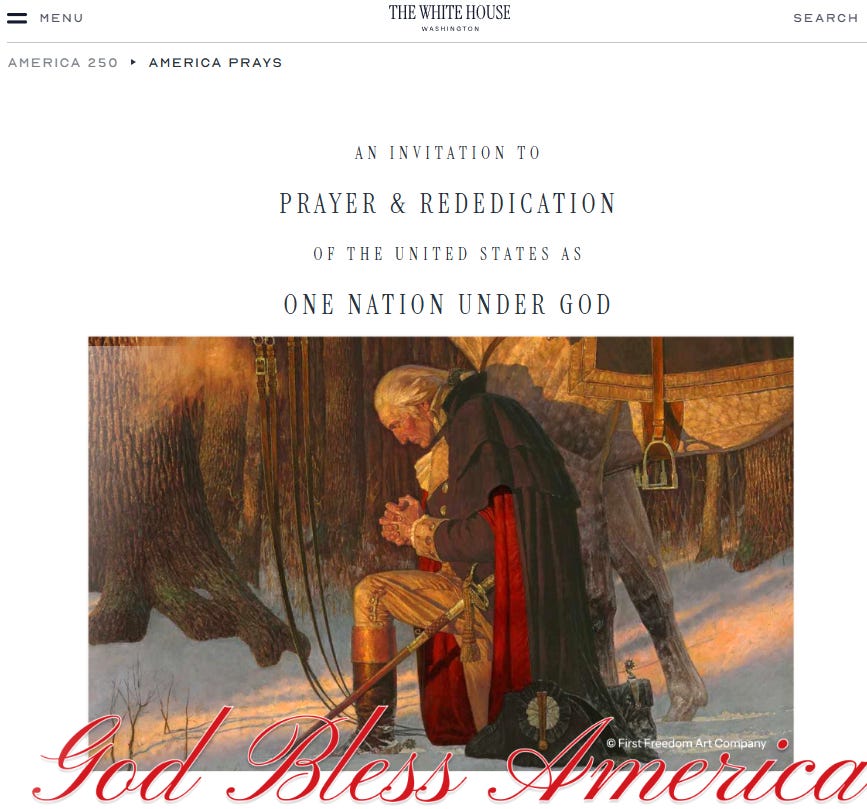
America Prays (National Mall Ceremony) Date: May 17, 2026 Link: White House America 250 Initiative
Today’s announcement by President Trump clarifies that his administration intends to use the 250th anniversary of the United States to elevate public religious expression. He signaled that the federal government will play an active role in facilitating mass prayer events on public land. This approach suggests a definitive shift toward integrating ceremonial religious practices into official state functions.
This story is notable because it tests the legal boundaries of government-sponsored religious activity. By framing the May event as a historical “rededication” rather than a new mandate, the administration seeks to align the ceremony with established traditions of “ceremonial deism.” The outcome of this event will likely influence future judicial interpretations of the Establishment Clause during the administration’s second term.
1. What is the “America Prays” event on May 17, 2026?
The “America Prays” event is a large-scale public prayer gathering scheduled for the National Mall in Washington, D.C. President Trump invited Americans from all 50 states to attend what he calls a “once in a lifetime national moment.” The event will include:
-
A formal ceremony to rededicate the country to its “Creator.”
-
Speeches, songs, and storytelling focused on the role of faith in U.S. history.
-
A call for citizens to pray for the nation’s next 250 years. The White House has already released a 22-page document highlighting the “Christian roots” of the country to support the initiative.
2. How does the May 2026 event fit into Trump’s “Freedom 250” plan?
The “Freedom 250” initiative is the administration’s year-long celebration of the 250th anniversary of the Declaration of Independence. Trump is positioning the May 17 prayer event as the spiritual anchor of this celebration. He argued at the prayer breakfast that “prayer is America’s superpower” and that the nation’s 250-year story is one of “divine providence.” Other components of the plan include:
-
The “America’s Ball for the Mall” gala on May 7, 2026.
-
National Day of Patriotic Devotion observances.
-
New Department of Education guidance protecting prayer in public schools.
3. What legal precedents exist for a president-led prayer event?
The administration relies on a long history of presidential calls for prayer to justify the May 2026 event.
-
1789: George Washington issued a Thanksgiving Proclamation to thank God for the Constitution.
-
1863: Abraham Lincoln called for a national day of “humiliation, fasting, and prayer” during the Civil War.
-
1952: Harry Truman signed the law establishing the annual National Day of Prayer.
-
1988: Ronald Reagan fixed the National Day of Prayer as the first Thursday in May. Trump’s legal team argues that because presidents have called for prayer since the founding, the May 17 event is a constitutional continuation of American tradition.
4. Why are civil liberty groups challenging the May 2026 gathering?
Groups such as Americans United for Separation of Church and State have criticized the event as “Christian Nationalist.” Their primary arguments include:
-
Government Endorsement: Critics claim the White House is using federal resources to promote a specific religious viewpoint.
-
Exclusion: Opponents argue the focus on “Christian roots” ignores the pluralistic reality of modern America.
-
Coercion: There are concerns that federal employees or military members may feel pressured to participate in the “sacred ceremony.” The President dismissed these concerns at the breakfast, predicting that while Democrats might sue, his administration would “win it” in court.
Analysis
The President’s decision to hold a mass prayer event in May represents a calculated effort to define the American identity through a religious lens. From a constitutional perspective, the administration is moving toward a “non-coercion” standard. This theory suggests that as long as the government does not force individuals to pray, it is free to encourage or participate in religious activities. This is a departure from the “Lemon Test” of previous decades, which sought to limit government entanglement with religion.
Politically, the May 17 event serves as a powerful signal to the President’s base. By centering the 250th anniversary on a prayer ceremony, he is framing the debate over national identity as a choice between “believers” and “secularists.” This strategy forces his opponents into a difficult position: either support a popular religious tradition or risk appearing “anti-faith” by filing lawsuits to stop it.
The historical timing is also strategic. Using the 250th anniversary allows the administration to wrap the event in the flag, making any legal challenge look like an attack on the nation’s founding principles. If the Supreme Court continues its trend of protecting religious expression, the “America Prays” event could set a new high-water mark for state-supported religious ceremonies.
Ultimately, the May 17 gathering is about more than just a single day of prayer. It is an attempt to cement a specific interpretation of the First Amendment that prioritizes the “Free Exercise” of the majority over strict “Establishment Clause” restrictions. The legal and cultural results from this event will likely resonate for the remainder of the 2020s.
Citations
Arnold, Tyler. “Trump Announces May 17 Event to Rededicate U.S. as ‘One Nation, Under God.’” EWTN News, 5 Feb. 2026, https://www.ewtnnews.com/world/us/trump-prayer-breakfast-2026.
The White House. “Religious Freedom Day, 2026.” Whitehouse.gov, 16 Jan. 2026, https://www.whitehouse.gov/presidential-actions/2026/01/religious-freedom-day-2026/.
U.S. Department of Education. “Guidance on Prayer and Religious Expression in Public Schools.” Ed.gov, 5 Feb. 2026, https://www.ed.gov/about/news/press-release/us-department-of-education-issues-guidance-prayer-and-religious-expression-public-schools.
Subscription Call Like, share, and subscribe to ReligiousLiberty.TV for breaking news and case info. Subscribers get access to breaking news and case information.
Disclaimers AI Disclaimer: This article was assisted by AI. Legal Disclaimer: This does not constitute legal advice. Readers are encouraged to talk to licensed attorneys about their particular situations.
Tags Trump, America Prays, National Day of Prayer, Religious Liberty, Freedom 250