IF TRUMP EXITS NATO, THE WORLD’S PERSECUTED FAITHFUL PAY THE PRICE
He calls the alliance a ‘paper tiger.’ But before we burn it down, let’s fix what’s actually broken.
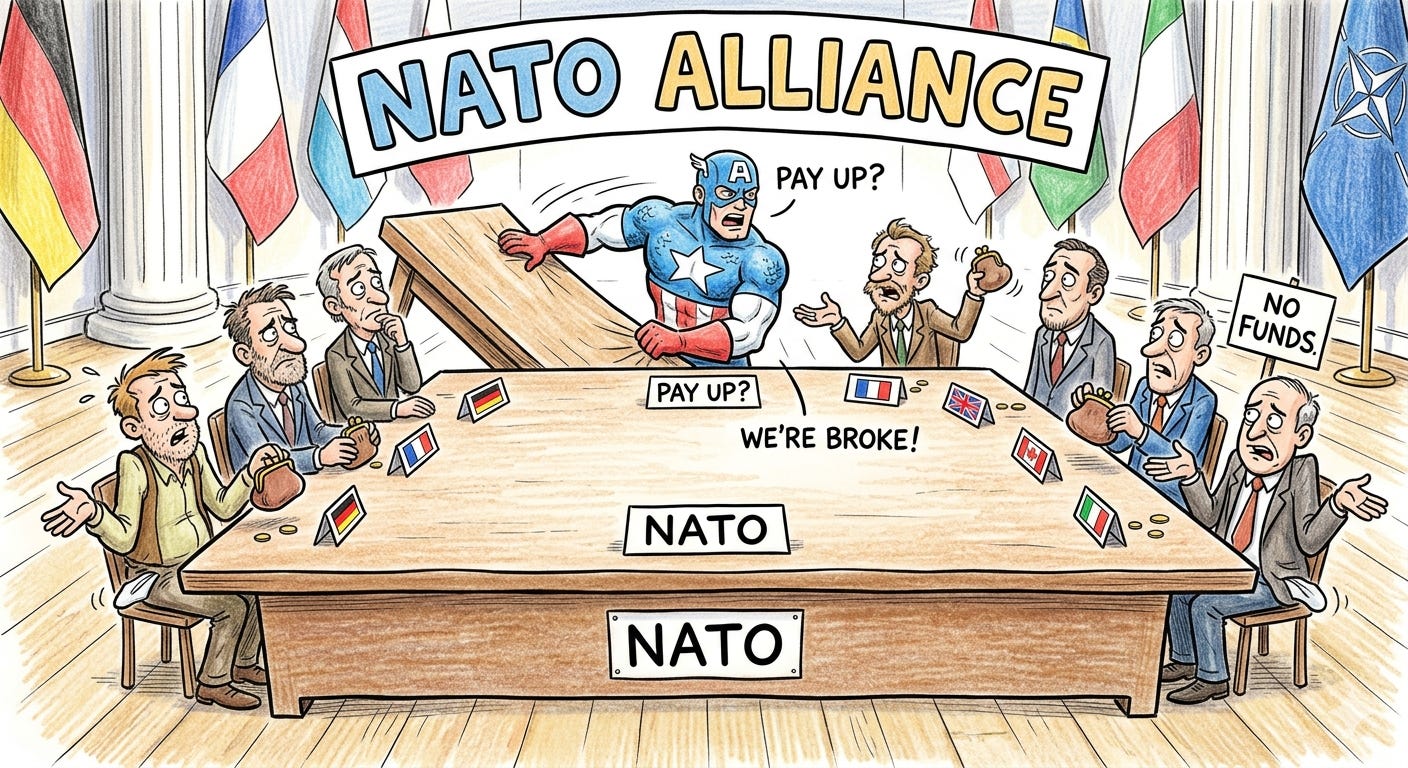
President Trump has declared he is “beyond reconsideration” on NATO, calling the alliance a “paper tiger” after European partners refused to join the U.S.-Israel war against Iran. His frustration is real, his math is partly right, and his solution is catastrophically wrong. Those three things can all be true at the same time.
TRUMP’S GRIEVANCE IS LEGITIMATE
Let’s give the president his due. For decades, the burden-sharing complaint was not a fever dream. It was a documented structural problem. Back in 2017, only four nations met the alliance’s agreed 2% of GDP defense spending threshold: the United States at 3.6%, Greece at 2.4%, the United Kingdom at 2.1%, and Poland at exactly 2%. The other 25 members were freeloading on American muscle while running generous social programs Washington taxpayers were implicitly subsidizing.
The United States remains the backbone of NATO’s military power, with estimated defense spending of around $980 billion, roughly 62% of NATO’s total defense budget, far exceeding any other member. That is not a partnership. That is a protection racket where one side pays and the other negotiates.
BUT THE PICTURE CHANGED, DRAMATICALLY
Here is what Trump’s grievance does not account for: it worked. In 2025 alone, European allies and Canada increased defense spending by 20% from the prior year, with all allies now exceeding the 2% threshold for the first time in recorded NATO history. For the first time ever, a European ally, Norway, has surpassed the United States in defense spending per capita.
European allies and Canada collectively invested $574 billion in defense in 2025, a 20% real-terms increase over 2024. Germany, the largest European military spender in the group, grew its expenditure by 24% year-on-year to $114 billion, exceeding the 2% GDP threshold for the first time since 1990. Spain increased defense spending by 50% to $40.2 billion, also clearing 2% for the first time since 1994.
Poland now leads all NATO members at 4.48% of GDP on defense, followed by Lithuania at 4% and Latvia at 3.73%. These are not countries with abstract fears about Russian aggression. They share a border with it.
NUMBERS DON’T TELL THE WHOLE STORY
The percentage figures, however, can obscure a structural reality. What Europe cannot quickly replace, likely because they depended solely on the United States, for the last few decades, is the invisible architecture the U.S. provides: satellite surveillance, missile defense, strategic airlift, and integrated command. Raw spending does not buy those capabilities overnight. Europe is spending more. It is not yet spending smarter. The fragmentation of 30-plus national procurement systems means duplication, interoperability gaps, and politically protected domestic defense industries that deliver less capability per euro than the numbers suggest.
THE WAY FORWARD: A NEW DEAL, NOT A WALKOUT
The answer to a bad business arrangement is renegotiation, not arson. Here is what a genuinely America-First NATO reform, one that actually reduces U.S. costs while maintaining deterrence, would look like.
The appointment of a European Supreme Allied Commander Europe, a post held by an American general since 1951, would fundamentally recalibrate the alliance’s power dynamics, reflecting Europe’s increasing defense capabilities and directly addressing long-standing U.S. criticisms about burden-sharing. Washington keeps the nuclear umbrella and the strategic reserve role. Europe commands the conventional defense of Europe. That is not weakness. That is a division of labor that actually saves American money.
European nations have already demonstrated they can operationalize NATO’s adapted posture. NATO’s Operation Baltic Sentry and Operation Eastern Sentry both relied extensively on European capabilities, showing that European nations can lead when the political will is present.
The U.S. National Security Strategy itself signals a willingness to reward countries that take on more regional security responsibility through trade benefits, technology sharing, and arms sales. That is a framework for transformation, not abandonment. Use it.
THE STAKES FOR THE FAITHFUL
The USCIRF 2026 Annual Report cataloged egregious violations spanning 29 countries, recommending 18 be designated Countries of Particular Concern for abuses including torture, prolonged detention, genocide-like policies, and destruction of religious sites, with Russia and China both on the list.
American diplomatic leverage over those governments does not flow from strongly worded press releases. It flows from the credible projection of power that NATO, for all its dysfunction, still represents. Blow up that alliance and you hand Beijing and Moscow a permission slip, not just for territorial aggression, but for the systematic elimination of religious minorities who have nowhere else to look for protection.
Trump can demand a better deal. He just cannot afford to walk away from the table.
SOURCES
1. Al Jazeera. “Trump Administration Signals It Is Mulling NATO Withdrawal After Iran War.” April 8, 2026. https://www.aljazeera.com/news/2026/4/8/trump-administration-says-it-is-mulling-nato-withdrawal-after-iran-war
2. Northeastern University. “What Would Happen if Trump Pulled Out of NATO?” April 9, 2026. https://news.northeastern.edu/2026/04/09/trump-pulling-out-of-nato-explained/
3. TIME. “Trump Threatens to Pull U.S. Out of NATO Amid Fallout Over Iran War.” April 1, 2026. https://time.com/article/2026/04/01/trump-considering-pulling-us-out-of-nato-iran-war-legal-options/
4. The Hill. “NATO Braces for Change Amid Donald Trump’s Withdrawal Threats.” April 2026. https://thehill.com/policy/defense/5815848-trump-nato-tensions-rise-withdrawal-threats/
5. World Population Review. “NATO Spending by Country 2026.” https://worldpopulationreview.com/country-rankings/nato-spending-by-country
6. Atlantic Council. “NATO Defense Spending Tracker.” April 9, 2026. https://www.atlanticcouncil.org/commentary/trackers-and-data-visualizations/nato-defense-spending-tracker/
7. The Global Statistics. “NATO Budget by Country Statistics 2026.” https://www.theglobalstatistics.com/nato-budget-by-country-statistics/
8. Visual Capitalist. “Charted: The U.S. Dominates NATO Defense Spending.” January 24, 2026. https://www.visualcapitalist.com/charted-the-u-s-dominates-nato-defense-spending/
9. SIPRI. “Global Military Spending Rise Continues as European and Asian Expenditures Surge.” April 27, 2026. https://www.sipri.org/media/press-release/2026/global-military-spending-rise-continues-european-and-asian-expenditures-surge
10. NATO Veterans. “Not De-coupling But De-risking NATO: Europe’s Bid for Strategic Autonomy.” December 6, 2025. https://nato-veterans.org/not-de-coupling-but-de-risking-nato-europes-bid-for-strategic-autonomy/
11. Atlantic Council. “How Europe Can Strengthen Its Own Defenses and Rebalance Transatlantic Relations.” December 15, 2025. https://www.atlanticcouncil.org/dispatches/how-europe-can-strengthen-its-own-defenses-and-rebalance-transatlantic-relations/
12. BEHorizon. “Europe’s Role in the 2025 U.S. National Security Strategy.” December 11, 2025. https://behorizon.org/europes-role-in-the-2025-u-s-security-strategy/
13. Washington Stand. “Escalating Crisis: USCIRF 2026 Report Exposes Severe Religious Freedom Abuses in 29 Countries.” March 5, 2026. https://washingtonstand.com/article/escalating-crisis-uscirf-2026-report-exposes-severe-religious-freedom-abuses-in-29-countries
14. USCIRF. “USCIRF Releases 2026 Annual Report.” March 4, 2026. https://www.uscirf.gov/news-room/releases-statements/uscirf-releases-2026-annual-report-exposes-egregious-religious