
It was midnight on the night before Father’s Day. Across the manicured, God-fearing lawns of Ohio, millions of suburban patriarchs were eagerly anticipating a fresh pack of low-cut socks, perhaps a silk tie, and the satisfaction of a morning brunch surrounded by their children.

But for two particular fathers, this was not that kind of Sunday.
Instead of resting easy, one father found himself hurtling down the cracked asphalt artery of Interstate 75, clutching the steering wheel of a sedan with a white-knuckled fury that defied the speed limit. His destination was a grim, fluorescent-lit purgatory: a train station that doubled as a Greyhound bus depot in a uniquely seedy, rust-eaten underbelly of Toledo, Ohio. The clock on the dashboard read well past midnight. A normal father sleeps at midnight.
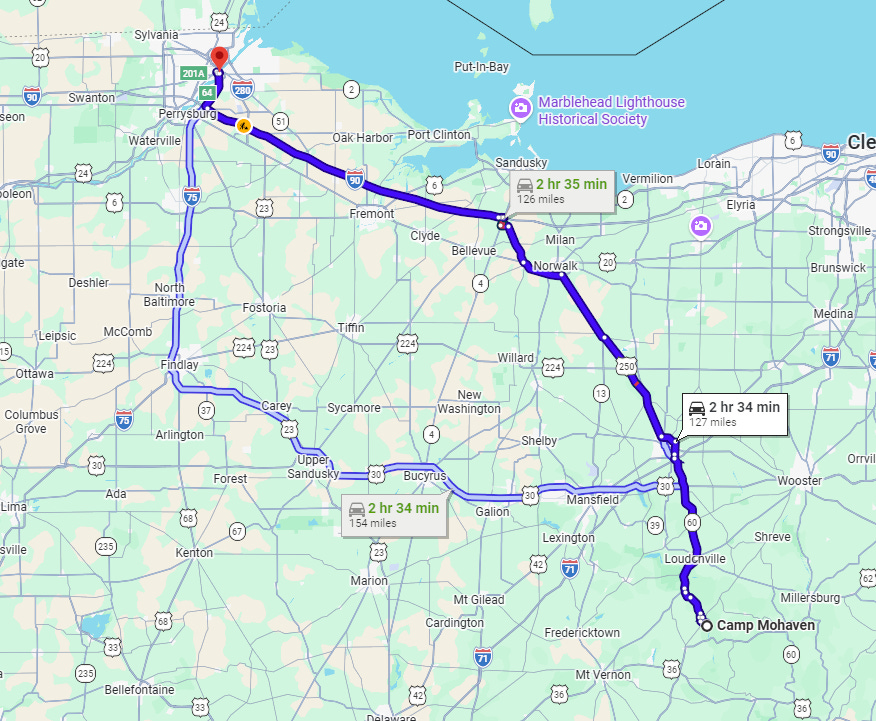
Toledo at 1:00 AM is a landscape painted in shades of diesel exhaust and broken glass. It is the kind of place where the desperate and the forgotten congregate under the flickering glare of vending machines, waiting for a delayed connection to nowhere. His daughter, a camp counselor who had signed up for a summer of wholesome Christian leadership at Camp Mohaven, had instead been dumped here like unwanted cargo, left on a concrete platform and abandoned.
And he wasn’t the only parent trapped in a nightmare of unhinged panic. Somewhere out there in the dark, another father, frantic and blinded by the sudden, terrifying realization that the summer camp he trusted with his son had effectively fed him to the wolves of the night, was racing down a rural state route. His panic was so blinding, his accelerator pressed so hard into the floorboard, that he collided head-on with a deer. The poor beast was obliterated, a sacrificial lamb to the altar of parental terror, leaving a streak of blood and fur across a shattered windshield. The girl’s dad was hours further away and had contacted the boy’s dad because he could get there a little faster even though it was still a long drive.
That is the true currency of Father’s Day in the Ohio Conference: two dads, fear, adrenaline, and roadkill. A cell phone with questionable battery life is the only lifeline as teenagers barely out of high school are left alone to face who-knows-what in a grungy mid-night train station. The camp director could have dumped them at an airport that was closer to the camp, but he said they would look “too suspicious” showing up there with their suitcases, so he took them where people go who have no other choice, and definitely have no tickets. After all, this was not a situation where he wanted to face questions. This was one of several jaw-droppingly bad decisions made by someone who should have known better that night, but apparently he thought it out before he shuffled a teenage boy and girl into his car without giving them any options, and drove them off like some people take unloved pets to a farm and push them out the door.
To fully understand the madness of this late-night drop-off, one must look at the brutal reality of the terrain. Ohio is not just a collection of quiet cornfields; it is a major crossroads for some of the darkest criminal enterprises in the nation. According to human trafficking statistics compiled by the Human Trafficking Courts blog, Ohio ranks fifth in the United States for human trafficking incidents and is listed as the fourth worst ratio in the nation per capita, translating to hundreds of ongoing nightmare cases every single year. The overwhelming majority of these cases involve the sexual exploitation of young females. To leave a young woman completely unescorted at a sketchy, dark transit hub in a city like Toledo after midnight is not just bad management. It is handing a potential target directly to an active, predatory ecosystem.
The train wouldn’t come until 5:22 a.m. that Sunday morning. This isn’t a Journey song – there’s no “Midnight train” going anywhere. We’ve asked the Conference whether they at least bought them tickets, and are waiting for a response.
How did it come to this? It is a story steeped in the peculiar, toxic brew of religious authority and bureaucratic cowardice. This is not the first time the Ohio Conference has stumbled through a crisis of its own making. There is a deeply entrenched, recurring pattern here of handling intense personnel issues with the subtlety of a sledgehammer and the transparency of a lead wall.
Consider the situation at the Worthington Seventh-day Adventist Church and Academy. When a volunteer teacher and youth minister was found to be caught in a federal investigation involving the distribution and possession of child sexual abuse material, the institutional response carried that same familiar, icy detachment. The conference told WSYX: “The school’s information officer tells us they are aware of the incident and that they alerted parents at the school and church. They say Brown was never an employee of the school or church, only a volunteer; they also stressed that no student in the school or church was abused by him.”
Whether it is a midnight abandonment at a bus station or the sudden unraveling of a trusted figure within a school (whether paid or just allowed to lurk for free), the Ohio Conference leadership seems unable to address a crisis in a straightforward manner and instead acts as if it is an inconvenience to be managed rather than a tragedy to be addressed. Conferences need to realize that they no longer have a built-in constituency that they can take for granted.
And in the case of Camp Mohaven, the sudden expulsion of this counselor looks less like administrative necessity and much more like a retaliatory strike. The young female counselor wasn’t terminated for some moral failure; she was whistleblowing. She had committed the cardinal sin of pointing out the reality behind the camp’s rustic charm: a severe, unsanitary rat infestation. In the calculus of institutional survival, a teenager demanding basic health standards is a threat to the summer revenue stream. The response to her whistleblowing was a swift, cold silencing, executed by abandoning her at a transit station to ensure she was removed from the property before her concerns could disrupt the camp’s image. It’s not clear what led to the expulsion of the male counselor. Given the totality of the circumstances, it’s hard to believe that whatever they did even approached the degradation they experienced.
Enter Pastor Joe Ottinger, the Camp Director. Acting with the absolute moral certainty that only middle-management religious zealots possess, Ottinger decided that the solution to a personnel issue was to personally drive young female counselors two-and-a-half hours to a sketchy transit hub in the dead of night, drop them off, and drive away. It is an act of breathtaking negligence, a shepherd driving the lamb straight to the transit station steps, checking his watch, and calling it administrative finality.
When the dust settled and the sun finally rose on Father’s Day, the outrage trickled all the way up the chain of command to the doorstep of Bob Cundiff, the President of the Ohio Conference. One might foolishly assume that the big boss, a man of God tasked with overseeing the entire flock, would welcome a conversation with a distraught, tithing parent whose child was left to fend for herself at a midnight bus station because of his director’s actions.
But President Robert Cundiff, wrapped tight in the protective shroud of ecclesiastical immunity, chose a different path. He refused the conversation. He bolted the doors of communication. He let Ottinger’s midnight drop-off stand as the official, unyielding policy of the conference.
Cundiff wrote this in response to an email from the girl’s father:
“I’m in receipt of your email and have noted your concern. I’m genuinely sorry you have had a bad experience.
“I am also aware of your recent blog post. Such posting disqualifies you as a productive conversation partner in this matter. As such, no appointment request will be granted.
“I do hope that you can find a way to lead your family through this in a way that restores peace to you all. I will be in prayer for you all to that end.
”Bob”
Note the classic, tired architecture of the bureaucratic brush-off. He begins with a perfunctory nod to ‘concern’—the kind of hollow, mid-level managerial pablum designed to check a box before the guillotine falls. Then, with the smug self-assurance of a man who mistakes his office for an altar, he attempts to police the terms of the engagement. He declares the author ‘disqualified’ for the high crime of public transparency. In the lexicon of the institutional apparatchik, ‘productive conversation’ is code for ‘silence.’ He wants a meeting that occurs in a vacuum, where he can bury the truth under a pile of internal memoranda and quiet handshakes.
But the coup de grâce is the parting shot—that oily, sanctimonious invocation of ‘prayer’ and ‘restoring peace.’ It is a breathtaking display of moral grandstanding. He cloaks his cowardice in the language of piety, essentially suggesting that if the author would only stop behaving like an investigative journalist and start behaving like a compliant supplicant, ‘peace’ might be restored. He’s not going to help the dad. The family is on its own to deal with the mess.
Cudiff’s note was a transparent, pathetic attempt to shame a dissenter into submission. It is the hallmark of an organization that fears the sunlight more than it fears the truth. If the institution has nothing to hide, why treat a request for accountability like a hostile insurrection? A man who hides behind a desk and prays for his critic to ‘lead his family better’ is not a leader.
And Cudiff could not have picked more impactful fathers to cross. The boy’s dad is still waiting to tell his story, but he sustained serious car damage as a result of his late night collision with the deer. The girl’s dad is Dr. Julian Vasquez Heilig, a heavily decorated public intellectual, Stanford University PhD, and a Professor of Educational Leadership, Research, and Technology at Western Michigan University. Routinely ranked among the top 200 education scholars in the United States by Education Week, Vasquez Heilig is an expert in organizational accountability who has provided expert testimony before national legislative bodies, the United Nations, and the U.S. Commission on Civil Rights, all while serving as a prominent civil rights leader within the NAACP. This is a man who routinely commands the national spotlight, with his research and commentary featured by the New York Times, the Washington Post, MSNBC, and National Public Radio. If President Bob Cundiff and Camp Director Joe Ottinger expected this to be a quiet, easily managed personnel dispute that would dissolve into the summer air, they completely miscalculated. Dr. Vasquez Heilig is a veteran of institutional warfare, a scholar who understands exactly how to dismantle bureaucratic evasion, and he is absolutely not the guy who is going to take the reckless abandonment of his daughter lying down.
There is a distinct brand of chutzpah reserved for religious executives like Cundiff. It is the ability to preach from a pulpit about accountability, love, and the protective hand of the Almighty, while simultaneously instructing staff to screen calls from a father demanding answers about his daughter’s safety. They invoke the Lord’s name to build their camps and collect their tithes, but when the legal liability starts to leak, the president hides behind his administrative handbooks and silent phone lines like a corrupt politician caught in a wiretap.
And leak it might. Beneath the self-righteous silence of Cundiff’s office lies a looming storm of legal exposure that no amount of prayer or administrative obfuscation can or should easily wash away.
There has long been a thin veneer in this country, a comfortable, pious assumption wrapped in outdated notions of the law, that religious entities are somehow blanketly immune from the reach of secular litigation. But that veneer is cracking. While churches enjoy certain structural protections, placing an 18-year-old employee on a concrete platform in a high-crime area after midnight, completely unescorted, veers dangerously past the boundaries of administrative discretion and straight into the territory of gross negligence and reckless endangerment.
If you terminate a cruise ship steward, you can’t toss them overboard with a life vest in the middle of the night. If you fire a flight attendant, you don’t push them out the door somewhere over the Mojave Desert with a parachute. If you decide not to keep a camp counselor around any longer who is otherwise staying on the property, eating your food and using your facilities, you don’t drive them a couple of hours and then toss them out in the middle of the night at a train station. Even if they had a car, if you made them drive away in the middle of the night on some rural road, there would still be liability issues if they had an accident due to your negligence. You would at least let the ship dock, the plane land, or the sun come up.
Whether the corporate veil will hold, or whether these actions will be deemed completely outside the scope of proper employment practices, leaving the individuals involved entirely un-indemnified and personally exposed, is a calculation that only a sharp, local Ohio trial attorney can truly dissect. But the smoke is rising, and the insurance underwriters are undoubtedly sweating and reading their contracts looking for coverage exclusions.
Time will tell if these camp counselors will band together to seek formal redress for their grievances in a court of law – indications are that they will. Because as the whispers growing out of Camp Mohaven indicate, this midnight abandonment is apparently not an isolated incident, but rather the latest symptom of a deeply entrenched, recurring pattern of organizational behavior.
What can Pastor Joe Ottinger and President Bob Cundiff learn on Father’s Day?
They could learn that a father’s duty does not end when the paperwork gets inconvenient, and it certainly doesn’t end at a Toledo bus depot after midnight. They could learn that true authority is derived from protecting the vulnerable, not protecting the brand or the corporate hierarchy. But looking at the institutional silence emanating from Cundiff’s office, it is clear that the only thing being worshiped in the Ohio Conference is the preservation of the institution itself. If all they could muster was a “we’re so sorry, we messed up big time and we won’t do it again,” that would be infinitely better. There may still be serious consequences but it would bode better for the future, but this silence reads like intense arrogance so heavy that it could sink a ship.

As the car finally pulled away from that Toledo station into the early morning air, the teenage counselors safe in the passenger seats, the neon lights of the city faded into the rearview mirror. The righteous parental indignation remained, burning hotter than any charcoal grill. The church can keep its hymns and its hollow apologies. On this Father’s Day, the real sermon was delivered on a concrete platform in Toledo, and the message was clear: when the wolves come, the shepherds will be the first to drive away, but Dad will always come running.
There is a terrifying, almost predatory beauty in the reckless, unconditional love of a father. It is a primal, unyielding force that laughs in the face of corporate handbooks, ignores the speed limit, and flatly refuses to negotiate with bureaucratic cowards.
A dad’s loyalty is not polite. It does not wait for an appointment, it does not screen its calls, and it does not care an atom about administrative convenience. When the world calculates the liability, cuts its losses, and drives away into the comfortable security of the night, a father’s love does something entirely unhinged—it comes running straight into the dark. It is the kind of fierce, protective fury that will tear through a midnight interstate, smash through structural barriers, and hold the line against any institution that dares to treat his child as collateral damage. You can threaten a dad with legal immunity, you can hide behind a corporate veil, and you can lock the front doors of the office, but you cannot outrun a man who would gladly watch the world burn just to ensure his son or daughter has a safe place to land.
Beyond the courtroom calculations and the administrative evasions, there is a human core to this story that the corporate machinery of the Ohio Conference completely failed to recognize. Seventh-day Adventist church members love the brave young camp counselors who were caught in this institutional crossfire, and we will stick around with them on every single step of this long march toward justice. We hope and pray that this will not affect their relationship with God or even their local churches as they go further into their education.
Their willingness to stand up for basic health and safety, and the absolute resilience they showed on that dark Toledo platform, represents everything that is actually worth saving. This cold, defensive stonewalling is not how the whole Seventh-day Adventist Church operates, nor is it how the church should ever be. The true heart of the faith isn’t found in the silent executive offices of a conference president or the reckless disregard of a camp director driving away into the night; it is found in the community that rises up to defend the vulnerable, demand accountability, and ensure that no child of God is ever abandoned to the wolves again.
Facts for this story were derived from Dr. Heilig’s blog and two stories published by Adventist Today. A call to the “AI assistant” at the Ohio conference and emails have not been answered but we do have the conference president’s response.