
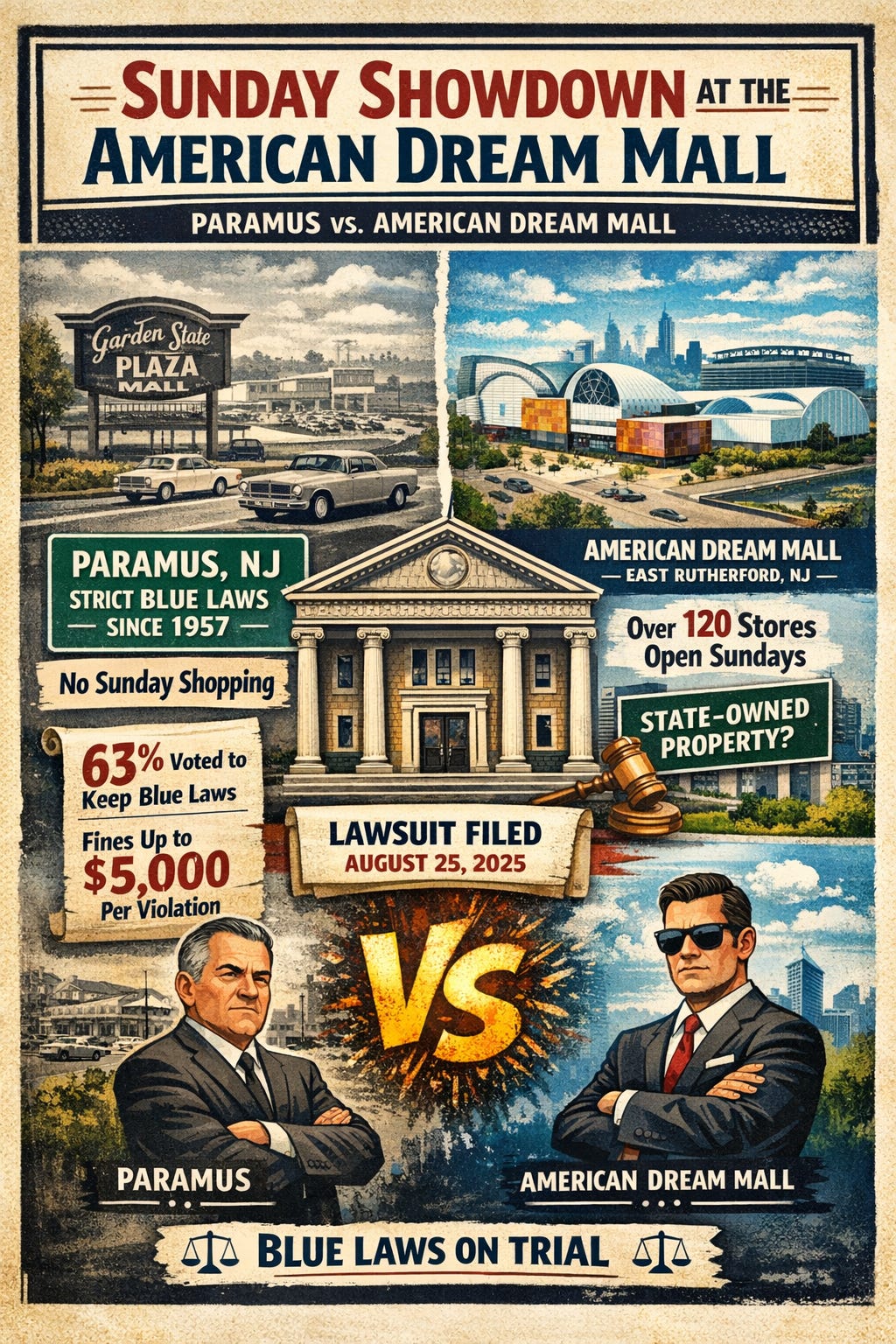
On August 25, 2025, Paramus, New Jersey, sued the American Dream Mall for allegedly violating Bergen County’s blue laws by opening more than 120 retail stores on Sundays starting in January 2025. Paramus enforces some of the strictest Sunday shopping laws in the U.S., enacted in 1957 to control traffic and limit commerce. The borough seeks escalating fines from $250 to $5,000 per violation, which could add up to millions. The mall says it is exempt due to state land ownership. A judge is reviewing dismissal motions in early 2026.
The Borough of Paramus is suing the American Dream Mall in Bergen County Superior Court, claiming the sprawling East Rutherford complex is openly violating the county’s longstanding Sunday blue laws. Filed on August 25, 2025, the complaint alleges that more than 120 retailers inside the mall have remained open on Sundays since at least January 2025, selling non‑essential goods in direct defiance of local and county laws. (njbiz.com)
But this is more than a technical dispute. It is a confrontation between two visions of public life: one rooted in pause and limitation, the other in commerce without borders. At its heart is a borough that has fought for nearly seventy years to enforce its own idea of what Sunday should be.
One of the Last Blue Law Strongholds in America
Paramus is not just enforcing Bergen County’s blue laws. It has its own set of even stricter restrictions, among the most expansive of their kind still in effect in the United States. While Bergen County prohibits sales of non‑essential items on Sundays, Paramus bans almost all retail activity on Sundays, including work performed in private homes, with narrow exceptions for food, medicine, newspapers, cigarettes, and charity. (en.wikipedia.org)
These local laws date to 1957, when the borough council proposed them as a direct response to the ongoing construction of Garden State Plaza and the Bergen Mall. Officials feared that the new malls, located near Routes 4 and 17, would overwhelm already congested highways and fundamentally change the town’s character. By adopting stricter Sunday laws, the borough aimed to hold the line. (en.wikipedia.org)
Even today, Paramus’s Borough Code forbids most “worldly employment” on Sundays. The ban extends so far that even BJ’s Wholesale Club, located at the junction of Routes 4 and 17, had to restrict its Sunday operations. The club may open only to sell food and essential items. Access to other merchandise is physically blocked off inside the store. (en.wikipedia.org)
Despite these constraints, Paramus consistently records the highest retail sales of any ZIP Code in the country, underscoring that the blue laws have not limited commercial success. (en.wikipedia.org)
Voters Have Repeatedly Backed the Restrictions
Bergen County voters first chose to retain the state’s blue laws in 1959, shortly after New Jersey permitted counties to decide by referendum whether to keep Sunday restrictions. The question has been revisited multiple times.
In 1980, repeal efforts failed. In November 1993, more than 63 percent of voters rejected a repeal of Bergen County’s blue laws. Even if the repeal had succeeded, Paramus’s stricter local ordinances would have remained in place. (en.wikipedia.org)
In 2010, Governor Chris Christie proposed repealing blue laws statewide, estimating that opening Bergen County for Sunday retail could generate $1.1 billion in new retail sales and $65 million in state tax revenue. The measure failed. (en.wikipedia.org)
There was one brief exception. After Hurricane Sandy struck in 2012, Christie issued an executive order temporarily suspending the blue laws in Bergen County and Paramus. The move faced a court challenge by Paramus but was upheld, and Sunday shopping resumed briefly on November 11, 2012, before the restrictions were reinstated the following Sunday. (en.wikipedia.org)
Paramus Pushes Back with the Law
Now, more than a decade later, Paramus is invoking those very laws against the American Dream Mall. The borough seeks a court order to stop Sunday sales and is requesting disorderly persons penalties under county statute:
-
$250 for a first violation
-
$1,000 for a second
-
$2,000 for a third
-
$5,000 for the fourth and each subsequent offense
With hundreds of alleged Sunday violations since early 2025, the fines could reach well into the millions of dollars, depending on how the court interprets the frequency and scope of violations. (tapinto.net)
A Legal Question of Land and Limits
The American Dream Mall is located on land owned by the New Jersey Sports and Exposition Authority, a state entity. That ownership forms the backbone of the defense. The mall’s operators argue that the blue laws do not apply to state-owned property and have moved to dismiss the lawsuit on the grounds that Paramus lacks standing and that enforcement authority does not extend to the Meadowlands site.
Paramus counters that retail activity is retail activity, regardless of land ownership, and the impact on surrounding communities, traffic, and business compliance is the same. The borough has also pointed to alleged prior assurances from American Dream developers that retail would remain closed on Sundays.
As of January 2026, the Superior Court is reviewing motions to dismiss from the mall and the NJSEA. If the case proceeds, the discovery phase could uncover further evidence about mall management decisions and the extent of Sunday sales. If the judge grants dismissal, the issue may shift back to state regulators or lawmakers.
Holding: The Borough of Paramus sued the American Dream Mall for violating Bergen County blue laws by operating more than 120 retail stores on Sundays.