Rededicate 250: The Right Diagnosis, the Wrong Doctor
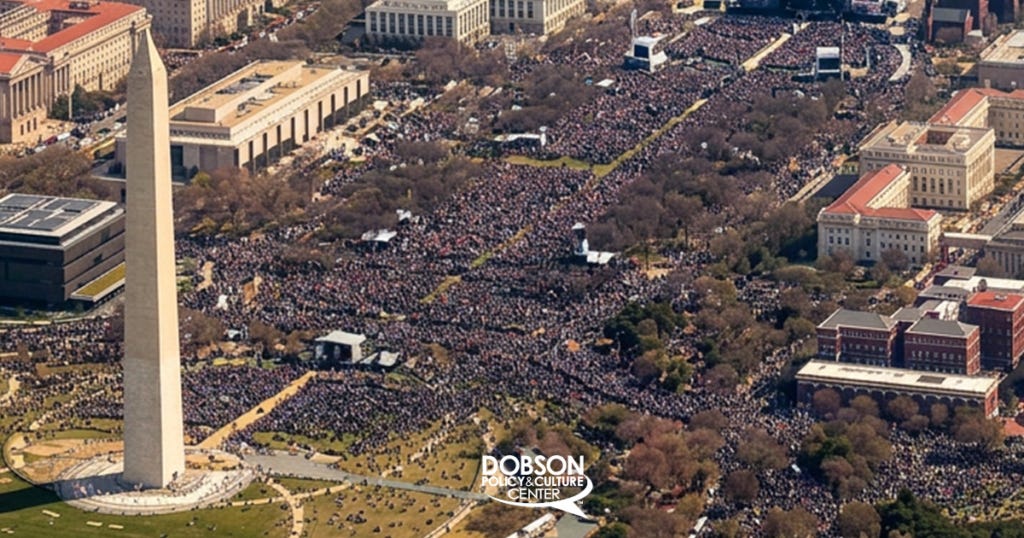
Photo: The Dobson Policy and Culture Center reports that over 100,000 people attended the event on May 17, 2026. https://www.drjamesdobson.org/policy-culture/rededicate-250/
The checklist published here last week (https://religiouslibertytv.substack.com/p/before-america-is-rededicated-to) offered eight questions to watch. The event on May 17 answered most of them. Some answers were reassuring. Others belonged in the record.
Drive through the American interior on a weekend morning and you will find the parking lots full. Small congregations in cinder-block buildings, megachurches with their own zip codes, Catholic parishes where the usher still hands you a bulletin at the door. The country that produces the highest rate of opioid mortality in the industrialized world also produces, in the same counties, more volunteer hours per capita than any comparable nation. There is a hunger here, and it is real, and it has been real for a long time. Anyone who dismisses the anxiety behind Sunday’s gathering on the Mall has never watched a pastor’s congregation age out of existence, or listened to a family try to explain to their teenagers why any of this matters. The diagnosis that motivated Rededicate 250 is sound. Moral disorientation is a genuine American condition, and the people who showed up in Washington brought legitimate grief with them.
That grief, it turns out, crosses party lines in ways that neither party wants to fully acknowledge.
The Left’s Own Autopsy
The Democratic National Committee released its 2024 “election autopsy” this week, a document the party had suppressed for months and released only under pressure. Its findings are worth examining carefully. The report found that millions of Americans are suffering and continue to be persuaded to vote against what Democrats believe are their own interests because they no longer see themselves reflected in the Democratic Party’s vision of America.  The report acknowledged that the party had developed a persistent inability or unwillingness to listen to all voters, and called on Democrats to focus less on abstract issues and identity politics and connect with voters on the issues they say matter most.  The cultural flashpoints that most visibly defined the 2024 campaign, the ones that moved voters most decisively according to the party’s own pollsters, were largely absent from the report itself, which criticized identity politics only indirectly while avoiding naming the actual cultural friction points that drove voters away. 
Read that carefully. The party of the secular left commissioned an internal accounting of why it lost, and the answer, however obliquely expressed, was that ordinary Americans felt culturally abandoned. The report does not conclude that Americans want less economic support from government. On kitchen-table questions, wages, housing, healthcare, the appetite for an active federal role remains broad and durable. What the report concedes, between the lines and occasionally in plain language, is that voters across the spectrum experienced something that felt like a sustained assault on common sense, shared norms, and the moral vocabulary that most Americans still use to raise their children.
That said, grief does not consecrate its remedy, and sincerity has never been a constitutional defense.
What the Declaration Already Says
There is, in fact, a document that already performs the rededication the organizers of Sunday’s event were reaching for, and it does so with considerably more precision. The Declaration of Independence states that all men are endowed by their Creator with certain unalienable rights, and that governments are instituted among men to secure those rights, deriving their just powers from the consent of the governed. That sentence does two things simultaneously, and both matter enormously. It places the origin of human rights above the government’s reach, in a Creator whose authority no legislature can override or reassign. And it places the government’s authority below the people’s, dependent on their ongoing consent rather than on any divine mandate the government might claim for itself. The government is the instrument. The Creator-endowed citizen is the principal. That architecture is what makes Americans free.
A genuine rededication to those principles would be worth celebrating on any Mall in any weather. The founders’ actual theology was eclectic, contested, and deliberately kept out of the constitutional structure for reasons they debated at length and recorded in detail. But their political theology, the idea that human dignity derives from a source the government did not create and cannot revoke, is the proposition on which everything else in the American experiment depends. Recommitting to that idea is an act of genuine patriotism, and it belongs to no single party or denomination. The question Sunday’s event raised is whether that is what was actually happening.
The Red Mass Comparison
The concern here is distinct from the objection raised by those who regard any public expression of religious conviction as a threat to civil order. That position mistakes secularity for neutrality and ends by privileging irreligion over faith, which the First Amendment forbids in both directions. Americans of deep conviction have always brought that conviction into public life. They should. The republic is richer for it. The question raised by Sunday’s event is narrower, more surgical, and in some ways more damaging to the religious enterprise it purported to serve.
Consider, for comparison, the Red Mass.
Every October, the Church of St. Matthew the Apostle in Washington hosts a Mass of the Holy Spirit for members of the legal profession, including Supreme Court justices, members of Congress, Cabinet officers, and the diplomatic corps. The tradition traces to 13th-century Europe, where it opened the judicial year with a prayer for wisdom. Washington has observed it since 1953. Several sitting justices attend regularly. The Mass is explicitly Catholic in theology, liturgy, and setting. Critics have periodically argued that justices appearing at a Catholic Mass on the eve of a new term creates Establishment Clause concerns, and those critics have a point worth taking seriously.
But the Red Mass also illustrates, by sharp contrast, what Rededicate 250 was and was doing. The Archdiocese of Washington organizes and funds the Red Mass. Attendance is voluntary and individual. No official speaks from the altar on behalf of the United States government. No Cabinet secretary pronounces the nation rededicated to Catholicism. The justices in the pews are there as private individuals of faith. The church pays its own bills. The government’s symbolic authority stays in the parking lot.
That distinction is the entire constitutional question.
Who Paid for This
At Rededicate 250, Secretary of State Marco Rubio, Defense Secretary Pete Hegseth, and Speaker of the House Mike Johnson lent the symbolic authority of the federal government to an event held on federally managed ground, backed in part through government-affiliated semiquincentennial initiatives. (https://www.patheos.com/blogs/theglobalcatholicreview/2026/05/rededicate-250-a-brazen-display-of-evangelical-nationalism/) The Interior Department reportedly directed at least $100 million in taxpayer funds toward the event. (https://truthout.org/articles/trump-admins-rededicate-250-event-panned-as-christian-nationalist-gathering/) Those funds came from Catholics, Jews, Muslims, Mormons, Buddhists, and the religiously unaffiliated alike, all taxpaying Americans with equal standing under the same Constitution the speakers on stage claimed to honor.
The problem with government-funded religion has nothing to do with religion being dangerous. Government is simply a poor steward of it. Roger Williams understood this before Madison did, and Madison put it in writing before anyone else in the founding generation thought to. When the state enters the sanctuary, it carries the habits of the state: the impulse to manage, to consolidate, to flatten the particular into the general. Government-backed religion produces a generic civic faith calibrated to the government’s purposes rather than the believer’s soul. Of Sunday’s speakers, only one was outside the Christian tradition: a single rabbi among hours of conservative evangelical programming. (https://www.deseret.com/u-s-world/2026/05/18/five-things-about-rededicate-250/) The appearance of pluralism was deployed in service of a very specific theology, which is the oldest trick in the civic religion playbook.
The Red Mass, whatever its critics argue, makes no claim to speak for America. It speaks for a congregation that chose to gather. The people at St. Matthew’s are there as individuals. The people on the Mall last Sunday were told, by officers of the United States government, that the nation itself was being rededicated on their behalf.
Representational Coercion
Rubio was direct about it: “Today we gather, as our forefathers did on this day centuries ago, to rededicate our nation to God.” (https://victorygirlsblog.com/media-rededicate-250-is-icky-racist-white-christian-nationalism/) When the Secretary of State of the United States pronounces a national rededication to a specific religious tradition, the American outside that tradition has had something done to them without consent. Their nation has been spoken for. The coercion is representational rather than physical, but representational coercion by government officials carries legal weight in Establishment Clause jurisprudence, and moral weight in any serious theology of religious freedom.
This is where the practical danger sharpens into something beyond the constitutional. The Declaration’s architecture places divine authority above the government precisely to keep the government humble, accountable, answerable to something it did not itself create. When a government adopts a religious tone, that architecture inverts. Policies begin to carry a theological warranty. Budget decisions, military actions, immigration enforcement, the whole apparatus of state power starts to arrive with a halo attached, as if the Cabinet meeting that produced it had divine sanction rather than a 51-vote majority. The official who has just rededicated the nation to God on the National Mall finds it considerably easier, the following Monday, to describe his department’s agenda as the fulfillment of a covenant. Dissent curdles from a legitimate democratic act into something that sounds, in that register, like apostasy. The Declaration says governments derive their just powers from the consent of the governed. A government that believes it has been rededicated to God by its own officials has subtly relocated the source of its authority, and the governed are the last to know.
That is the mechanism by which civic religion does its damage, quietly, in the language of routine governance, long after the worship band has packed up and gone home.
What Madison Knew
Madison argued in his Memorial and Remonstrance that even three pence of taxpayer money directed to religious purposes violated the principle, and he was arguing about a relatively modest Virginia teachers’ bill. His objection was theological before it was constitutional: entanglement corrupts both partners, and the church that draws its authority from state power has exchanged its birthright for a mess of pottage it will spend generations trying to return. The Rev. Adam Russell Taylor of Sojourners put the same argument from inside evangelical Christianity: “What is really being rededicated is a nation to a very narrow and ideological part of the Christian faith that betrays our nation’s fundamental commitment to religious freedom.” (https://religionunplugged.com/news/2026/5/18/rededicate-250-what-we-learned-from-the-prayer-rally)
Taylor believes in evangelism. He believes in the power of prayer. He believes the church has a calling to renew the culture. His objection is about the instrument chosen, and the answer from both constitutional history and church history is that the government is the wrong one.
Nobody leaves the Red Mass believing the Supreme Court has been rededicated to Roman Catholicism. The ritual operates in the register of personal piety, even when public figures participate. Rededicate 250 was engineered to operate in a different register entirely. Its stated purpose was corporate, national, and covenantal. The organizers said so explicitly: an act performed by and for the nation. That is what the word “rededicate” was doing in the sentence, and that is what made Sunday’s event constitutionally distinct from anything that happens at St. Matthew’s every October.
One-Off or Opening Act
Whether Sunday represented the opening ceremony of a new constitutional order or simply a large and enthusiastic rally that got ahead of its own language remains genuinely unclear. This appears, for the moment, to be a one-off, a semiquincentennial event shaped by the particular political and religious coalition that has formed around this administration, rather than the inauguration of a formal theocratic program. The longer-term trajectory belongs to a different conversation, one that will be shaped by facts that have yet to materialize. What can be said with confidence is that the architecture was assembled. The precedent was set. The officials who spoke know they can do it again, and the constituencies who attended know they can ask them to.
The Rededication That Already Happened
You can find those weekend congregations in every state, in counties where the pharmacy closed a decade ago and the hospital closed last year. They have been praying for their country every Saturday and Sunday without a government permit or a Cabinet video appearance, without federal funds or national stage dressing, without asking the Secretary of State to confirm that their prayers count. Those are the people the founders had in mind when they wrote that governments derive their just powers from the consent of the governed, and that the Creator, rather than the state, is the author of human dignity. Saturday worshippers and Sunday worshippers alike hold government accountable to a standard it did not write and cannot rewrite. Their faith requires no endorsement from the people it is supposed to hold accountable.
The DNC autopsy and Rededicate 250 are, in their own ways, responses to the same diagnosis. Americans across the political spectrum have felt something slipping, and they are looking for an institution that will name it honestly and address it seriously. The autopsy gestures at the problem while declining to name the specific failures. The rally names God while declining to specify which constitutional boundaries apply. Neither document quite trusts its audience with the full argument. The American people, meanwhile, keep filling those parking lots every weekend, which suggests they have given up on neither God nor the proposition that something larger than government is both the source of their dignity and the standard by which their government will one day be measured.
A rededication to the Declaration’s actual principles, that human rights originate above the government’s reach and that the government’s authority flows upward from the people rather than downward from heaven, would be worth every dollar spent and every hour on the Mall. That rededication happens every weekend in thousands of congregations across this country, and has for 250 years, without a budget line or a Cabinet speaker. It requires the government’s restraint far more than it requires the government’s assistance.
Three more Freedom 250 events are scheduled before July 4. (https://freedom250.org/celebration/rededicate-250-a-national-jubilee-of-prayer-praise-and-thanksgiving) The record from Sunday now exists. The question going forward is whether the government has begun to believe it can do religion’s work, and whether the church has begun to believe it needs the government to try. History’s answer to both propositions is the same, and it is written in the ruins of every established church that mistook proximity to power for evidence of God’s favor.