
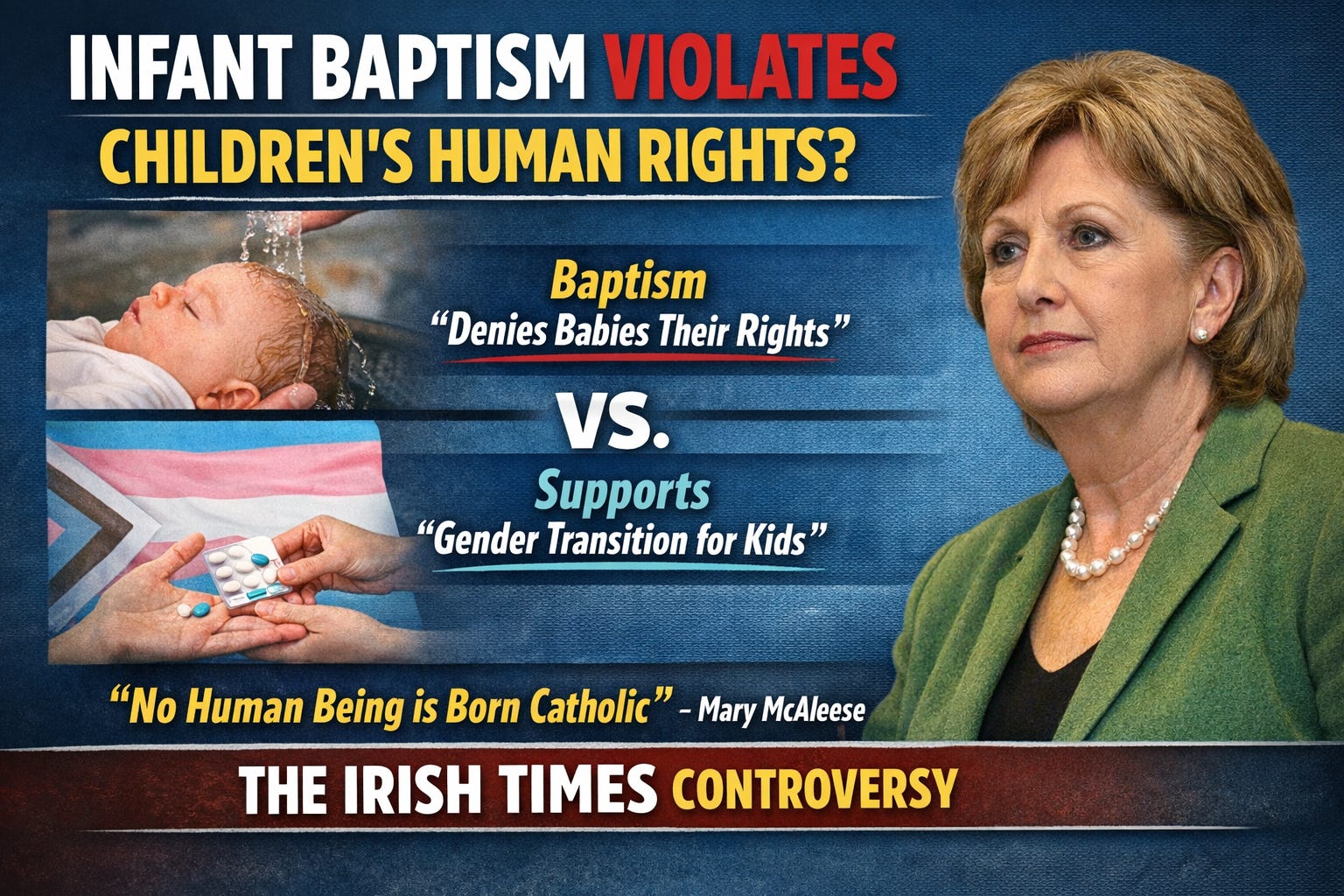
One must admire the consistency with which the modern progressive turns a blind eye toward what is inconvenient and glares with moral indignation at what is harmless. Former Irish President Mary McAleese has now turned her well-developed sense of indignation toward infant baptism, calling it, in an Irish Times essay, “a key Catholic recruitment tool” that violates children’s human rights. She insists no child is born Catholic, and thus no parent has the right to affiliate them with the Church before they can choose for themselves.
This is offered as a defense of autonomy, of course — the latest banner under which the secular conscience wages its noble battles. And yet, McAleese belongs to the very culture that insists children too young to spell “gender” must be allowed to select one, preferably under state guidance. That those same children cannot receive a splash of water and a blessing without international rights law being summoned from Geneva would be comic, were it not treated with such self-regard.
McAleese’s claim is not new, though she dresses it in the solemn robes of the Universal Declaration of Human Rights and the UN Convention on the Rights of the Child. These instruments, so often cited by those who cannot persuade in their own moral tongue, are meant to be invoked like sacred scripture, preferably without reading their actual contents. What is baptizing a child, if not an expression of a parent’s most intimate convictions about truth, goodness, and the life of the soul? What is it, really, that she fears — that the child might believe what the parents do?
Of course, the child is free to leave the Church. Many do, without violence, without loss of citizenship or civil rights. There is no penalty, no Vatican tax for apostasy. What McAleese objects to is not coercion but inheritance — that religion, like language, is passed down in trust. She may wish children were born without culture, creed, or kin, suspended in moral ether until the age of majority. But no child is raised in such a vacuum, and no society has ever endured that tried.
The irony, and it is sharp, is that those who wish to banish baptism in the name of consent are the same who cheer when children transition genders at twelve. In one act, parents are dangerous agents of dogma; in the other, they are enlightened allies of self-expression. That both involve irrevocable claims about identity is not questioned. That one is painless and symbolic while the other medical and permanent is not admitted. The baptismal font offends; the surgical table does not.
Here we see the hallmark of our moral confusion: the insistence that belief is dangerous and biology is optional, that tradition must ask permission and ideology may act unchecked. Mary McAleese’s proposal is not for the liberation of children but for their indoctrination into a different orthodoxy — one that masks itself in the language of autonomy while demanding submission to the dogmas of the day.
It is not the baptism of babies that should trouble us. It is the baptism of every cultural instinct into law, the ceremonial denunciation of old customs by those who mistake novelty for virtue. Regardless of what you think about baptism – be it immersion for adults, sprinkling, or baptism for infants, the Catholic Church and others that practice infant baptism, for all their faults, believe they baptize infants into grace. McAleese would apparently rather leave them to the catechism of the committee and the silence of the state.
TLDR (Too Long / Didn’t Read Summary):
Mary McAleese’s recent remarks calling infant baptism a human-rights violation have stirred controversy in Ireland. While she frames the sacrament as coercive, critics argue it’s a harmless tradition and expression of parental belief, especially since baptism has no legal consequences. McAleese’s view reflects broader progressive ideas about child autonomy, but raises questions about consistency — especially since many of those same circles endorse irreversible medical transitions for minors. There has been no official Church response. Debate continues in media and legal commentary.
If you found this perspective thought-provoking, please share it, like it, and subscribe to ReligiousLiberty.TV at religiouslibertytv.substack.com. Get immediate access to breaking legal analysis, cultural commentary, and religious liberty updates.
Legal Disclaimer:
This does not constitute legal advice. For legal advice about your specific situation, consult a licensed attorney.
Tags:
Mary McAleese, Infant Baptism, Parental Rights, Children’s Autonomy, Religious Freedom